USS Missouri: The ‘Mighty Mo’ – America’s Last Battleship

The Mighty Mo: USS Missouri (BB-63)
The USS Missouri (BB-63) was no ordinary battleship. As one of the longest-serving battleships in U.S. Navy history, she played a major role in the U.S.’s military history. She saw action during World War II, the Korean War, and Operation Desert Storm. In addition, she served as the site of Japan’s formal surrender ceremony, an event that officially ended World War II.
For decades, Missouri engaged in high-risk operations and missions. The ship survived numerous kamikaze attacks. She fired cruise missiles into Iraq. Missouri even escorted oil tankers through the Persian Gulf.
Missouri became an icon for sailors and the public alike. Many knew her as The Mighty Mo. Designed for war, her lengthy service record made her one of the most recognizable U.S. battleships.
A Design Built for Strength
The U.S. Navy commissioned the USS Missouri on June 11, 1944. The ship was the last battleship built by the United States. By this time, the nature of naval warfare was already shifting toward aircraft carriers. However, she was part of both the 7th Fleet and the 3rd Fleet.
The USS Missouri was also a fast and large battleship for her class.
Length: 887 feet
Beam: 108 feet
Top speed: 32.5 knots (37.4 mph)
Range: 15,000 nautical miles
The ship’s power was one of the reasons for this. Four General Electric steam turbines and eight Babcock & Wilcox boilers powered the battleship. This combination of machinery allowed her to keep up with carrier task forces over long ranges.
Missouri’s main advantage was in her weapons. The Navy designed her armaments to inflict serious and heavy damage.
Firepower: The Guns That Shaped Battles
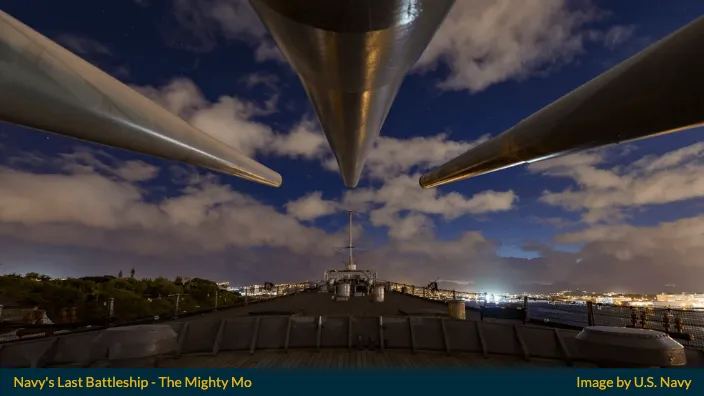
Missouri’s primary battery was her nine 16-inch (406 mm) guns. Three turrets were fitted with three barrels each.
A 2,700-pound projectile was the 16-inch gun’s shell. It exited the barrel at 2,690 feet per second. This speed allowed for a maximum range of about 24 miles. If one of these shells hit, it would create a crater 50 feet across.
It did not end there. Missouri was also armed with the following:
20 five-inch (127 mm) dual-purpose guns
80 Bofors 40 mm anti-aircraft guns
49 20 mm anti-aircraft guns
This combination was to support several tasks. The big guns could hit ships and land-based targets. The five-inch guns were to attack both aircraft and surface targets. The smaller anti-aircraft guns were to defend the ship against aerial attack.
World War II: From Iwo Jima to Tokyo Bay
USS Missouri entered World War II late. The Pacific war still needed heavy firepower.
In February 1945, she bombarded targets at Iwo Jima. In April 1945, she supported the battle of Okinawa. Okinawa became one of the bloodiest battles in the Pacific.
On April 11, 1945, a Japanese kamikaze hit the ship. The aircraft struck the starboard side. The blast shook the deck. Fire spread near the impact area. Sailors fought the flames. The ship took minimal damage. Missouri stayed in the fight.
September 2, 1945 changed the ship’s story for good.
The War Ends on Missouri’s Deck
Japan surrendered aboard the USS Missouri.
Germany had already surrendered. Japan faced defeat after the atomic bombings. Allied leaders planned a formal signing in Tokyo Bay. They held the ceremony on Missouri’s deck.
Japanese Foreign Minister Mamoru Shigemitsu signed the surrender documents. The U.S. Navy recorded the event on video. The ceremony lasted 23 minutes.
Senior leaders attended. The group included:
- General Douglas MacArthur
- Admiral William Halsey
- Admiral Chester Nimitz
- Leaders from the United States
- Leaders from Britain
- Leaders from other Allied forces
Missouri had served for about a year. The surrender ceremony fixed her place in World War II history.
Life Aboard the USS Missouri
For the 2,700 sailors on board, life was intense.
Daily drills: Battle practice, gun maintenance, and emergency response training.
Crew roles: Officers managed carrier screens, gunners manned the turrets, and engineers kept the ship running.
Training: New sailors drilled for daylight attacks, submarine evasion, and amphibious landings. Every day was preparation. Every sailor had a mission.
USS Missouri in Modern Warfare
Even after decommissioning, Missouri’s influence didn’t fade.
Aircraft carriers & missile warfare: By the 1980s, the U.S. Navy had shifted focus. But Missouri still had a role.
Desert Storm (1991): She launched Tomahawk cruise missiles and provided naval gunfire support in Iraq.
Influence on modern warships: Her long-range bombardment tactics shaped future destroyers and amphibious landing ships. Even in retirement, she was setting the standard.
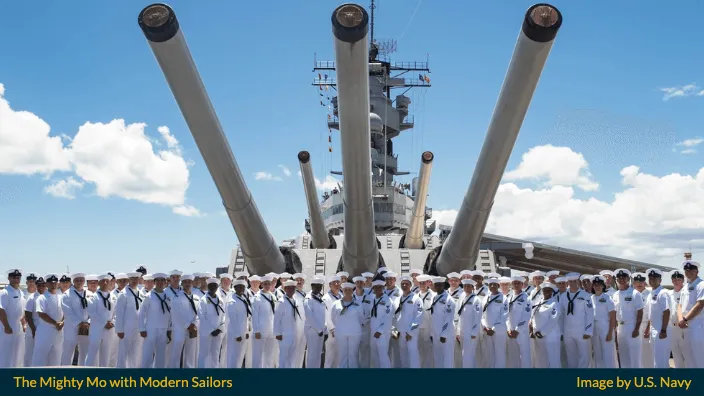
Cold War, Gulf War, and Beyond
Missouri kept serving after World War II.
- Korean War (1950 to 1953): Missouri shelled North Korean positions from offshore.
- 600-ship Navy program (1980s): The Navy upgraded Missouri and added modern missile systems.
- Gulf War (1991): Missouri launched Tomahawk missiles at Iraqi targets. The strikes showed a battleship could still support modern operations.
Missouri’s Upgrades & Tech Advancements
Missouri changed as warfare changed.
- Weapons upgrades: Missouri moved from heavy gun focused defense, including Bofors 40mm guns in World War II, to missile power later on. In the 1980s modernization, she carried 32 BGM-109 Tomahawk missiles.
- Radar & electronics: By the 1980s, Missouri had updated radar, improved tracking, and modern systems that helped guide missiles and coordinate strikes.
- Compared to other Iowa-class battleships: Missouri mattered for more than firepower. She also carried major historical weight. The WWII surrender took place on her deck. That moment set her apart from the rest of the class.
Her Decommissioning
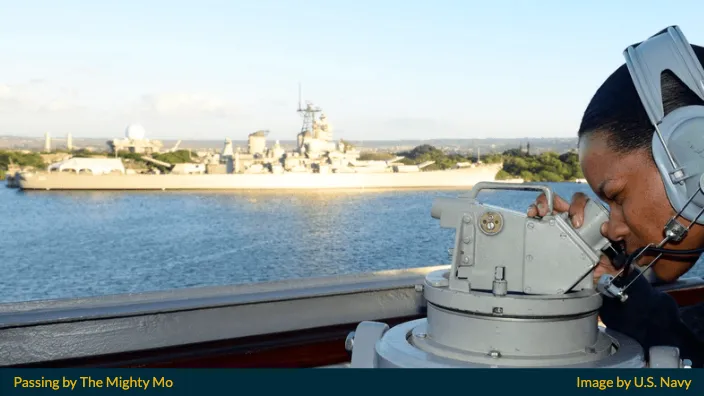
U.S. Navy vessel passing the USS Missouri (BB-63). Decommissioned March 31, 1992. Credit: U.S. Navy.
The first time Missouri left service came in 1955, after the Korean War. The Navy moved her into the reserve fleet. She stayed there for decades.
The 1980s changed the plan. The United States pushed for a larger fleet under the 600-ship Navy goal. Leaders wanted more punch at sea, so they brought Missouri back.
By 1986, the Navy finished her major upgrades. Missouri carried Tomahawk missiles and Harpoon missiles. She also had newer radar and modern combat electronics. Those updates put her back in the fight in time for Operation Desert Storm (1991). Missouri launched Tomahawks and used naval gunfire against targets in Iraq.
After the war, the battleship role kept shrinking. Carriers, submarines, and guided-missile destroyers became the main tools for sea power. Missouri left service again in 1992, and this retirement lasted.
Still, the Navy did not scrap her. Missouri became a museum ship at Pearl Harbor, Hawaii. She remains preserved and open to the public.
Missouri’s Second Life: Museum & Pop Culture Icon
Today, Missouri sits at Pearl Harbor, Hawaii, as a museum run by the USS Missouri Memorial Association. Visitors can see her close to the USS Arizona Memorial. That placement connects two turning points of World War II. The Arizona marks the attack that pulled the U.S. into the war. Missouri marks the surrender that ended it.
Missouri also built a second reputation outside military history.
Hollywood moments:
- Under Siege (1992): Filmmakers used Missouri as the setting for a hostage crisis aboard a battleship.
- Battleship (2012): Missouri appears in a science-fiction story and returns to the spotlight for a new generation.
- Documentaries: Producers often use Missouri in programs about World War II, sea power, and naval technology.
Cher’s music video controversy
In 1989, Cher filmed “If I Could Turn Back Time” aboard Missouri. The video showed her performing in a revealing outfit with sailors nearby. The U.S. Navy later said it should not have approved the filming. The clip still became a well-known pop culture reference.
Why the Mighty Mo Still Matters
Missouri represents more than armor and weapons.
She supported major Pacific battles. She survived a kamikaze hit. She served as the stage for Japan’s surrender in 1945. Decades later, she fired missiles during the Gulf War.
Now she rests in Pearl Harbor. People visit her to understand service, loss, and the scale of U.S. naval history. Missouri was not just a battleship. She remains a lasting symbol.
You may also be interested in learning about Navy WESTPAC: 7th Fleet Deployments for Pacific Fleet operations, Gator Navy: Amphibious Warfare for modern naval power, and The Oldest Ratings in the U.S. Navy for the sailors who served on ships like Missouri.