The Ultimate Guide to Navy Boot Camp: What to Expect
Navy boot camp is run by Recruit Training Command (RTC) at Naval Station Great Lakes. RTC is the Navy’s only enlisted training facility under the Naval Service Training Command. Recruits arrive as civilians and train to become U.S. Navy Sailors.
This guide explains what happens from arrival through graduation. It covers preparation, packing rules, a training timeline, and information for friends and family.

Prepare for Navy Boot Camp
Boot camp moves fast once training begins. The schedule leaves little time for personal errands. Handle bills, childcare, and banking before departure. Pack only allowed items and required documents. Study basic Navy knowledge and build fitness before reporting.
Navy START Guide for Future Sailors
The Navy START guide covers standards and required knowledge for new recruits. START stands for Standards, Transitions, Acknowledgement, Requirements, and Training. Download the guide below. The download does not require an email opt in.
The guide includes information such as:
- Navy Rank Structure
- Chain of Command
- Sailor’s Creed
- 11 General Orders of a Sentry
- And more
Use the checklist below before reporting to Navy boot camp.
Before You Arrive
- Memorize a mailing address or bring a small address book. Staff stores personal items and ships them home.
- Keep nails clean and natural. Do not use polish, gel, or acrylics.
- Shave your face.
- Remove false eyelashes.
- Meet Navy grooming standards for hair. Keep hair a natural color. Ask your recruiter about unclear rules.
- Dress for the weather.
- Wear pants or shorts with a T-shirt.
- Wear closed-toe shoes with socks.
- Do not wear flip-flops or sandals.
Required Items
Bring the items below.
All Recruits Must Have:
- Social Security card
- Immunization records
- COVID-19 Vaccination Record Card for vaccinated recruits
- Two forms of valid ID. One must have a photo. Names must match exactly.
Acceptable IDs:
- U.S. Passport or Foreign Passport
- Driver’s License
- U.S. Military Dependent’s ID
- Personal Identity Verification Card
- Voter’s Registration Card
- Certificate of U.S. Citizenship or Naturalization
If Applicable:
- Marriage Certificate
- Divorce Decree
- Dependent Birth Certificates
- DDS Form
- Permanent Resident Card, for non-citizens
What You Can Bring
- Wristwatch
- Wedding ring
- Religious medallion (max size: 2″x1″)
- Writing material
- Pocket-sized religious text
- Small address book
- Plastic hairbrush, pick, or comb
- Prepaid phone cards
- One pair of prescription glasses or reading glasses
- Less than $10 in cash
- Prescription medications
Female Recruits May Also Bring:
- Feminine hygiene products
- Conservative cosmetics (one of each: face powder, blush, lipstick, eyeshadow, mascara)
- Barrettes (must match hair color)
What NOT to Bring
Leave prohibited items at home. Staff will collect restricted items during processing.
- Shaving cream, aftershave, cologne
- Aerosol containers of any kind
- Lighters, lighter fluid, tobacco, vapes
- Gambling items (cards, dice, etc.)
- Metal hairbrushes, picks, or combs
- Glass containers, mirrors
- Razors, knives, or any blades
- Non-prescription drugs or medications
- Alcohol-based health items
- Extra civilian clothing
- Electronic devices (video games, MP3 players, cameras, etc.)
- Hair dryers, curling irons
- Food (gum, candy, chips, etc.)
- Firearms, weapons, explosives
- Narcotics or related paraphernalia
Complete personal errands before arrival. Boot camp leaves little time for personal tasks during early training.
When You Get There
Arrival & Processing: Your First Taste of Military Life
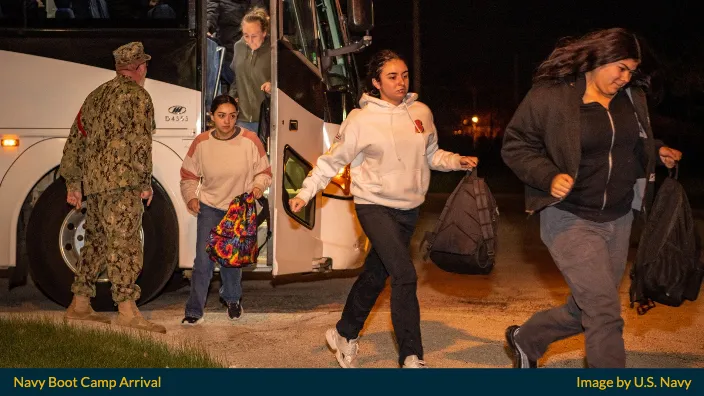
Processing starts after arrival at RTC Great Lakes. Staff assigns recruits to Recruit Divisions and introduces their Recruit Division Commanders (RDCs). RDCs train recruits and enforce standards throughout boot camp.
Processing Days can include:
- Medical and dental screenings
- Immunization record review and COVID-19 vaccination record check
- Haircuts, uniform issue, and compartment assignments
- Physical fitness assessments
- Administrative tasks and document checks, including secure website registration
- Screening for tobacco products and illegal drugs
- Mask requirement review based on current policy
- Phone call home before phone storage
Navy Boot Camp Schedule
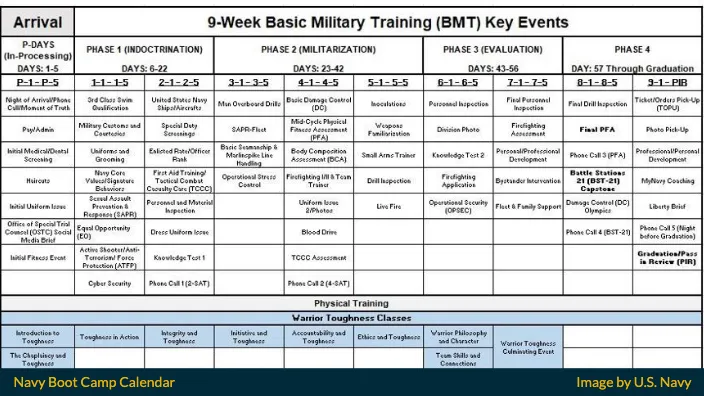
Week 1: The Shock Factor
Week 1 includes physical training, classroom instruction, and swim qualifications. Every recruit completes a 3rd Class Swim Qualification. The test includes a 50-yard swim, a 5-minute prone float, and clothing inflation techniques. Water Survival Instructors teach the required skills. Swim qualification is required to continue training.
Week 1 also covers core topics.
- Core Navy values: Honor, Courage, Commitment
- Basic seamanship skills and life skills
- Military training benefits and expectations
- Uniform regulations and grooming standards
- Watchstanding basics
- Introduction to force protection and armed conflict conduct
PACER
Also Read: Navy Boot Camp PACER Test: Complete Guide
Weeks 2-3: Getting Into the Rhythm
Training becomes more structured during weeks 2 and 3. Days include more drill, physical training, and classroom work.
These weeks focus on:
- Naval history and customs
- U.S. Navy ships, aircraft, and operational structure
- The Uniform Code of Military Justice (UCMJ)
- Basic seamanship, including line handling on the USS Marlinespike simulator
- First aid and damage control fundamentals
- Sexual Assault Prevention and Response (SAPR) training
Man-overboard drills occur during this phase. Many divisions observe a Pass-in-Review ceremony for a graduating division.
Initial Swim Qualification
Swim qualification continues during early training.
First Uniform Issue
Uniform issue occurs during early training. Staff teaches wear and care standards.
MARLINESPIKE
Basic seamanship practice occurs on the USS Marlinespike simulator.
Sustained Run
Running workouts build endurance.
Weeks 4-6: Hands-On Combat & Damage Control Training
Training expands to damage control and emergency response skills. Firefighting and damage control become major priorities.
Training can include:
- Firefighting techniques and basic competencies
- Damage control equipment usage
- Breathing device training
- Confidence Chamber (gas chamber simulation)
- Chemical, Biological, Radiological, Nuclear, and Explosives (CBRNE) defense
- Weapons training: Marksmanship, pistol qualification, and clearing barrel procedures
This phase includes additional academic testing. The RDC Physical Fitness Assessment (PFA) occurs during this phase. Drill practice and physical training continue throughout.
Confidence Chamber
The Confidence Chamber event occurs during training.
Drill Inspection
Divisions complete drill inspections.
Firefighting
Firefighting assessments occur during training.
Weeks 7-8: The Final Challenges
Weeks 7 and 8 focus on final evaluations and graduation requirements.
Training can include:
- Final personnel inspections
- Fleet and Family Support and Warrior Toughness training
- Physical Readiness Test (PRT) (Push-ups, planks, and a 1.5-mile run)
- Final seamanship and damage control evaluations
- Capstone events, including the 12-hour event: Battle Stations
Battle Stations 21 is a 12-hour capstone event aboard USS Trayer. The event uses training scenarios that test teamwork and basic skills. Completion supports graduation requirements.
Warrior Toughness
Warrior Toughness training occurs during this phase.
Official Physical Fitness Assessment (OPFA)
The official physical fitness assessment occurs during this phase.
Battle Stations (Part 1)
Battle Stations begins with scenario-based training events.
Battle Stations (Part 2)
Battle Stations continues through additional scenarios and evaluations.
Week 9: Graduation - Pass-In-Review
Week 9 ends with the Pass-In-Review Ceremony. Recruits wear dress uniforms and march in formation. Families can attend as guests. The ceremony marks the end of recruit training.
After graduation, new Sailors move on to A School. A School provides advanced training for a specific Navy job. Some roles also require additional weapons training.
The Journey to Graduation
Graduation marks completion of RTC training.
Inside Your Boot Camp Division
The Chain of Command Runs the Show
Each division uses a chain of command for daily tasks. The RPOC is the Recruit Chief Petty Officer. The RPOC leads the recruit staff and communicates with the RDCs. The AROC is the Assistant RPOC. The AROC supports schedules and accountability. The Master-at-Arms supports good order in the compartment. Section leaders help enforce folding, stowing, and cleaning standards.
Guard Duty Never Stops
Watchstanding is required during training. The Petty Officer of the Deck (POOD) controls the compartment entrance and logs events. Roving Watch patrols the compartment and checks for safety and cleanliness issues before inspections.
Everything is a Test
Recruits attend classes on Navy basics. The Education Petty Officer (EPO) helps coordinate study sessions. Tests affect division progress. The Athletic PO helps organize physical training. Some divisions also compete in Captain’s Cup events.
Cleaning Crew Holds the Line
Divisions assign cleaning and supply roles. The Head PO manages restroom cleaning tasks. The Laundry PO tracks laundry and uniform distribution. The Forward Hold PO manages cleaning supplies. The Iron PO helps maintain uniform appearance and organizes ironing stations.
Mail and Morale Keep You Going
Mail supports communication with family. The Mail PO helps distribute letters. The Religion PO helps coordinate time for prayer.
One Crew, One Fight
Each role supports the division. Recruits without titles still follow standards and complete assigned tasks. Attention to detail affects inspections and training outcomes. Consistent discipline helps the division run smoothly.
Information for Your Friends and Family
Communicating with Your Recruit
RTC stores cell phones during training. Phones return the day before graduation. Most communication happens through mail. RTC does not recommend a specific delivery service. Most families use USPS.
Mailing Address
Use this format for sending letters:
SR LAST NAME, FIRST NAME, MI SHIP XXX DIV XXX RECRUIT TRAINING COMMAND Great Lakes, IL 60088-XXXX
Each ship has a specific address. The list below shows examples.
- Ship 2 and 3: 3600 Ohio Street, Great Lakes, IL 60088-3156
- Ship 5: 3610 Illinois Street, Great Lakes, IL 60088-3118
- Ship 17 (Separation Unit): 2705 Kansas Street, Great Lakes, IL 60088-3140
Mail Delivery Time
Standard USPS mail can take 5 to 10 business days to reach recruits. Add an extra day for internal processing. Timing depends on the postal service, weather, and sorting at RTC.
What You Can Send
Mail can include letters and small photographs. Do not send packages, clothing, toiletries, food, medicine, or supplements. Do not send cough drops or water flavor packets.
Emergencies & Contacting Your Recruit
Contact the American Red Cross for family emergencies. The Red Cross notifies service members about serious family matters.
You will need:
- Recruit’s full name, rank, and military address
- Social Security number
- Deployment or home base unit, as applicable
Find your local Red Cross office at redcross.org.
Mail Issues
Mail delays are common during training. Weather and routing can delay delivery. Mail can reroute after a division change.
Training Delays
RCU (Recruit Convalescent Unit) or Fitness Hold
No visits are allowed. A status change can trigger a call.
Physical Fitness Test Failures
Failing the PFA delays graduation. Retesting can occur within a few days. A recruit can also move to a fitness unit. This delay can last 3 to 4 weeks.
Swim Qualification Failure
Swim qualification is required. Extra training can follow a failed attempt. Some recruits move to another division. Some divisions graduate before a recruit passes swim qualification. The recruit goes to A School without the ceremony.
Battle Stations 21 (Final Exam)
Battle Stations occurs in the final week of training. Some divisions test as late as Wednesday before graduation. Failure delays graduation. Refundable travel tickets help with changing plans.
Graduation Information
Recruits call about graduation delays. Graduation proceeds as scheduled in most cases.
Guests
Each recruit can invite four guests. Each recruit can invite three guests during graduations with 11 or more divisions. Every guest must be on the access list.
Schedule
- 6:30 AM - RTC gates open
- 7:00 AM - Doors open
- 8:45 AM - All guests seated (doors close)
- 9:00 AM - Ceremony starts
- 10:30 AM - Ceremony ends
Tickets are free. Guests pick up tickets at the Recruit Family Welcome Center during graduation week.
Accessibility
Wheelchairs are available on a first-come, first-served basis. Handicapped parking is available with a valid permit.
Liberty After Graduation
- Staying in Great Lakes for “A” School: Sailors check in right after graduation. This can take 5 or more hours.
- Going to “A” School out of state: Sailors fly out the next day. Flight details are private.
No Phones Allowed
Recruits cannot have cell phones, even after graduation.
Separation & Holding Unit
A separated recruit moves to Ship 17. The separation process can take 10 to 20 days. Time varies by case.
Reasons for separation can include:
- Medical or psychological conditions
- Failing physical fitness or swim requirements
- Legal or administrative issues
Ship 17 Conditions
Recruits have individual beds and storage. Recruits receive daily hygiene time. Recruits receive clean laundry each week. Entertainment can include TV, books, and board games.
Contacting a Recruit in Separation
Recruits receive one short call upon transfer. Recruits receive a 20-minute call after a legal briefing. Further calls depend on status.
Travel Arrangements
The Navy provides transportation back to the home of record. This travel is typically by bus or train. A recruit can upgrade to a flight. The recruit pays out of pocket for an upgrade.
Pay & Benefits
Pay stops after separation approval. Final pay is direct deposited within 1 to 2 business days. Uniform reimbursements are not provided. Most recruits separated from boot camp do not qualify for military benefits.
General Information
- Closest airports
- O’Hare International, 30 miles
- Midway, 46 miles
- Milwaukee’s General Mitchell, 49 miles
- Hotel Info: navylifegl.com/rtc
- Graduation DVD: Contact Navy Exchange Photographic Services at (847) 578-6205
No Tours Available
RTC does not offer personal tours due to high operational demands.
Privacy Restrictions
Medical, training, and separation details cannot be shared without the recruit’s written consent.
Ready to Take on Navy Boot Camp
Boot camp tests physical endurance, discipline, and teamwork. Preparation reduces avoidable problems. Use the checklist below.
- Memorize the Navy Core Values
- Study the Navy rank structure
- Get in shape (push-ups, planks, running, swimming)
- Read the Bluejacket’s Manual
- Understand recruit requirements for personal items and health products
Training begins on arrival. Preparation can reduce early setbacks.