Surface Warfare Officer (SWO) Program
When you purchase through links on our site, we may receive compensation at no extra cost to you.
A new Surface Warfare Officer can be learning to drive a warship while leading the crew who keep part of it running. The bridge watch ends. The division’s work does not. That split between watch duties and people is the part of the SWO job that a list of ships and weapons cannot explain.
The Navy trains officers for both tasks. The route starts with school. Watch teams then train at sea. The captain grants key duties after the officer has proved the skills. The job has gains and costs that a recruiting pitch can leave out. The full path to the warfare pin helps make those clear.
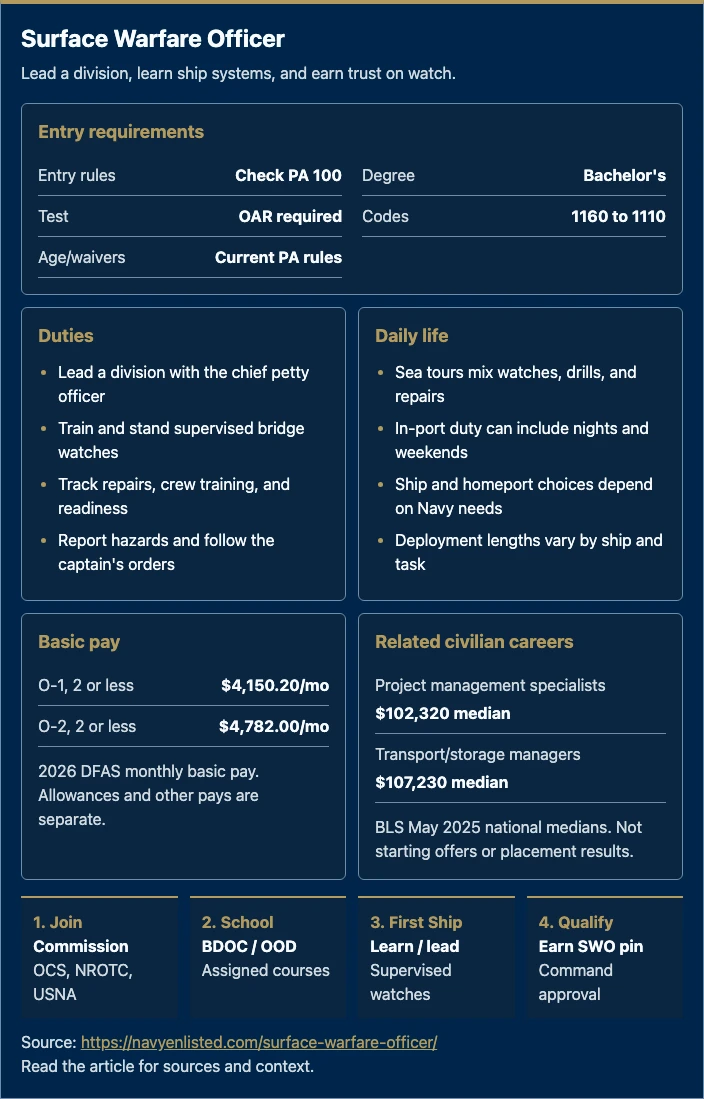
Entry requirements
- Entry rules
- Check PA 100
- Degree
- Bachelor's
- Test
- OAR required
- Codes
- 1160 to 1110
- Age/waivers
- Current PA rules
Duties
- Lead a division with the chief petty officer
- Train and stand supervised bridge watches
- Track repairs, crew training, and readiness
- Report hazards and follow the captain's orders
Daily life
- Sea tours mix watches, drills, and repairs
- In-port duty can include nights and weekends
- Ship and homeport choices depend on Navy needs
- Deployment lengths vary by ship and task
Basic pay
- O-1, 2 or less
- $4,150.20/mo
- O-2, 2 or less
- $4,782.00/mo
2026 DFAS monthly basic pay. Allowances and other pays are separate.
Related civilian careers
- Project management specialists
- $102,320 median
- Transport/storage managers
- $107,230 median
BLS May 2025 national medians. Not starting offers or placement results.
- JoinCommissionOCS, NROTC, USNA
- SchoolBDOC / OODAssigned courses
- First ShipLearn / leadSupervised watches
- QualifyEarn SWO pinCommand approval
Source: https://navyenlisted.com/surface-warfare-officer/
Read the article for sources and context.
Job Role and Responsibilities
A Surface Warfare Officer leads Sailors and helps operate Navy surface ships. Junior officers run a division while learning ship systems, safe ship handling, and watch duties. Those who qualify can later seek roles as department heads and ship captains.
The job belongs to the Unrestricted Line. On a ship, a division may care for equipment, run a service, or support a combat task. Its officer works with a chief petty officer and other skilled Sailors. The officer learns from those Sailors. The duty to lead the division still rests with its officer.
A bridge watch is a different duty. The officer of the deck directs the watch team under the captain’s standing orders. The team tracks nearby ships and follows the planned route. It reports changes that could put the ship at risk. The captain sets rules for when the watch must call for help.
| Navy identifier | Meaning in this career |
|---|---|
| 1160 | Surface Warfare Officer trainee |
| 1110 | Qualified Surface Warfare Officer |
| AQD | An added qualification code, not a replacement for the officer’s designator |
These codes show a field, skill, or stage of training. They are not pay grades. An ensign and a lieutenant may both belong to the same community while holding different ranks.
Work can involve radar, charts, ship controls, radios, and combat-system displays. The gear depends on the ship and assigned job. An ensign in charge of pumps and pipes faces different work from one in charge of weapons or deck gear.
Work Environment
Most early career work is aboard ships. At sea, the crew fits drills, repairs, and training around each watch. In port, maintenance and duty days continue. Being in the homeport does not mean every evening or weekend is free.
The chain of command gives the work structure. A division officer reports through a department head. The captain and executive officer run the ship. Chiefs bring deep knowledge of the crew and equipment. A new officer who ignores that knowledge can make a simple problem much harder.
Good leadership starts with clear tasks and follow-through. If a repair slips, the division officer needs facts. They need to know which part failed and who needs help. They also need to know what the delay means for the ship. A polished brief cannot fix a missing part or an unsafe work plan.
Leaders give feedback during work and in one-to-one talks. Formal fitness reports put the record in writing. Watch performance and division results both count. No current rate for how many SWOs stay in the Navy was found in the sources checked. One number would also hide how much life can vary by ship. Ask people in the job which ship and tour they mean. A story from one crew may not fit another.
Training and Skill Development
Officers can enter through the Naval Academy, NROTC, or Officer Candidate School. The OCS route serves many applicants who already hold a degree. The Navy describes 13 weeks of OCS training in Newport, Rhode Island. Passing that school earns the commission. The SWO pin still has to be earned aboard a ship.
| Stage | What the officer learns | Timing and limits |
|---|---|---|
| Commissioning route | Military leadership and basic officer duties | OCS is 13 weeks; Academy and NROTC routes differ |
| Basic Division Officer Course | Division leadership, ship systems, and surface operations | The SWOS overview describes an eight-week course |
| OOD Phase I and assigned courses | Bridge work, ship handling, and billet skills | Orders and course schedules control timing |
| First ship | Local systems, watch duties, and warfare knowledge | Supervised practice and command qualification |
| Later courses | More advanced watch and leadership work | Depends on career stage and assignment |
BDOC gives new officers a shared base for the first ship. The ship adds its own gear, crew, and ways of working.
Earning a watch duty takes study and proof of skill. New SWOs use the relevant personnel qualification standards. They train with skilled watch teams and show they can do the work. A signature is supposed to follow demonstrated knowledge. It is not a substitute for practice.
There is no safe promise that every officer earns the pin by the same month. A ship needs time to train its crew. Schedules and each person’s progress affect when the pin can be earned. The first course is only part of the time spent in training. Travel, a wait for class, and more courses can add time before the first ship.
Later schools teach skills for department head duties or other fields. The Navy selects people for those roles based on skills and its own needs. Good work can open doors. It does not promise a chosen next job.
Entry-test prep and shipboard training serve different needs. The OAR tests math, reading, and mechanical skills. A paid prep course can help structure study for that exam. It does not teach a bridge watch or award a warfare pin.

Physical Demands and Medical Evaluations
Shipboard work includes steep ladders, narrow passages, moving decks, and emergency drills. A watch may mean long hours on foot. Heat, noise, weather, and interrupted rest can make routine tasks harder. The crew needs the strength and fitness to work safely there.
The December 2025 Guide-5A tables list the following event scores for ages 17 to 19 below 5,000 feet. These are published score categories, not a promise that the lower row meets every current OCS or fleet requirement.
| Sex | Published category | Push-ups | Plank | 1.5-mile run |
|---|---|---|---|---|
| Male | Probationary, 45 points | 42 | 1:11 | 12:45 |
| Female | Probationary, 45 points | 19 | 1:01 | 15:00 |
| Male | Satisfactory Medium, 50 points | 46 | 1:22 | 12:15 |
| Female | Satisfactory Medium, 50 points | 20 | 1:11 | 14:45 |
Use the correct age, sex, altitude, and approved event table. Medical waivers and alternate cardio events have separate rules. The command fitness leader and current Physical Readiness Program guidance control the actual assessment. An applicant should train beyond a bare threshold rather than plan around the smallest possible margin.
An entry health exam is not the same as a fitness test. Health staff check whether a person meets the rules for service and sea duty. Report health issues in full. The staff with that duty must decide if the rules are met or a waiver can be sought.
Deployment and Duty Stations
Surface ships operate from homeports in the United States and overseas. The Navy fills open jobs as crews need people. Officers can state a choice of coast, ship, or port. That choice is not a promise.
A sea tour includes more than a single deployment. A ship can leave port for drills, tests, and short trips before a long voyage starts. Repair work may keep a ship in port while still demanding long duty hours.
There is no fixed deployment length that fits every ship or year. A new task can change the plan. Ask which parts of the ship’s plan are firm and which may change. A homeport tells a family where the ship is based, rather than how often it will be there.
Career Progression and Advancement
The first goal is to lead a division well and earn trust on watch. Later jobs can place more people and gear in an officer’s care. A rise in rank is not the same as being picked to command. The Navy makes both choices through its own processes.
| Career stage | Common work | What builds readiness for the next stage |
|---|---|---|
| Division officer | Lead a division and qualify on the ship | Safe decisions, sound knowledge, and crew results |
| Shore assignment | Training, staff, or other assigned work | Broader skills and sustained performance |
| Department head | Lead a ship department | Readiness across several divisions |
| Executive officer | Help run the whole command | Shipwide leadership and judgment |
| Commanding officer | Command the ship or unit | Successful screening and required preparation |
| Pay grade | Navy officer rank |
|---|---|
| O-1 | Ensign |
| O-2 | Lieutenant junior grade |
| O-3 | Lieutenant |
| O-4 | Lieutenant commander |
| O-5 | Commander |
| O-6 | Captain |
The second table is a rank reference, not a promotion schedule. The sources do not give a sound way to predict one person’s rise in rank or chance at command. Fitness reports record how well an officer has done the job. Boards use them to help judge who is ready for more. Strong work must be sustained across assignments.
A nuclear surface warfare path has its own screening and training. A move into a new field needs both approval and an open job. Officers interested in a Foreign Area Officer transfer should check the actual program rules and timing. A move does not by itself end a promise to serve.
Salary and Benefits
Basic pay follows rank and time served. A new SWO does not get a special basic-pay rate for that job. The shared table below uses the site’s 2026 DFAS officer-pay data. A column marked 2 means over two years of service, rather than exactly the second anniversary.
| Rank | Pay Grade | YOS <2 | YOS 2 | YOS 4 | YOS 6 |
|---|---|---|---|---|---|
| Ensign (ENS) | O-1 | $4,150 | $4,320 | $5,222 | - |
| Lieutenant Junior Grade (LTJG) | O-2 | $4,782 | $5,446 | $6,484 | $6,618 |
| Lieutenant (LT) | O-3 | $5,534 | $6,274 | $7,383 | $7,737 |
| Lieutenant Commander (LCDR) | O-4 | $6,295 | $7,286 | $7,881 | $8,332 |
Source: DFAS 2026 pay tables. Figures reflect the 2026 pay raise.
| Pay or benefit | What determines it |
|---|---|
| Basic pay | Grade and creditable service in the DFAS table |
| Housing allowance | Eligibility, duty location, grade, and dependency status |
| Subsistence allowance | Applicable officer rate and eligibility |
| Career sea pay | Qualifying assignment and accumulated sea duty |
| Retention bonus | The specific program, written agreement, and eligibility |
Allowances are not a single cash amount that every ensign receives. The amount can change if the Navy provides housing or a member’s status changes. The DFAS pay tables separate basic pay from other pays and allowances. The food allowance for officers differs from the enlisted rate.
Health care, paid leave, and funds for school can add value. Each has its own rules. Leave still needs approval, and an operating schedule can limit when it can be taken. Retirement pay depends on the plan and time served. The Blended Retirement System includes the Thrift Savings Plan. It also pays a pension to those who serve long enough to earn one. A short first tour does not earn a full military pension.
Risk, Safety, and Legal Considerations
Fire, flooding, heavy equipment, and collisions are real shipboard hazards. A poor watch decision can affect other ships as well as the crew. Safety training, drills, protective equipment, and clear orders reduce risk. They do not remove it.
An officer must report a problem the watch team cannot safely handle. Calling the captain early gives the command time to act. The watch still has work to do. The same principle applies to repairs. Hiding a problem to make a readiness report look better can put people at risk.
Applicants must meet the program’s rules for security. The exact clearance and access needed depend on the program and billet. The proper security review decides who meets those rules. No recruiter can promise the result before that review ends.
Orders, military law, and a written promise to serve govern the job. A change in world events may change a ship’s task or schedule. Read the agreement before signing. Ask how schools, sea tours, and later choices affect the date a request to leave may be made.
Impact on Family and Personal Life
The same job can feel quite different during school, a shipyard period, and a deployment. A family needs to plan housing and work around each phase. A homeport address alone leaves out much of the picture.
Plan who will handle bills, child care, and urgent choices during time apart. Set expectations for contact at sea. The ship’s work can limit calls and messages. A missed call does not reliably explain what is happening aboard the ship.
Commands, ombudsmen, and Fleet and Family Support Centers offer support. Ask which office handles a specific need rather than expecting one contact to solve every issue. An overseas move may need health checks and plans for school and travel. Start those checks early once orders make the move real.
The tradeoff is practical. Families may value stable pay and benefits while finding the schedule hard. Both can be true. Travel has a cost in home life. A tour may mean missed birthdays or two homes to run. A move may force a partner to leave a job.
Post-Service Opportunities
Shipboard leadership can support a move into civilian operations work. It helps to show what was achieved in terms a new employer can grasp. Managing a maintenance schedule, resolving a supply delay, and leading a team are clearer examples than a list of Navy acronyms.
The Bureau of Labor Statistics provides the following national comparisons. These are May 2025 medians across each occupation. They are not starting offers, SWO placement results, or guarantees for a departing officer.
| Civilian field | Related shipboard experience | BLS annual median |
|---|---|---|
| Project management specialists | Plans, budgets, deadlines, and coordination | $102,320 |
| Transportation, storage, and distribution managers | Moving people and material under constraints | $107,230 |
Some sea jobs need a civilian license or proof of time at sea. A warfare pin is not a merchant mariner credential. Use career support to check the skills and licenses a new job needs. Make a plan to fill any gap.
Leaving the Navy also takes planning. Serve the agreed time and check any reserve duty still owed. Follow the approved process to leave. Wanting a new way of life does not end a contract early.
Qualifications and Eligibility
OCS applicants need a degree, U.S. citizenship, a qualifying test score, and a passed health review. Academy and NROTC routes have their own entry rules. Do not apply one route’s application checklist to every future SWO.
The table below uses a dated set of entry rules. A newer version may change them. NavyCS’s SWO summary cites Program Authorization 100 dated November 30, 2023. Ask an officer recruiter to check the current Navy rules before using these figures to apply.
| OCS item | Published November 2023 baseline |
|---|---|
| Citizenship | United States citizen |
| Degree | Bachelor’s degree from a regionally accredited institution |
| Cumulative GPA | At least 2.75 on a 4.0 scale |
| Officer Aptitude Rating | At least 42 on the most recent exam |
| Age | At least 19 and under 29 at the expected commissioning date |
| Waivers | Case-specific review; approval is not automatic |
The Navy’s program-authorization index is the place to check for a replacement. Check age limits, waivers, past service, and board rules against that exact version. Do not pick the most helpful parts from two old versions.
The OAR minimum sets a floor. Reaching it does not mean a board will select an applicant. Study the math, reading, and mechanical skills that the test covers. Start by finding weak areas, then work through errors and timed practice. Compare OAR prep options by how well they teach missed skills, rather than by question count alone.
We may earn a commission from the course link below. If structured lessons suit your needs, an approved OAR preparation course is one option. Check what it teaches and compare the current terms with free practice. The Navy does not require a course. Buying one does not assure a score or a place.
For the application itself, use a clear sequence.
- Confirm the current entry route and authorization with an officer recruiter.
- Gather transcripts, identity records, and any required service records.
- Complete testing and the authorized medical process.
- Resolve any waiver request before treating the package as eligible.
- Confirm the board process, written obligation, and orders after selection.
There is no verified wait time that fits every applicant. Health checks, missing records, waivers, and board dates can cause delays. A recruiter can check where a package stands. A generic online timeline cannot.

The cited November 2023 rules call for eight years of total service. It requires at least four years of active service or two division officer tours. The longer of the two controls. Under that plan, both tours take an average of 5.25 years. That average is not a date anyone can count on leaving. Check the current rule and any extra time owed before signing.
Newly commissioned officers enter as ensigns, pay grade O-1. Prior enlisted service can affect pay eligibility. Officer-candidate pay before commissioning is a separate matter. The BDCP route also needs its own eligibility and benefit review.

Is This a Good Job for You? The Right (and Wrong) Fit
This job can suit people who want to learn how a ship works and lead a crew. They need to take feedback, admit gaps, and do sound work when tired. Being comfortable with responsibility is useful. Pretending to know an answer is not.
People who need fixed hours or a firm choice of home may find the sea tours hard. The same goes for people who want to lead but dislike repairs, paperwork, or repeated drills. Those tasks are part of how a ship becomes ready to operate.
Compare surface warfare with submarine service by actual work setting and training. The Supply Corps comparison can help distinguish ship handling from a logistics career. Neither choice can be reduced to which community sounds more impressive.
An applicant with less cash for prep may prefer free practice or a lower-cost guide. A guide is a secondary format, not a substitute for diagnosing weak skills. Check the current price and contents before buying.

More Information
An officer recruiter can confirm the current authorization, board process, and written obligation. Ask for the rule in force and how it fits your age, degree, test record, and past service. Use those answers to judge whether life aboard ship fits your plans.
Related work in the nuclear surface community and Naval Flight Officer community involves distinct training and entry requirements. Compare the actual jobs and obligations rather than treating a future transfer as a promise.