Navy Unrestricted Line Officer Programs
As you’ll discover, there’s a wide range of programs under the Navy’s unrestricted line, offering plenty of options depending on your skills and interests.
Let’s dive in and explore your opportunities!
What is an Unrestricted Line Officer in the Navy?
In the Navy, the Unrestricted Line Officer (URL) community is made up of the Navy’s main warfighters. These officers carry out the Navy’s core missions, whether at sea, in the air, or on the ground.
Unlike restricted officers, URL officers in both the Regular Navy and the Naval Reserve aren’t limited in the duties they can perform, giving them the freedom to lead in a variety of critical operational roles.
An Unrestricted Line Officer is a commissioned officer of the line in the United States Navy who is qualified to command at sea war-fighting combatant units such as naval warships, aircraft carriers, submarines, aviation squadrons, SEAL teams, and also shore bases to include naval bases and naval air stations.
They can also command such units’ upper echelons, such as special warfare groups, air wings and air groups, and destroyer and submarine squadrons.
At the Flag officer (Admiral) level, URL officers can command patrol and reconnaissance groups, expeditionary strike groups, carrier strike groups, task forces, and fleet/force commands.
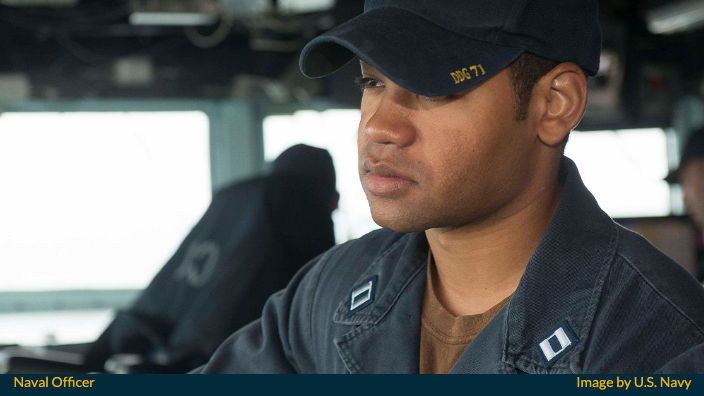
Unrestricted Line Officer Ranks
| Pay Grade | Navy Rank | Abbreviation |
|---|---|---|
| O-1 | Ensign | ENS |
| O-2 | Lieutenant Junior Grade | LTJG |
| O-3 | Lieutenant | LT |
| O-4 | Lieutenant Commander | LCDR |
| O-5 | Commander | CDR |
| O-6 | Captain | CAPT |
| O-7 | Rear Admiral (Lower Half) | RDML |
| O-8 | Rear Admiral (Upper Half) | RADM |
| O-9 | Vice Admiral | VADM |
| O-10 | Admiral | ADM |
How It Breaks Down:
- O-1 to O-3: Brand-new officers start at Ensign (O-1). By Lieutenant (O-3), they’re leading teams, running divisions.
- O-4 to O-6: Lieutenant Commanders (O-4) take on bigger roles. Commanders (O-5) lead departments. Captains (O-6) run ships, major shore units.
- O-7 to O-10: Rear Admirals (O-7, O-8) call the shots on strike groups and big operations. Vice Admirals (O-9) and full Admirals (O-10) run entire fleets.
This is Navy-specific. The other branches do it differently.
Salary and Benefits
Base pay (taxable)
Active duty Unrestricted Line Officers earn monthly basic pay based on rank and years of service. The 2026 rates took effect January 1, 2026 and are published in Schedule 8 of the White House pay tables.
Common 2026 starting points (monthly, 2 years or less):
| Pay grade | Monthly basic pay | Annual basic pay |
|---|---|---|
| O-1 (ENS) | $4,150.20 | $49,802.40 |
| O-2 (LTJG) | $4,782.00 | $57,384.00 |
| O-3 (LT) | $5,534.10 | $66,409.20 |
| O-4 (LCDR) | $6,294.60 | $75,535.20 |
| O-5 (CDR) | $7,295.40 | $87,544.80 |
| O-6 (CAPT) | $8,751.30 | $105,015.60 |
There are also statutory monthly caps that can limit basic pay at senior longevity points.
Allowances (mostly tax-exempt)
Most Navy officers receive allowances that can make total take home compensation much higher than basic pay alone, especially in high-cost areas.
- Basic Allowance for Subsistence (BAS) helps offset food costs. In 2026, officer BAS is $328.48 per month.
- Basic Allowance for Housing (BAH) helps cover housing costs when government quarters are not provided. Rates depend on duty station, pay grade, and dependent status, and BAH is not taxed. Use this BAH calculator.
- Many allowances are tax-exempt, including the two most common ones, BAS and BAH. tax-exempt allowances
For a quick, realistic estimate of “civilian equivalent” compensation that includes the tax advantage of allowances, the DoW publishes a Regular Military Compensation tool.
Special and incentive pays (community and billet dependent)
Unrestricted Line Officers may qualify for additional pays depending on warfare community, qualification status, and assignment.
- Career Sea Pay (CSP) for qualifying sea duty assignments. Officer CSP varies with pay grade and cumulative sea duty time.
- Aviation Incentive Pay (AvIP) for eligible naval aviators and naval flight officers, based on years of aviation service.
- Submarine Duty Pay for eligible submarine-qualified officers, with rates tied to rank and time in service.
- Hazardous Duty Incentive Pay (HDIP) for specific duties (examples include flight deck, demolition, and parachute).
- Hardship Duty Pay (HDP) may apply in designated locations with challenging living conditions.
Core benefits package
Navy Active Duty officer compensation also includes a benefits package designed around readiness, stability, and long-term retention.
- Health care through TRICARE Prime options supporting active duty medical readiness.
- Life insurance through SGLI, with premiums taken from base pay.
- Paid leave earned at 2.5 days per month (30 days per year).
- Retirement and TSP participation under the Blended Retirement System for eligible accessions, including government automatic and matching contributions up to 5% (subject to program rules and timelines).
- Education benefits through Navy voluntary education programs and GI Bill eligibility over time.
How To Become An Unrestricted Line Officer
You should know right off the bat that earning a commission in the United States Navy is one of the most difficult to achieve.
You’ll need to first verify that you satisfy the minimum criteria for commissioning with the United States Navy. It is as a result advised that you apply no later than a year before your college graduation date, since seats are limited and fill quickly.
Keep in mind this isn’t the same as applying for a civilian managerial position, as Naval Officers, and Unrestricted Line Officers in particular, have a more direct impact on national security.
Understand that you will be held to a higher standard of performance and conduct than your civilian counterparts.
If that didn’t get you down, you might be well suited for this position, because you have high levels of pride and integrity.
You can find the fundamental information you’ll need to know in order to apply below. More requirements will be added to you throughout the application process, but this will get you in the door.
For the Unrestricted Line Officer In-Service Procurement Program, a quota exists for commissioning and includes qualified enlisted personnel who are able to apply.
If you are seeking a more personalized assessment and guidance, you should contact your local Navy Officer recruiter.
While individual jobs will have their own distinct requirements, the following are all prerequisites for all Navy Unrestricted Line Officers, per the Navy Personnel Command.
Navy Unrestricted Line Officer Eligibility Requirements
| Citizenship | You must be a United States citizen, either born or naturalized. |
|---|---|
| Education | You must have at least a baccalaureate degree from a regionally accredited college or university. GPA requirement and degree major requirements will differ for each URL officer position. |
| Physical | You must pass a physical and medical screening, usually given as part of the application process. |
| Aptitude | You must pass the Officer Aptitude Rating (OAR) or the Aviation Selection Test Battery (ASTB). |
Source: Navy Personnel Command
Officer Candidate School (OCS)
All prospective Unrestricted Line Officers will spend about 12 weeks in Newport, Rhode Island at Navy orientation training.
The OCS curriculum will further your professional understanding of the Navy and help you make the transition from civilian to military life.
Academic courses, military instruction, and physical fitness training are all challenging and rigorous at Navy OCS. You must be self-disciplined, physically fit, and have strong study habits, since you will be working very hard.
Topics include naval operations, orientation, and administration, as well as naval history, and the functions of strategic deterrence, sea control, force projection, and presence to control the seas during conflicts and sustain the seas during peace.
Prior to OCS graduation and commissioning as a Navy officer, you will be assigned to a ship. Your career as a URL Officer begins as soon as OCS training is completed.
Compare Related Navy Jobs
If you are narrowing officer paths, start with Navy Pilot vs NFO and Navy SWO vs Submarine Officer. These comparisons show how aviation and shipboard officer paths differ by test gate, training, work setting, and fit.
Aviation specialties within the officer programs
The Naval Aviator program covers the route to becoming a Navy pilot. Explore its aircraft specialties: strike fighter, helicopter, maritime patrol, Hawkeye, TACAMO, and CMV-22B Osprey.
The Naval Flight Officer program covers mission and tactical crew duties. Its specialties include strike fighter NFO, maritime patrol NFO, airborne early warning NFO, and TACAMO NFO.
These are specialties within the pilot and NFO programs. Students cannot reserve a particular aircraft when they apply.
Navy Unrestricted Line Officer Jobs
In the Navy, there are several Unrestricted Line Officer designators, which include: