Navy OCS Guide for Officer Applicants
This guide provides helpful information for those looking to become a United States Naval Officer during Fiscal Year 2026.
Navy OCS (Officer Candidate School) is one of the primary paths to a commission in the U.S. Navy.
There are many aspects to Navy OCS and knowing these ahead in preparation will provide you with a distinct advantage. So, read and understand the information here to fully prepare for your arrival at Navy OCS.
So let us jump right into the details.

What is the Navy Officer Candidate School (OCS)?
The Navy Officer Candidate School is a training facility at the Officer Training Command in Newport, Rhode Island, where the U. S. Navy provides initial military training to newly selected Unrestricted and Restricted Line Officer candidates.
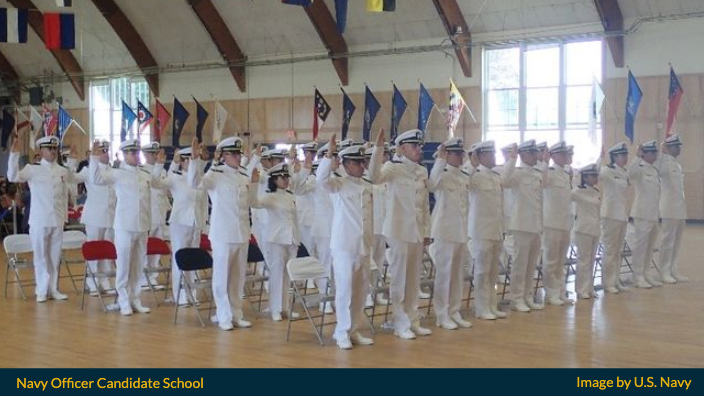
Officer Candidate School Mission and Purpose
The mission of Officer Candidate School (OCS), a 13-week officer accession program, is to develop civilians, enlisted, and newly commissioned personnel. It also instills the highest ideals of Honor, Courage, and Commitment. This prepares graduates for service in the fleet as outstanding Naval Officers morally, mentally, and physically.
Major Curriculum Subjects
OCS covers major subjects across academics, leadership, and shipboard skills.
- Division Officer Fundamentals
- Engineering and Weapons
- Watch Officer (Navigation and Seamanship)
- Naval History
- Leadership and Ethics
- Cyber and Damage Control
What the 13-Week Program Builds
The 13-week OCS school gives you a working understanding of the Navy. This includes Navy life on and off the water. It prepares you to take on officer duties. It also pushes you toward your maximum potential.
Navy OCS is both ethically, psychologically, and physically taxing.
How You Get Tested
At OCS, you will be tested on your own Honor, Courage, and Commitment. You will be pushed to meet the highest levels of these principles. The curriculum places strong focus on academic performance.
Mental training includes:
- Military information memorization
- Academic courses
- Military inspections
Physical Training Expectations
Physical Training (PT) starts as soon as you arrive at OCS. The program includes calisthenics and cardiovascular conditioning. It also includes track running and road running.
Candidates who arrive in poor physical condition and fail the Initial Strength Test (IST) are subject to instant separation from OCS.
People often say Navy OCS is hard. It is hard for those who arrive unprepared. Navy OCS is easier to pass for people who truly want to become Naval Officers.
You will be sworn in by a commissioned officer when you join the US Navy. You will be required to affirm the following oath:
Oath of Office for Commissioned Officers
“I, __, having been appointed an Ensign in the United States Navy, do hereby accept such appointment and do solemnly swear, that I will Support and Defend the Constitution of the United States against all enemies, foreign and domestic, that I will bear true faith and allegiance to the same; that I take this obligation freely, without any mental reservation or purpose of evasion, and that I will well and faithfully discharge the duties of the office on which I am about to enter. So, help me God.”
The Navy Core Values
Navy Core Values at a Glance
The U.S. Navy is a professional force focused on national defense. It works to protect freedom and support a safer future.
Navy personnel, officers and enlisted, have served these ideals for over 200 years. They defend the values that shape the country and its people.
The Navy calls these steady values its Core Values:
- Honor
- Courage
- Commitment
Every sailor has a duty to know them. They must understand them and live them every day.
Knowing the Navy Core Values by heart before Navy OCS is a smart move.
Honor
“I will bear true faith and allegiance…”
As a result, we will:
- Act in a manner that upholds the highest standards of ethics in all interactions with superiors, peers, and subordinates
- Be truthful and honest in our interactions with one another and with those outside the Navy
- Be willing to make honest recommendations and to accept those recommendations from junior personnel
- Support new ideas and deliver the bad news, even when it is unpopular
- Adhere to an unwavering code of integrity, taking accountability for our actions
We will not stand for illegal, inappropriate, or even the appearance of such activity. We are responsible for both our personal and professional conduct. The honor it is to serve our nation is something that we will be conscious of.
Courage
“I will support and defend…”
As a result, we will:
- Meet challenges while upholding a higher standard of personal conduct and decency
- Have courage to meet the demands of our profession and the mission when it is risky, demanding, or otherwise difficult
- Make decisions in the best interest of the Navy and the nation without consideration for personal consequences
- Be loyal to our country by ensuring the resources entrusted to us are used in an honest, careful, and efficient manner
Commitment
“I will obey the orders…”
As a result, we will:
- Demand respect from everyone in the chain of command
- Be concerned for the safety, professional, personal, and spiritual well-being of our employees
- Treat every person with respect and dignity, regardless of their race, religion, or gender
- Be dedicated to positive change and continuous improvement
- Display the highest level of moral character, technical excellence, quality, and competence in the work we have been trained to do.
One of the most crucial choices you will ever make is whether to join a prestigious organization with a long and illustrious history. You will be a part of a team that only works as well as its members do their jobs and strive to achieve a shared objective.
The Eleven General Orders of a Sentry
- To take charge of this post and all government property in view.
- To walk my post in a military manner, keeping always on the alert and observing everything that takes place within sight or hearing.
- To report all violations of orders I am instructed to enforce.
- To repeat all calls from posts more distant from the Guardhouse than my own.
- To quit my post only when properly relieved.
- To receive, obey, and pass on to the sentry who relieves me all orders from the Commanding Officer, Command Duty Officer, Officer of the Deck, and Officers and Petty Officers of the Watch only.
- To talk to no one except in the line of duty.
- To give the alarm in case of fire or disorder.
- To call the Officer of the Deck in any case not covered by instructions.
- To salute all officers and all colors and standards not cased.
- To be especially watchful at night, and during the time for challenging, to challenge all persons on or near my post, and to allow no one to pass without proper authority.
Prior to leaving for Officer Candidate School, you must memorize the Eleven General Orders of a Sentry while in the Officer Commissioning Onboarding Program.
What to Expect When Arriving at Navy OCS?
All candidates must report to Navy OCS in civilian clothes. This includes candidates with prior military service. You must arrive by the time listed in your instructions.
Check-in is usually at 0800 on Sunday morning.
Storage space is limited at OCS. Pack only a small amount of civilian clothing.
Civilian clothes are not worn during training or while on leave. During the first week, OCS will issue the required uniforms and other necessary clothing.
When Checking In
When you arrive at Naval Station Newport, use Gate 1. Ask the gate guard for directions to the OCS check-in area. Then follow the posted signs that read “OCS Arrivals.”
Check-in takes place in Callaghan Hall. Designated parking will be available.
If you arrive in Newport before your assigned report day, you must arrange your own lodging. Navy OCS cannot house students before their report date.
If you drive, bring these items:
- Driver’s license
- Vehicle registration
- Proof of insurance
- A notarized authorization to drive the vehicle if you are not the owner
Long-term parking is available on base. You typically will not access your car until OCS graduation.
Personal Mail
You are free to receive and send mail while at Navy OCS. While in training, your address will be as follows. Please keep in mind that the only variables in the address are your name and class number.
OC (Your Name)
Officer Candidate School Class XX-XX (Assigned upon arrival) Officer Training Command Newport 1356 Meyerkord Ave. Newport, RI 02841
Emergency Issues from Home
In the event of an emergency while you are in training, family members and next of kin may reach you at (401) 862-4321 through the Command Duty Officer.
NOTE: The caller must say that you are assigned to Officer Candidate School and that they want to report an emergency. The Department of War mandates that anybody seeking to contact you do so via their local Red Cross in the case of a medical emergency or death in your immediate family.
Pay and Benefits While in Training
You go on active duty the moment you leave your residence. You get paid at the E-5 pay and allowance level, or at your current paygrade if it is higher.
If you are married or have children, the Navy adds Basic Allowance for Housing (BAH). This allowance is tax-free.
If your dependents do not live in the Newport region, you may qualify for Family Separation Allowance (FSA). Eligibility depends on your specific situation.
Leave of Absence
Officer Candidates will only be permitted leave in the event of an emergency.
What to Bring to Navy OCS?
All candidates must ensure they bring all the items listed below. Missing items upon arrival may cause issues with the reporting process.
Administrative Items to Bring
All candidates must bring:
- Official copy of Permanent Change of Station (PCS) orders (or Navy Reserve orders) along with any modifications to the original orders
- Copies of prescriptions from civilian doctors if you are using prescription medicine. You should carry at least two weeks’ supply of medicine with you.
- All medical and dental records, as well as vaccination data (military and civilian)
- A voided personal check to verify proper setup of your military pay direct deposit account
- Two forms of identification documents
- Contact information for the recruiter (name, phone number, fax number, and NTAG address)
- Driver’s license number, car insurance policy number, license plate number, vehicle make and model (if you drove to OCS)
- Bank checks
Prior Active Duty Enlisted Sailors must bring:
- Military Common Access Card (CAC)
- Transfer EVAL from previous command
- Proof of all medals, awards, and unit citations
- SMART transcripts
- Page Two (Record of Emergency Data)
All candidates with prior military service must bring:
- All DD-214s
- All DD-368s
- NGB-22 (National Guard)
- Point capture sheet (Reservists)
- Page Two (Record of Emergency Data)
- Last Personnel Support Detachment (PSD) point of contact information
Collegiate Program participants must bring:
- Military Common Access Card (CAC)
- Page Two (Record of Emergency Data)
- Original or court certified copy of marriage certificate, along with your spouse’s original identification documents. This will be required to add your spouse as your dependent on the system.
- Original or court certified copy of Social Security card and birth certificates for all dependents. This will be required to add your dependents as your official dependents on the system.
- Original child custody documents
- Original Divorce documents
Recommended items to bring (but not required):
- Credit or debit cards
- Book of mail stamps
- List of emergency contacts written on paper
Training Items to Bring
When you arrive at Navy OCS, you will be issued the essential uniform items.
Your rank also affects your clothing allowance. Prior Chief Petty Officers do not receive this allowance, since they already receive one.
The required training items are listed below. Bring only what is specified.
Male candidates should bring:
- 7 pairs of white socks
- 7-10 sets of white underwear and briefs
- At least one white towel and one washcloth
- Personal Toiletries – Only the Essentials (Full size, not travel size)
- Shaving gear with replaceable blades (6 weeks’ worth)
- Toothbrush/paste and floss
- Deodorant
- Soap/Shampoo
- Nail clippers
Female candidates should bring:
- White basic underwear: 7-10 pairs
- 3 regular bras NOT sports bra (one white or skin tone bra to be worn with white uniforms)
- 5 sports bras (white)
- Conservative one-piece swimsuit (Black/Navy Blue)
- At least one white towel and one washcloth
- Personal Toiletries – Only the Essentials (Full size, not travel size)
- Products for Feminine Hygiene
- Toothbrush/paste and floss
- Deodorant
- Soap/Shampoo
- Make-up and hair products (gel/mousse/hairspray) may be brought but will not be permitted until the last session of training.
- Hairbrush
- Nail clippers
All candidates should bring:
- Glasses: A sturdy pair with a black/brown strap to use while exercising. When you finish your physical check-in, you will be given a government set of glasses. Do not forget to bring your eyeglasses.
- Contact lenses: Typically, they may not be worn until the last period of training.
- Running shoes: On check-in day, you will be suited for and given a pair of running shoes. As a backup, carry a recent pair of running shoes. Minimalist footwear is not permitted.
Optional to bring:
- Alarm clock
- Cell Phones with charger (after week 9)
- Wristwatch (black only)
- Wallet, checkbook, and bank card
- Females only: Gold ball stud earrings (after week 9)
What NOT to Bring to Navy OCS?
Do not bring the following items to Navy OCS. You will not need them and will not be allowed to use them. All candidates should not bring:
- Any sporting gears
- Personal blankets
- Technological equipment (Kindles, iPads, laptops, video game consoles, and so forth)
- Over-the-counter medicine
- Weapons are all prohibited (including edged, pointed, and impact weapons, pocket knives, and letter openers)
- All aerosol canisters
- Aftershave/cologne
- Hair care items containing grease
- Lighter fluid • Matches
- Non-Navy books and periodicals (religious articles are permitted)
- Cards, dice, gambling paraphernalia
- Large and bulky stationery
- Large plastic picks, rakes, etc., or anything made of metal
- Cigarettes, e-cigarettes, vapes, cigars, pipes, tobacco, chewing tobacco
- Deodorants greater than three ounces
Non-prescription medicines and medications will be seized and destroyed. These include, but are not limited to:
- Antihistamines
- Motion Sickness medication
- Acne medication
- Commercial sleeping aides
- Decongestants
- Eyewash
- Analgesics
- Sex-related materials excluding diaphragms and condoms
- Phisoderm, Phisohex, and other similar products
Candidates should never bring dangerous items, such as:
- Firearms, ammunition
- Fireworks
- Clubs, batons, and brass knuckles
- All straight razors and knives with blades longer than 3 inches (knives and blades less than 3 inches in length, ice picks and scissors should be left home)
- Narcotic substances and any drug-related paraphernalia such as roach clips, hash pipes, and hypodermic needles
Drugs and Alcohol Policy
The U.S. Navy enforces a zero-tolerance policy for illicit drugs and alcohol misuse.
- A positive drug test for illicit substances can result in discharge. It can also disqualify you from future enrollment.
- A positive alcohol test may trigger an evaluation for dependence. It can also lead to discharge from the military.
What to Expect During Navy OCS Training?
Students/candidates have little spare time in the OCS program.
A typical daily routine is:
| Time | Activity |
|---|---|
| 0500-0700 | Reveille, PT, Hygiene, Breakfast |
| 0700-1130 | Drill / Academics |
| 1130-1230 | Lunch |
| 1230-1700 | Drill / Academics |
| 1700-1800 | Dinner |
| 1800-2100 | Study |
| 2100-2200 | Hygiene, Preparations, Taps |
Duties and Awards
Every group has chores. That is true at home and in the Navy.
At Navy OCS, these chores are called sweepers. Sweepers include deck swabbing, facility upkeep, grass care, snow removal, and other tasks. The goal is a clean, safe, and livable space for everyone.
Your class also competes for several awards during OCS. These include physical performance, scholastic achievement, military drill, personnel inspections, and overall excellence.
Winning classes earn Guidon streamers. They march in formation and attend events with the Guidon. It shows their strong standing.
Military Pay
Navy pay is issued twice a month by direct deposit to your chosen bank.
To set this up, bring a completed Direct Deposit Sign-Up Form (Standard Form 1199A) to Navy OCS. Most banks provide this form.
Before you leave for OCS, Section 3 of the 1199A must be completed by your financial institution. Bring your checkbook and your ATM card for your account.
Military Leave
While on active duty, leave is earned at 2.5 days per month. During Navy OCS training, leave is only allowed for emergencies.
Academics
Navy OCS prepares you for a career as a commissioned officer. It gives you a basic grasp of military, academic, and nautical subjects. It also builds moral, mental, and physical growth. The program teaches the core ideals of Honor, Courage, and Commitment.
Training at OCS is grouped into these main units:
- Leadership and Ethics You work through case studies to sharpen decision-making. You apply leadership principles in realistic situations. You also examine ethical issues officers may face on duty.
- Division Officer Fundamentals You learn key programs and requirements for Division Officer duties. You take part in simulations based on real scenarios. These focus on leadership and people problems. Topics include Suicide Awareness and Prevention, Fraternization, Hazing, SAPR, CMEO, ORM, Navy E-Learning, PII, the GI Bill, and the Fleet and Family Support Center.
- Watch Officer This unit introduces nautical terms, gear, and deck routines. You learn to use the maneuvering board for watch-standing. Navigation training includes chart work, Navigational Aids, and the Rules of the Road. You interpret charts and plot simulated ship movement at sea. These skills are also tested in a Conning Officer Virtual Environment simulator.
- Damage Control You get hands-on training in firefighting and flooding control. You work with a team during practical drills. Training includes the Firefighting Trainer and the Wet Trainer.
- Engineering and Weaponry You learn the basics of propulsion plants and auxiliary systems. You study electrical distribution across the ship. You also cover naval radars and underwater sound transmission. Instruction includes electronic warfare and weapon systems.
- Cyberwarfare You are introduced to the intelligence community and defensive cyber actions. You learn naval network architecture and key procedures. Instruction also covers offensive cyber tactics.
- U.S. Naval History You study U.S. naval history from the Revolutionary War to today. The course highlights major campaigns and naval changes over time. It also covers technology and tactics in combined warfare. You learn rank structure, traditions, and naval etiquette. You study the Chain of Command and parts of naval strategy. The course covers battle theaters, doctrine, platforms, and current global threats. You also learn admin topics like records, promotion, classified handling, career development, and compensation. Final topics include the Military Code of Conduct and the UCMJ. Instruction includes investigations, NJP, courts-martial, and administrative discharges.
Military Training
Military training at Navy OCS falls into these main categories:
- Physical Training (PT) Navy OCS includes four Physical Fitness Assessments (PFAs). These are the Initial Strength Test (IST), the In-PFA, the Mid-PFA, and the Out-PFA. Passing criteria on the IST starts at Satisfactory Medium. Standards increase with each later assessment.
- Room, Locker, and Personnel Inspections (RLP) A candidate’s room can be inspected at any time. Candidates must keep spaces and uniforms up to standard. Details matter. You also must retain required knowledge.
- Personnel Inspection (PI) Uniform fit, haircut, and shave get close review. Cleanliness and grooming are checked. Your overall military appearance is judged.
- Military Drill Drill is taught and practiced for hours. Training ends with a graded drill competition. Your performance is measured against the standard.
- Battle Stations (Navy OCS Culminating Training Event) This is the final test, and it is long. Candidates face demanding events back to back. It checks mental toughness, physical stamina, and leadership under pressure.
Swim Qualifications
When you arrive at Navy OCS, you must pass the Navy-approved Standard Basic Swimming Test for Swimmer Third Class. The test takes place in a controlled setting with safety staff present.
Candidates who appear unsafe in the water may be pulled from training. They will receive remedial swim instruction. Candidates who still cannot pass after repeated remedial training may be considered for removal from the program.
You must arrive prepared to pass this test. Speak with your recruiter about swim prep before shipping.
Third Class Swim Test includes these events:
- Abandon Ship Jump: Candidates jump from a 3-meter tower to simulate abandoning ship.
- 5-minute Prone Float: Candidates float face down for five minutes using survival skills.
- 50-yard Swim: Candidates swim 50 yards using one stroke or a mix of these: breaststroke, crawl, sidestroke, or elementary backstroke.
Safety Note: The swimmer must appear safe, calm, and in control during all swim events.
Navy Officer Ranks
Ensign—O-1 (ENS)
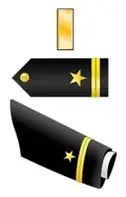
In the United States Navy, an O-1 is an Ensign. His or her insignia is a one-gold bar collar device, or a one-half-inch gold stripe outboard of a one-half-inch gold five-pointed star on black shoulder boards, or a one-half-inch gold stripe below a one-half-inch gold five-pointed star on service dress blue uniform sleeves.
Lieutenant Junior Grade–O-2 (LTJG)
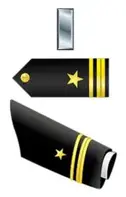
In the United States Navy, an O-2 is a Lieutenant Junior Grade. His or her insignia comprises a single silver bar collar device, or a 1/2-inch gold stripe outboard of a 1/4-inch gold stripe outboard of a gold five-pointed star on black shoulder boards, or a 1/2-inch gold stripe below a 1/4-inch gold stripe below a gold five-pointed star on service dress blue uniform sleeves.
Lieutenant—O-3 (LT)
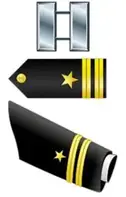
A Lieutenant in the United States Navy is an O-3. His or her insignia comprises two silver bar collar devices, or two 1/2-inch gold stripes outboard of one gold five-pointed star on black shoulder boards, or two 1/2-inch gold stripes below one gold five-pointed star on service dress blue uniform sleeves.
Lieutenant Commander—O-4 (LCDR)
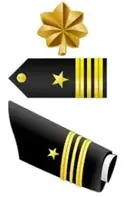
A Lieutenant Commander in the United States Navy is an O-4. His or her insignia is a one-gold oak leaf collar device, or a one-half-inch gold stripe outboard of a one-quarter-inch gold stripe outboard of a one-half-inch gold stripe outboard of a one-half-inch gold stripe outboard of a one-half-inch gold stripe outboard of a one-half-inch gold stripe outboard of a one-half-inch gold stripe outboard of one-half.
Commander—O-5 (CDR)
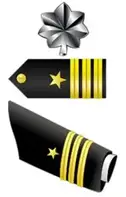
A Commander in the United States Navy is an O-5. His or her insignia comprises a single silver oak leaf collar device, three 1/2-inch gold stripes outboard of a single gold five-pointed star on black shoulder boards, or three 1/2-inch gold stripes below a single gold five-pointed star on service dress blue uniform sleeves.
Captain—O-6 (CAPT)
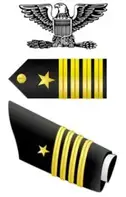
A Captain in the United States Navy is an O-6. His or her insignia comprises a single silver eagle collar device, four 1/2-inch gold stripes outboard of a single gold five-pointed star on black shoulder boards, or four 1/2-inch gold stripes below a single gold five-pointed star on service dress blue uniform sleeves.
Rear Admiral (Lower Half)—O-7 (RDML)
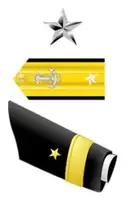
A Rear Admiral in the United States Navy is an O-7 (Lower Half). His or her insignia comprises a single silver five-pointed star collar device, or a single silver five-pointed star outboard of a single silver fouled anchor on gold shoulder boards, or a single two-inch gold stripe under a single gold five-pointed star on service dress blue uniform sleeves.
Rear Admiral (Upper Half)—O-8 (RADM)
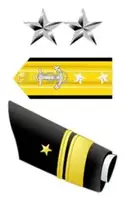
A Rear Admiral in the United States Navy is an O-8 (Upper Half). His or her insignia comprises a two-silver five-pointed star collar device, or two silver five-pointed stars outboard of one silver fouled anchor on gold shoulder boards, or one two-inch gold stripe beneath one 1/2-inch gold stripe beneath one gold five-pointed star on service dress blue uniform sleeves.
Vice Admiral—O-9 (VADM)
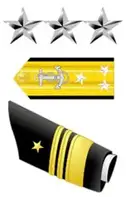
A Vice Admiral in the United States Navy is an O-9. His or her insignia is a collar device with three silver five-pointed stars, or three silver five-pointed stars outboard of one silver fouled anchor on gold shoulder boards, or one two-inch gold stripe below two 1/2-inch gold stripes below one gold five-pointed star on service dress blue uniform sleeves.
Admiral—O-10 (ADM)
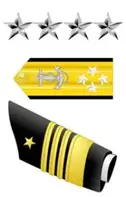
An Admiral in the United States Navy is an O-10. His or her collar device is a four silver five-pointed star, or four silver five-pointed stars outboard of one silver fouled anchor on gold shoulder boards, or one two-inch gold stripe below three 1/2-inch gold stripes below one gold five-pointed star on service dress blue uniform sleeves.
Fleet Admiral—O-11 (FADM)

A Fleet Admiral in the United States Navy is an O-11. His or her insignia comprises a collar device with five silver five-pointed stars, or five silver five-pointed stars outboard of one silver fouled anchor on gold shoulder boards, or one two-inch gold stripe below four 1/2-inch gold stripes below one gold five-pointed star on service dress blue uniform sleeves.
Navy Warrant Officer Ranks
Warrant Officer 1—W-1 (WO1)

A Warrant Officer1 is a W-1 in the United States Navy (WO1). His or her insignia comprises a single bar collar device with a blue backdrop and one gold break, or a gold 1/4-inch stripe with three blue breaks on a black shoulder board or a service dress blue uniform sleeve.
Chief Warrant Officer 2—W-2 (CWO2)
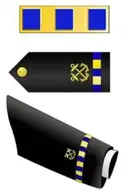
A W-2 is a Chief Warrant Officer 2 in the United States Navy (CWO2). His or her insignia comprises a single bar collar device with a blue backdrop and two gold breaks, or a gold 1/2-inch stripe with three blue breaks on a black shoulder board or a service dress blue uniform sleeve.
Chief Warrant Officer 3—W-3 (CWO3)
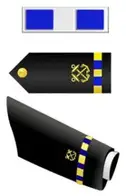
A CWO3 is a W-3 in the United States Navy. His or her insignia comprises a single bar collar device with a blue backdrop and one silver break, or a gold 1/2-inch stripe with two blue breaks on a black shoulder board or a service dress blue uniform sleeve.
Chief Warrant Officer 4—W-4 (CWO4)
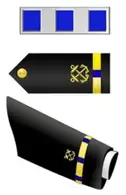
A CWO4 is a W-4 in the United States Navy. His or her insignia is a single bar collar device with a blue backdrop and two silver breaks, or a gold 1/2-inch stripe on a black shoulder board or the service dress blue uniform sleeve.
Chief Warrant Officer 5—W-5 (CWO5)
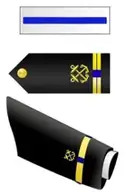
A CWO5 is a W-5 in the United States Navy. His or her insignia is a single bar collar device with a silver background and a horizontal blue line on a black shoulder board or the service dress blue uniform sleeve, or a gold 1/2-inch stripe with a horizontal line and a blue break on a black shoulder board or the service dress blue uniform sleeve.
Navy Enlisted Ranks
Seaman Recruit—E-1
A Seaman Recruit is an E-1 in the United States Navy. He or she wears no insignia.
Seaman Apprentice—E-2
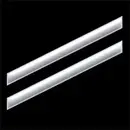
A Seaman Apprentice is an E-2 in the United States Navy. His or her insignia comprises two parallel diagonal slashes.
Seaman—E-3
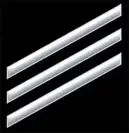
A Seaman is an E-3 in the United States Navy. His or her insignia comprises three parallel diagonal slashes.
Petty Officer Third Class—E-4
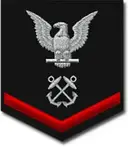
In the United States Navy, an E-4 is a Petty Officer Third Class. His or her insignia comprises one chevron under one eagle.
Petty Officer Second Class—E-5
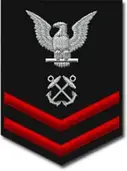
A Petty Officer Second Class in the United States Navy is an E-5. His or her insignia comprises two chevrons under one eagle.
Petty Officer First Class—E-6
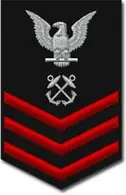
A Petty Officer First Class in the United States Navy is an E-6. His or her insignia comprises three chevrons under one eagle.
Chief Petty Officer—E-7
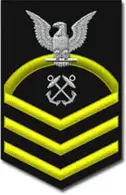
A Chief Petty Officer in the United States Navy is an E-7. His or her insignia comprises three chevrons under one rocker beneath one eagle. The insignia will be a gold fouled anchor collar device with a silver USN overlaid across the anchor in khaki clothing.
Senior Chief Petty Officer—E-8
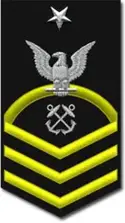
A Senior Chief Petty Officer in the United States Navy is an E-8. His or her insignia comprises three chevrons under one rocker beneath one eagle, beneath one star centered above the eagle. The insignia will be a gold fouled anchor collar device with a silver USN placed over the anchor below one silver star in khaki clothing.
Master Chief Petty Officer—E-9
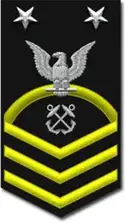
In the United States Navy, an E-9 is a Master Chief Petty Officer. His or her insignia comprises three chevrons under one rocker beneath one eagle, beneath two stars centered above the eagle. The insignia will be a gold fouled anchor collar device with a silver USN placed over the anchor below two silver stars in khaki clothing.
Master Chief Petty Officer of the Navy—E-9
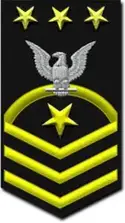
The Master Chief Petty Officer of the Navy is an E-9. His or her insignia comprises three chevrons under one rocker beneath one eagle beneath three stars centered above the eagle. The insignia will be a gold fouled anchor collar device with a silver USN placed over the anchor below three silver stars in khaki clothing.
Navy Officer Warfare Devices
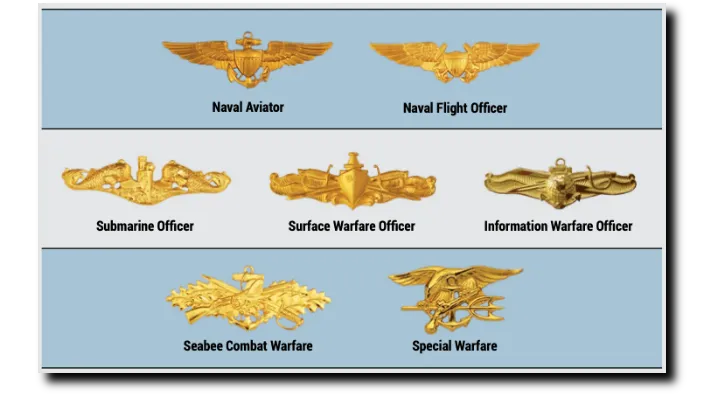
Image by the U.S. Navy
Navy Line and Staff Corps Devices
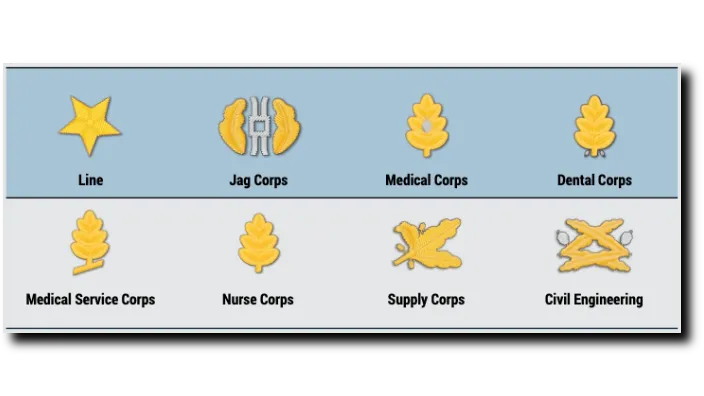
Image by the U.S. Navy
Marine Corps Officer Ranks
Second Lieutenant—O-1 (2ndLt)

A Second Lieutenant in the United States Marine Corps is a 0-1. His/her insignia comprises a single gold bar collar device.
First Lieutenant—O-2 (1stLt)

A First Lieutenant in the United States Marine Corps is a 0-2. His/her insignia is a collar device with one silver bar.
Captain—O-3 (Capt)

A Captain in the United States Marine Corps is a 0-3. His/her insignia is a collar device with two silver bars.
Major—O-4 (Maj)

A Major in the United States Marine Corps is an 0-4. His/her collar device is a single gold oak leaf.
Lieutenant Colonel—O-5 (LtCol)

A Lieutenant Colonel in the United States Marine Corps is a 0-5. His/her insignia is a collar device with one silver oak leaf.
Colonel—O-6 (Col)

A Colonel in the United States Marine Corps is a 0-6. His/her insignia is a collar device with one silver eagle.
Brigadier General—O-7 (BGen)

A Brigadier General in the United States Marine Corps is a 0-7. His/her collar device is a single silver star.
Major General—O-8 (MajGen)

A Major General in the United States Marine Corps is an 0-8. His/her insignia is a collar device with two silver stars.
Lieutenant General—O-9 (LtGen)

A Lieutenant General in the United States Marine Corps is a 0-9. His/her insignia is a collar device with three silver stars.
General—O-10 (Gen)

A General in the United States Marine Corps is a 0-10. His/her insignia is a collar device with four silver stars.
Marine Corps Warrant Officer Ranks
Warrant Officer 1—W-1 (WO1)

A WO is a W-1 in the United States Marine Corps. His/her insignia comprises a red bar with one gold break.
Chief Warrant Officer 2—W-2 (CWO2)

A CWO2 is a W-2 in the United States Marine Corps. His/her insignia is a red bar with two gold breaks.
Chief Warrant Officer 3—W-3 (CWO3)

A CWO3 is a W-3 in the United States Marine Corps. His/her insignia comprises a red bar with one silver break.
Chief Warrant Officer 4—W-4 (CWO4)

A CWO4 is a W-4 in the United States Marine Corps. His/her insignia comprises a red bar with two silver breaks.
Chief Warrant Officer 5—W-5 (CWO5)

A CWO5 is a W-5 in the United States Marine Corps. His/her insignia is a silver bar with a horizontal red line.
Marine Corps Enlisted Ranks
Private—E-1
A Private in the United States Marine Corps is an E-1. He or she wears no insignia.
Private First Class—E-2 (PFC)
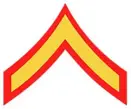
A Private First Class in the United States Marine Corps is an E-2. His/her insignia is a single chevron.
Lance Corporal—E-3 (LCpl)
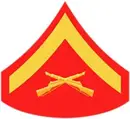
A Lance Corporal in the United States Marine Corps is an E-3 His/her insignia is a chevron with crossed rifles.
Corporal—E-4 (Cpl)
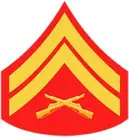
A Corporal in the United States Marine Corps is an E-4. His/her insignia comprises two chevrons crossed by rifles.
Sergeant—E-5 (Sgt)
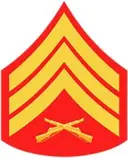
A Sergeant in the United States Marine Corps is an E-5. His/her insignia comprises three chevrons crossed by weapons.
Staff Sergeant—E-6 (SSgt)
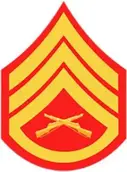
A Staff Sergeant in the United States Marine Corps is an E-6. His/her insignia comprises three chevrons above crossed weapons on one rocker.
Gunnery Sergeant—E-7 (GySgt)
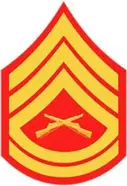
A Gunnery Sergeant in the United States Marine Corps is an E-7. His/her insignia comprises three chevrons crossed by two rockers.
Master Sergeant—E-8 (MSgt)
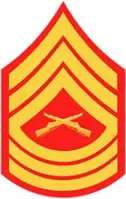
A Master Sergeant in the United States Marine Corps is an E-8. Three chevrons over crossed rifles over three rockers is his/her insignia.
First Sergeant—E-8 (1stSgt)
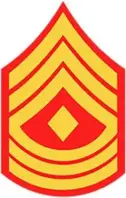
A First Sergeant in the United States Marine Corps is an E-8. Three chevrons above one diamond over three rockers is his/her insignia.
Sergeant Major—E-9 (SgtMaj)
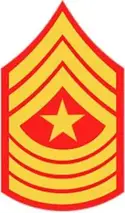
A Sergeant Major in the United States Marine Corps is an E-9. Three chevrons above one star over four rockers is his/her insignia.
Master Gunnery Sergeant—E-9 (MGySgt)
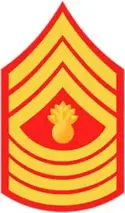
A Master Gunnery Sergeant in the United States Marine Corps is an E-9. His/her insignia comprises three chevrons on top of an exploding bomb on top of four rockers.
Sergeant Major of the Marine Corps—E-9 (SgtMajMC)
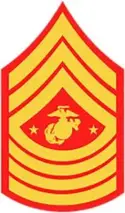
The Sergeant Major of the United States Marine Corps is an E-9. His/her insignia comprises three chevrons above the Marine Corps logo, which are centered between two five-pointed stars on four rockers.
Military Phonetic Alphabet and Signal Meaning
| Letter | Name | Phonetic Pronunciation | Navy Meaning |
|---|---|---|---|
| A | Alfa | AL-fah | I have a diver down; keep well clear at slow speed. |
| B | Bravo | BRAH-voh | I am taking in, discharging, or carrying dangerous cargo. |
| C | Charlie | CHAR-lee | “Yes” or “affirmative”. |
| D | Delta | DELL-tah | I am maneuvering with difficulty; keep clear. |
| E | Echo | ECK-oh | I am directing my course to starboard. |
| F | Foxtrot | FOKS-trot | I am disabled; communicate with me. (On carriers: Flight ops underway) |
| G | Golf | GOLF | I require a pilot. |
| H | Hotel | hoh-TELL | I have a pilot on board. |
| I | India | IN-dee-ah | Coming alongside. |
| J | Juliet | JEW-lee-ett | I am on fire and have dangerous cargo; keep clear. |
| K | Kilo | KEY-loh | I wish to communicate with you. |
| L | Lima | LEE-mah | You should stop your vessel immediately. |
| M | Mike | MIKE | My vessel is stopped; making no way. |
| N | November | no-VEM-bur | No or negative. |
| O | Oscar | OSS-kur | Man overboard. |
| P | Papa | pah-PAH | All personnel return to ship; proceeding to sea (inport). |
| Q | Quebec | kay-BECK | Boat recall; all boats return to ship. |
| R | Romeo | ROH-me-oh | Preparing to replenish (at sea); ready duty ship (inport). |
| S | Sierra | see-AIR-ah | Conducting flag hoist drill. |
| T | Tango | TANG-go | Do not pass ahead of me; keep clear. |
| U | Uniform | YOU-nee-form | You are running into danger. |
| V | Victor | VIK-tah | I require assistance. |
| W | Whiskey | WISS-kee | I require medical assistance. |
| X | Xray | ECKS-ray | Stop carrying out your intentions and watch for my signals. |
| Y | Yankee | YANG-kee | Ship has visual communications duty. |
| Z | Zulu | ZOO-loo | I require a tug. |
Military Time
The Navy runs on a 24-hour day. Ships often use a clock with a 24-hour dial.
Hours are numbered 1 through 24. After noon, the count continues to 13.
Times like 8 a.m. and 7 p.m. are written as 0800 (zero eight hundred) and 1900 (nineteen hundred).
NEVER USE THE TERM “nineteen hundred hours.”
In the Navy, hours and minutes are written together. 10:45 a.m. becomes 1045 (ten forty-five). 9:30 p.m. becomes 2130 (twenty-one thirty).
To help you understand Navy time, use a 24-hour dial. Learn more in our Ultimate Guide to Military Time.
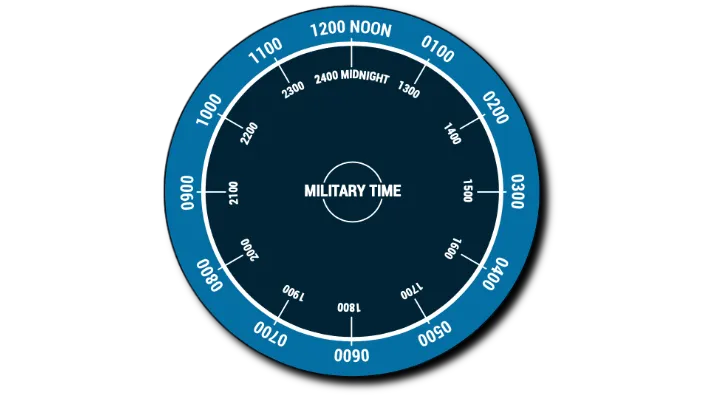
Image by the U.S. Navy
Navy Terminology
The Navy, like every other profession, has its own language. Learning the following Navy words now can help you when you start recruit training.
- ADRIFT: Loose from moorings and out of control (applied to anything lost, out of hand, or left lying about)
- AFT-END: Near or toward the stern of the vessel
- ALL HANDS: The entire ship’s company, both Officer and Enlisted
- ALLOTMENT: An amount of money a member has coming out of his regular pay
- AYE-AYE: Reply to an order or command meaning, “I understand and will comply. “
- BARRACKS: Building where Sailors live BELOW: Downstairs
- BRIGHTWORK: Brass or shiny metal kept polished rather than painted
- BULKHEAD: (wall) a partition or barrier that separates compartments in a ship
- BUNK OR RACK: Bed
- BUOY: An anchored float used as an aid to navigation or to mark the location of an object
- CARRY ON: An order to resume work or duties
- CAST OFF: To throw off; to let go; to unfurl
- CHAIN LOCKER: Compartment in which anchor chain is stowed
- CHIT, CHIT BOOK: Coupon or receipt book
- CHOW HALL (MESS DECK): Place to eat
- COLORS: Raising or lowering of a national flag, ceremonies held at 0800 and sunset for hoisting and hauling down the National Ensign
- DECK: (floor) a platform of horizontal planks or plates spanning across a ship or boat at any of its many levels
- DEEP SIX: To dispose of by throwing over the side
- ENSIGN: National flag; Commissioned Officer between the rank of Chief Warrant Officer and Lieutenant Junior Grade
- FAST: Snugly secured
- FATHOM: A unit of length (equal to 6 feet) used for measuring the depth of water
- FLAG OFFICER: Any Commissioned Officer in pay grade O-7 or above
- GALLEY: Kitchen
- GANGWAY: An opening in a bulwark or lifeline that provides access to a brow or accommodation ladder; an order meaning to clear the way
- GEAR LOCKER: Storage room
- GEEDUNK: Candy, gum, or cafeteria
- GENERAL QUARTERS: Battle stations
- HEAD: Bathroom or toilet
- LIBERTY: Permission to leave the base (usually for not over 48 hours)
- LIFELINE: Lines erected around the weather decks of a ship to prevent personnel from falling or being washed over the side
- OVERHEAD: Ceiling
- PASSAGEWAY or P-WAY: Hallway
- QUARTERS: Assembling of all hands for muster, instruction, and inspection
- RATING: A job specialty title
- REVEILLE: Wake up, start a new day
- SCULLERY: Place to wash dishes
- SCUTTLEBUTT: Drinking fountain; a rumor
- SECURE: Lock, put away or stop work
- SICKBAY: Hospital or Medical clinic
- SWAB: Mop
- TAPS: Time to sleep, end of day
- TATTOO: Five minutes before taps
- TOPSIDE: Upstairs
- TURN TO: Begin work
- WORKING ALOFT: Working above the highest deck; performing maintenance on the ship’s mast
The Articles of the Code of Conduct
- I am an American, fighting in the forces which guard my country and our way of life. I am prepared to give my life in their defense.
- I will never surrender of my own free will. If in command, I will never surrender the members of my command while they still have the means to resist.
- If I am captured, I will continue to resist by all means available. I will make every effort to escape and aid others to escape. I will accept neither parole nor special favors from the enemy.
- If I become a prisoner of war (POW), I will keep faith with my fellow prisoners. I will give no information nor take part in any action which might be harmful to my comrades. If I am senior, I will take command. If not, I will obey the lawful orders of those appointed over me and will back them up in every way.
- When questioned, should I become a prisoner of war, I am required to give my name, rank, service number and date of birth. I will evade answering further questions to the utmost of my ability. I will make no oral or written statements disloyal to my country and its allies or harmful to their cause.
- I will never forget that I am an American, fighting for freedom, responsible for my actions, and dedicated to the principles which made my country free. I will trust in my God and in the United States of America.
Strictly Prohibited Activities
While in training at Navy OCS, candidates are strictly prohibited from engaging in the following activities:
- Motorcycle riding/driving
- Using tobacco, on or off duty
- Application of new tattoos
- Fraternization
- Socializing between candidates and staff
- Dating between candidates
- Private meetings behind closed doors between candidates of the opposite sex
- Public displays of affection or sexual contact between candidates
- Consumption or storage of alcohol in command spaces
- Gambling
- Hazing
- Driving/riding in motor vehicles without the permission of the Class Officer
- Participation in hazardous activities (skydiving, bungee jumping, etc.)
Note: Candidates will be briefed on all prohibited activities during Indoctrination Week.
Navy Leadership Traits
- Judgment
- Justice
- Decisiveness
- Initiative
- Dedication
- Tact
- Integrity
- Endurance
- Bearing
- Unselfishness
- Courage
- Knowledge
- Loyalty
- Enthusiasm
- Honor
Remember them with the help of this mnemonic: JJ did tie buckle H
“A Navy Officer candidate does not lie, cheat, or steal, nor tolerate those who do.”
Anchors Aweigh (Lyrics)
Stand, Navy out to sea Fight our-battle cry We’ll never change our course So vicious foe steer shy-y-y-y Roll out the TNT Anchors Aweigh Sail on to victory, and Sink their bones to Davy Jones, hooray! Anchors Aweigh, my boys Anchors Aweigh Farewell to foreign shores We sail at break of day-ay-ay-ay Through our last night ashore, Drink to the foam Until we meet once more. Here’s wishing you a happy voyage home! Blue of the mighty deep Gold of God’s great sun Let these our colors be Till all time be done, done, done, done. On seven seas, we learn Navy’s stern call Faith, courage, service true With honor, over honor, over all.
The Marines’ Hymn (Lyrics)
From the Halls of Montezuma, To the Shores of Tripoli; We fight our country’s battles In the air, on land, and sea; First to fight for right and freedom And to keep our honor clean; We are proud to claim the title Of United States Marine. Our flag’s unfurled to every breeze, From dawn to setting sun; We have fought in every clime and place Where we could take a gun. In the snow of far-off northern lands And in sunny tropic scenes, You will find us always on the job — The United States Marines. Here’s health to you and to our Corps Which we are proud to serve; In many a strife we’ve fought for life And never lost our nerve. If the Army and the Navy Ever look on Heaven’s scenes, They will find the streets are guarded By United States Marines.
The Sailor’s Creed
I am a United States Sailor. I will support and defend the Constitution of the United States of America and I will obey the orders of those appointed over me. I represent the fighting spirit of the Navy and those who have gone before me to defend freedom and democracy around the world. I proudly serve my country’s Navy combat team with Honor, Courage, and Commitment. I am committed to excellence and the fair treatment of all.
Naval Warfare Principles
Levels of War
The strategic level is concerned with achieving national objectives. The operational level is concerned with the forces in the theater. The tactical level is concerned with the specifics of particular encounters.
Maritime War
Using decisive offensive force to gain control of the sea is the first step in establishing our hegemony in any territory.
Littoral Warfare
Littoral warfare refers to fighting on land near to the seas that is under the control of and susceptible to the striking power of sea-based forces.
Naval Tactical Mission
- Strike Warfare – Any combination of naval forces aimed at damaging or destroying the target objective.
- Amphibious Warfare – Landing a military force on a hostile coast.
- Electronic Warfare (EW) – Prevent the opponent from using the electromagnetic spectrum effectively.
- Air Warfare (AW) – The activities necessary to neutralize or decrease the enemy’s air and missile threat to a manageable level.
- Undersea Warfare (USW) – Actions made to prevent the adversary from effectively using his submarines and the undersea environment.
- Surface Warfare (SW) – Prevent the opponent from using his surface warships and merchant capacity effectively.
Personnel Qualification Standards
The Commissioning Onboarding Program Personnel Qualification Standards (COP PQS) helps candidates build a solid base. It ensures each person learns and keeps key Navy knowledge and skills. The goal is a smooth shift from civilian life into entry-level Navy officer training.
COP PQS has two phases:
- Training Phase: You study basic facts about the United States Navy.
- Sign-Off Phase: You show what you learned, either orally, physically, or both.
Training Phase
Each module ends with a list of reference materials for that topic. Your recruiter provides materials as needed so you can learn the required facts. You must meet with your recruiter or an authorized COP manager at least twice a month. Your recruiter explains the process in more detail during those meetings.
Sign-Off Phase
When you have a solid understanding of a full module, you notify your recruiter. After your recruiter verifies your knowledge, they sign off your completion for that module. Completing COP PQS is the first step in Navy training and your first professional certification.
Navy OCS Physical Fitness Standards
The Navy values a healthy body and a strong mind. Navy OCS physical training builds stamina and endurance. It also improves overall fitness for demanding standards.
Most of this training uses calisthenics and cardio conditioning. Cardio work includes track running and road running. Physical training starts soon after you arrive.
During your first week at OCS, you take a physical fitness assessment (PFA). The PFA includes push-ups in two minutes. It also includes a forearm plank, with time based on age. You also complete a 1.5-mile run.
Arrive in the best shape you can. Better fitness lowers the risk of injury. Planning ahead helps.
Navy Physical Readiness Test (PRT) Standards
Failing any requirement results in an unsatisfactory PRT score. A failed PRT may lead to removal from the program. It may also add remedial training to your daily schedule.
Male and Female: Age 20—24 Years Male and Female: Age 25—29 Years
U.S. Navy Height and Weight Standards
Keeping a sharp military look gets harder at an unhealthy weight. The Navy uses body-fat percentage to confirm personnel stay within healthy limits.
To become a Naval Officer, you must meet the Navy’s body-fat standards.
The Navy also uses height and weight limits as a screening tool. These numbers help decide when a body-fat check is required. The height and weight requirements are listed below.
Physical conditioning is required while you are enrolled in any college program. Your Navy Recruiting District will monitor and enforce it.
To reach the fitness level needed for Navy OCS, start the conditioning plan in this guide early. Build consistency before you arrive. Always include a warm-up and a cool-down in your routine.
Physical Fitness Concepts
Total Body Fitness
Physical fitness refers to an individual’s ability to do both aerobic and strength-related tasks effectively and to keep such capability throughout life.
A physically fit individual possesses cardiovascular endurance, anaerobic capability, muscular strength and endurance, and muscular strength and endurance.
Balanced Training
A well-rounded physical fitness program comprises four key training components: aerobic (cardiovascular), muscular strength and endurance, flexibility, and warm-up/cool-down.
Cardiovascular Conditioning
Building an aerobic basis is the first stage in any training program.
This needs two to four sessions per week of continuous aerobic exercise (e.g., running, brisk walking) at a moderate intensity for 15 to 30 minutes.
Officer Candidates should aim for a heart rate of 130 to 150 beats per minute during exercise, or a perceived effort of “moderately hard.”
Faster is not always better. Running a 12-minute mile or a six-minute mile gives almost the same aerobic and caloric benefit if your heart rate is within the ideal range.
A healthy young adult should create an aerobic basis over four to six weeks.
Muscle Conditioning
Muscle conditioning comprises both strength and endurance exercise. It should be done on non-consecutive days two to three times a week for specific muscle groups.
Calisthenics are bodyweight workouts that provide resistance. They may build muscular strength and endurance.
Flexibility Training
Joint range of motion is referred to as flexibility. The goal of flexibility training is to create a permanent stretch in the muscles and connective tissues so that the joints may move freely.
Physical Fitness Routine
Stretching
Stretching exercises should ideally be performed BEFORE and AFTER any rigorous physical training. Perform workouts in this order.
- Warm-up
- Stretch
- Exercise
- Cool-Down
- Stretch
Because muscles are most flexible when warm, do a 10 to 15 minute warm-up before stretching. A brisk walk, light jog, or mild calisthenics helps reduce the risk of tissue tears.
Keep stretches specific to the workout. If the session is mostly jogging, focus on lower-body muscles.
Use slow, static stretches with no bouncing. Hold each stretch for 10 to 20 seconds. Stretch to a point of tightness, not pain. Use good body mechanics for safety and results.
A good target is three to five times per week.
Warm-up and Cool-down
The warm-up should:
- Last at least 10 minutes
- Use major muscle groups
- Work your way up to the desired activity (e.g., brisk walking to warm-up running)
The cool-down should:
- Last at least 10 minutes
- Use the same major muscle groups as the previous exercise session (e.g., brisk walking to cool down after jogging)
- Finish with stretching activities that target all major muscle groups
A physical training program should contain the following components:
- Two sessions per week of non-consecutive aerobic training
- Two sessions per week of non-consecutive muscular strength and endurance training
- Warm-up and cool-down (including a complete body flexibility routine) before and after each exercise session
Aerobic Conditioning
Warm-Up Exercises (10 to 15 minutes)
- Jumping jacks
- Arm circles
- Brisk walk
- Knee lifts
Aerobic Conditioning Program (15 to 25 minutes)
- Run 1 to 1.5 miles
Cool-down and Flexibility Training (10 to 15 minutes)
The cool-down should use the same muscle groups as the workout. Use a similar activity with steadily lower intensity for 10 to 15 minutes. A good example is brisk walking after running.
End the cool-down with full-body stretching after your heart rate is close to resting. Spend 5 to 10 minutes on stretching.
Stretch Exercises
All stretches should be static, with no bouncing. Hold each stretch for 10 to 20 seconds.
- Chest stretch: Stand tall. Gently clasp both hands and place them behind your neck. Slowly pull your elbows back until you feel a stretch in your chest. Do not strain your neck or pull your head forward. Caution: A partner may help, but they must not force the stretch by pulling your elbows back.
- Posterior shoulder stretch: Bring your right arm across your body. Use your left hand to hold the back side of your right arm above the elbow. You should feel a stretch in the back of the shoulder and upper arm. Repeat on the other side.
- Triceps stretch: Reach behind your back with your left arm. Use your right hand to gently push on the back side of your left arm. You should feel a stretch in the left triceps. Repeat on the other side.
- Outer hip and low back stretch: Sit with legs straight in front of you. Cross your right foot over your left leg near the left knee. Place your left elbow on the outside of your right knee. Gently press your knee toward the left side of your body. You should feel a stretch in the outer right hip and in the low to mid-back. Repeat on the other side.
- Abdominal stretch: Lie on your stomach. Place your hands near your shoulders. Slowly push up until you feel a stretch in your abdominals. Do not lock your elbows. Do not force full back extension. If you feel low back pain, use the propped-on-elbows position instead.
- Low back stretch: Lie on your back. Pull one or both knees toward your chest. You should feel a stretch in the buttocks and low back.
- Piriformis stretch: Lie on your back with both knees bent at 90 degrees. Cross your right ankle over your left thigh. Place both hands behind your left thigh. Gently pull the left leg toward your chest until you feel mild tightness in the right buttock and outer thigh. Repeat on the other side. Seek medical attention if you have low back discomfort after strenuous activity. This stretch builds flexibility and may help relieve pain.
- Hip flexors stretch: Stand in a lunge stance. Place your right foot about 3 to 4 feet in front of your left. Slowly bend both knees until your body is close to parallel with the ground. Keep your left knee near 90 degrees. Gently push your left hip forward until you feel a stretch in the front of the hip. If you do not feel it, gently lean your upper body back. Repeat on the other side.
- Quadriceps stretch: Stand and keep your balance. Slightly bend your left knee. Grip your right ankle with your right hand. Gently pull your right foot toward your buttocks. Keep your knees aligned, with the right knee directly under the hip. You may also stretch your trapezius by turning your chin toward the opposite side of your chest. Repeat on the other side.
- Modified hurdlers stretch: Sit in a V-position. Pull your left foot toward your groin. Keep your right leg straight with a slight bend in the knee. Lean forward and reach toward your right ankle to stretch the hamstring. Pulling your toes back makes the stretch harder than pointing them. Repeat on the other side.
- Groin stretch (butterfly): Sit upright. Bend both knees and bring the soles of your feet together. Bring your feet closer to your body. Hold your feet with your hands. Place your elbows on your knees. Lean forward slightly as your elbows press down gently. You should feel a stretch in the groin.
- Calf stretch: Start in a push-up position. Cross your left foot over your right. Keep the right knee straight. Gently press the right heel toward the surface. You should feel a stretch in the right calf. Hold for 15 seconds. Repeat on the other side. Keep your body in a straight line from shoulders to ankle to help protect your low back and support core control.
Muscle Strength and Endurance Conditioning
Warm-Up Exercises (10 to 15 minutes) Use a simple warm-up to raise your heart rate and loosen joints.
- Jumping jacks
- Arm circles
- Brisk walk
- Knee lifts
Muscle Strength and Conditioning Routine (20 to 40 minutes) Complete the exercises in the order listed. Group A targets the body’s major muscle groups. Group B can be added for variety and a stronger training effect.
Group A
- Push-ups (chest and shoulders)
- Squats (hamstrings, quadriceps, gluteal)
- Toe raises (shin muscles)
- Heel raises (calf muscles)
- Narrow grip push-ups (chest, triceps)
- Front lying chest lifts (backs)
- Trunk curls (abdominal)
Group B
- Lunges (hamstrings, quadriceps, gluteal)
- Outer thigh lifts (hip abductors)
- Inner thigh lifts (hip abductors)
- Front lying leg lifts (gluteal)
- Twisting trunk curls (abdominal, oblique)
- Hip rollers (abdominal)
From week one to week eight, increase sets and repetitions over time. Week one uses two sets of 20 to 30 reps for each exercise. Week eight uses two to three sets of 30 to 50 reps for each exercise.
At the end of each set, you should feel brief muscle tiredness. Rest about two minutes between sets.
Cool-down and Flexibility Training (10 to 15 minutes) Use the same cool-down and stretching approach listed in aerobic conditioning.
Low Intensity Training
Warm-Up Exercises (10 to 15 minutes) Use a short warm-up to raise your heart rate and loosen joints.
- Jumping jacks
- Arm circles
- Brisk walk
- Knee lifts
Aerobic Conditioning Program (20 to 40 minutes)
- Run 1 to 1.5 miles
Navy PRT Exercises
Candidates will be tested on the exercises below during the PRT. Practice these before arriving at Navy OCS.
Forearm Plank
The forearm plank builds core strength.
Start by lying face down on the deck. Bend your elbows. Place your forearms flat on the deck. Keep your body in one straight line through your head, shoulders, back, buttocks, and legs.
Keep these standards during the test:
- Place elbows directly under the shoulders. Keep a 90-degree bend.
- Keep forearms flat. Do not lift hands or forearms.
- Keep feet about hip width apart.
- Raise hips off the deck. Only forearms, wrists, and toes touch.
- Keep knees straight, pelvis neutral, and back flat.
- Keep the body straight from head to heels at all times.
- Keep head and neck neutral. Look straight down at the deck.
- Keep toes and forearms in contact with the deck throughout.
- Do not clasp hands at any time.
- Do not let any body part touch a vertical support surface.
Push-Ups
Push-ups show upper-body strength in the chest, shoulders, and triceps. Use proper form to reduce injury risk and support core strength.
Start in the relaxed position. Move into a front leaning rest. Place hands shoulder width apart. Keep feet together.
Use these standards during the exercise:
- Keep arms, back, buttocks, and legs straight from head to heels.
- Lower by bending elbows until upper arms are parallel to the deck.
- At the bottom, elbows reach about a 90-degree bend.
- Keep the body aligned while lowering and rising.
- Return by extending elbows until arms are almost straight.
- Keep elbows loose at the top.
More Information
If you have questions that are not answered by this guide, contact your Navy Officer recruiter. They will be able to provide you with detailed information regarding Navy OCS.
You may also visit the Officer Training Command website to learn more about Officer Candidate School. Hope you find this comprehensive guide helpful in your pursuit of becoming a commissioned Naval Officer.