Navy Master-at-Arms (MA): Definitive Guide
When you purchase through links on our site, we may receive compensation at no extra cost to you.
A Navy Master-at-Arms (MA) is an enlisted security specialist. You protect people, aircraft, ships, and shore sites. You also enforce laws and Navy rules on Navy property. Many MAs work in a public-facing role, so your judgment matters as much as your fitness.
This job fits sailors who like responsibility, structure, and clear standards. It can also feel repetitive during long stretches of gate watches. The mix depends on your unit, your qualifications, and your duty station.

Job Role and Responsibilities
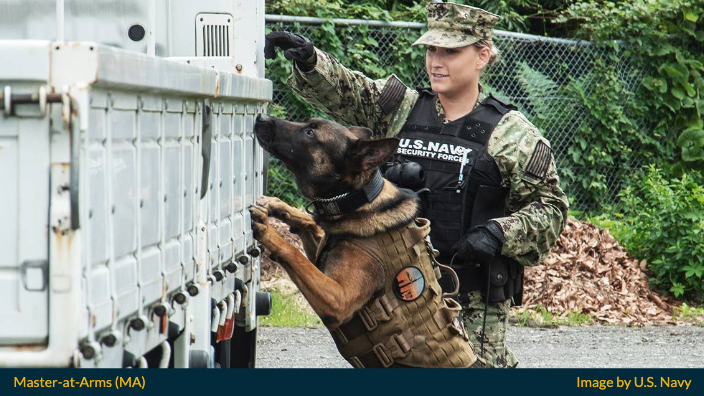
Master-at-Arms is the Navy’s law enforcement and security rating. The core mission is force protection and good order. On a normal day, you control access, patrol assigned areas, respond to incidents, and write reports that can be used later for command action. In some billets, you support investigations and security planning. In other billets, you work with military working dogs or protective services teams.
| Item | What it is for MA |
|---|---|
| Branch | U.S. Navy |
| Career type | Enlisted rating |
| Rating title | Master-at-Arms (MA) |
| Core mission | Force protection, physical security, and law enforcement |
| Typical clearance level | Secret eligibility is required for the rating |
Most MA work can be grouped into four lanes. Your billet decides which lane dominates.
Access control and patrol
- Run vehicle and pedestrian entry control points.
- Check IDs and authorizations.
- Patrol by foot or vehicle, depending on the base and zone.
- Watch cameras and alarms, then dispatch responders.
Incident response and enforcement
- Respond to fights, theft, domestic calls, or suspicious activity.
- Detain and control subjects when authorized.
- Coordinate with the command duty officer and other responders.
- Preserve scenes and collect basic facts for follow-on action.
Administrative and command support
- Write clear reports with times, names, and actions taken.
- Track citations, evidence custody, and duty logs.
- Support training records, watch bills, and inspection prep.
Specialized security operations
- Support antiterrorism and force protection programs.
- Conduct physical security checks and vulnerability reporting.
- Support protective services, investigations, or corrections tasks.
Common MA specializations and NEC identifiers
Not every MA holds a Navy Enlisted Classification (NEC). Many do later, after follow-on schools and screening. These NECs are tied to specific billets and paygrade ranges.
| NEC | Title | Typical focus | Paygrades listed |
|---|---|---|---|
| P01A | Security Training Analyst | Program analysis and security training support | E6–E9 |
| P02A | NCIS Operations Specialist | Investigative support duties tied to NCIS ops | E5–E9 |
| P03A | Security Training Development Specialist | Course and training development work | E7–E9 |
| P04A | Harbor Security Boat Training Supervisor | Waterborne security training leadership | E6–E9 |
| 853A | Level II Coxswain, Harbor Patrol Unit | Operate small craft for harbor patrol missions | Screening applies |
| P05A | Dog Handler | Military working dog handling and searches | E3–E6 |
| P06A | Kennel Master | Kennel operations and dog program management | E5–E9 |
| P08A | Afloat Corrections Specialist | Brig and detention duties afloat | E4–E9 |
| P09A | Protective Service Specialist | Protective services planning and execution | E5–E7 |
| P10A | Nuclear Weapons Security Specialist | Security for nuclear weapon-related missions | E1–E9 |
| P11A | Physical Security Specialist | Surveys, assessments, and physical security work | E4–E9 |
| P12A | Military Criminal Investigator | Criminal investigations and investigative support | E5–E9 |
| P13A | Law Enforcement Specialist | Advanced law enforcement duties in billets | E4–E6 |

Work Environment
MA work happens where the Navy needs security coverage. That usually means a base, a pier, a gate, or a high-value facility. Some billets are afloat or expeditionary. Your environment can shift fast. A quiet watch can turn into a medical response, a traffic stop, or a security alert with no warning.
Many MAs work in shifts. Nights, weekends, and holidays are normal in force protection units, because security coverage does not stop. The pace depends on the installation and local activity. A large fleet concentration area can mean constant traffic and frequent calls. A smaller site can mean long stretches of routine checks and patrol.
Your day is shaped by standards and checklists. Most commands run formal post orders. You follow them, then document what you did. That structure helps when decisions are challenged later. It also means small mistakes stand out, because your work is easy to audit.
MA teams work with many groups, often in the same day.
- Base operations and command duty sections
- Fire and emergency services
- Medical clinics or ambulance crews
- Tenant commands and watchstanders
- Federal partners and local law enforcement, when required
The social side of the job is real. You speak to civilians, families, contractors, and visiting units. Some people will be stressed or angry before you even arrive. You still need steady tone, clear commands, and professional restraint.
Equipment varies by site and billet. You may use radios, cameras, access control systems, and patrol vehicles. Some posts use barrier systems and electronic credential readers. Some roles require more gear, like protective equipment or dog handling equipment. Your command also controls weapon issuance and qualification schedules, which can change your routine.
Job satisfaction often depends on variety. A billet with patrol, training, and special evolutions can feel busy in a good way. A billet that is mostly gate coverage can feel repetitive. Many sailors manage that by chasing qualifications, instructor roles, or specialized NEC pipelines that broaden duties over time.
Training and Skill Development
Every MA starts with Navy Recruit Training. After boot camp, you move into job training under the Center for Security Forces training enterprise. CENSECFOR is the Navy organization that oversees training delivery for the MA rating.
Initial training pipeline
Training details can change as the Navy updates curriculum. Navy Recruiting lists MA “A” School in San Antonio, Texas, and describes it as about nine weeks. CENSECFOR has also described a longer Ready Relevant Learning pilot curriculum that ran about 4.2 months, so length can vary by class and program version.
| Stage | What you do | Where it happens |
|---|---|---|
| Recruit Training | Military basics, fitness, discipline, seamanship | Great Lakes, Illinois |
| MA “A” School | Law enforcement and security foundations | San Antonio, Texas area |
| Post-school qualification | Unit watchstanding and local procedures | First command |
In “A” School, expect a mix of classroom and hands-on practice. The goal is safe, repeatable performance. You learn to follow rules, apply force options correctly, and document actions clearly. You also build habits that matter later, like radio discipline, scene safety, and communication under stress.
Skills you build after “A” School
Most MA skill growth happens on the job. Commands train you on local post orders, local laws, and base-specific threats. A busy installation can build strong call handling and patrol judgment. A high-security billet can build inspection discipline and procedural accuracy.
Skill development often tracks three themes:
Tactical competence
- Safe weapon handling and qualification cycles
- Defensive tactics and control methods
- Response patterns for alarms and calls
Security professionalism
- Access control integrity and fraud awareness
- Patrol pattern planning and observation
- Vulnerability awareness and reporting
Leadership and instruction
- Training junior watchstanders
- Writing clear post orders and SOP updates
- Running drills and watch relief standards
Follow-on schools and NEC paths
NEC pipelines usually require screening, command recommendation, and school seats. For MAs, these NECs include areas like military working dogs, protective services, physical security, investigations, and specialized training roles.
If you want variety, plan early. Talk to your chain of command about qualifications and timing. Use your first tour to build a strong watchstanding record. That record often decides who gets advanced schools and high-trust assignments.

Physical Demands and Medical Evaluations
MA work is not constant high-intensity action, but it is physically demanding in stubborn ways. You stand for long periods. You walk or patrol in heat, rain, and cold. You may wear gear that adds weight and slows movement. Some billets involve running, climbing stairs, or controlling combative subjects. Many MAs also work nights, which can make recovery harder if you do not manage sleep well.
Navy fitness testing expectations in 2026
The Navy uses the Physical Readiness Test (PRT). The PRT includes push-ups, a forearm plank, and a cardio event such as the 1.5-mile run. Standards vary by age and sex, and they also differ by altitude category. Below are the minimum “Probationary” standards for the youngest bracket (17–19) at altitudes under 5000 feet, using the 1.5-mile run as the cardio example.
| Event | Male 17–19 minimum | Female 17–19 minimum |
|---|---|---|
| Push-ups | 42 reps | 19 reps |
| Forearm plank | 1:11 | 1:01 |
| 1.5-mile run | 12:45 | 15:00 |
Commands may set higher goals than the minimum category for competitiveness and readiness. Still, the minimum table is a useful baseline for planning your first year.
Body composition and routine screening
Along with the PRT, the Navy uses body composition standards. That usually means height and weight screening, then a tape measurement if needed. If you struggle here, it can limit schools, special assignments, and advancement momentum. Treat it like part of your job, not a side project.
MA-specific physical realities
Even when a watch looks calm, your body stays “on.” You need fast transitions from sitting to moving. You also need fine motor control, because tools, restraints, and weapons require safe handling. A steady heart rate helps, but so does grip strength and core endurance.
Medical evaluations are part of both entry and ongoing service. For MA, correctable vision and normal color perception matter, because you must read credentials and recognize warning indicators. The rating also requires standards tied to judgment and reliability, because many duties involve access, weapons, and sensitive areas.
If you want to succeed long-term, build a routine that matches shift work. Lift weights twice a week. Do short runs or intervals that mimic quick responses. Add mobility work for hips and ankles, because standing posts punish stiffness.
Deployment and Duty Stations
MA assignments are spread across the fleet, but the work is shore-heavy compared to many Navy ratings. The MA career path document describes the rating as about 70 percent shore billets. That shapes your life more than people expect. You may still deploy, but many sailors spend more time on bases than on ships.
Sea and shore rotation pattern
A common baseline listed for MA is 36 months shore, then 36 months sea, repeated through the career. The detailing model is also described as CONUS and OCONUS rotational. In this model, certain OCONUS assignments are treated like sea tours for rotation purposes.
That matters because “sea duty” for MA does not always mean a ship. It can also mean high-tempo, deployable security missions, or overseas billets with demanding schedules.
Where MAs serve
You can be assigned to many kinds of places.
- Large fleet bases with heavy gate traffic
- Naval air stations with flightline security needs
- Shipyards and piers with restricted areas
- Training commands and student control settings
- Forward locations overseas with force protection focus
- Units that support port and harbor security missions
Some MAs work on ships, especially larger platforms with robust security needs. Others are attached to expeditionary or specialized security units. Your NEC path can strongly influence this. A harbor security or protective services path can pull you toward specific hubs and mission sets.
What “deployment” looks like for MA
Deployment can mean a ship deployment, but it can also mean temporary duty in support of a security mission. The length is not one-size-fits-all. Expect workups or pre-deployment training in some units. Expect long shifts in many deployed security billets, because watch coverage drives manning needs.
If you want more travel, you can aim for overseas billets or deployable units. If you want more stability, many large shore installations offer predictable schedules once you learn the rhythm of the post rotation.
Career Progression and Advancement
MA is an enlisted rating with a clear ladder, but your day-to-day duties change a lot by paygrade. Early on, you prove reliability on post. Later, you lead watch teams, run programs, and manage risk for the command.
Enlisted rank structure in the MA rating
| Paygrade | Navy rank title | How MA work usually changes |
|---|---|---|
| E-1 to E-3 | Seaman Recruit to Seaman | Learn post orders, patrol basics, report writing |
| E-4 | Petty Officer Third Class | Become a solid responder, mentor junior posts |
| E-5 | Petty Officer Second Class | Lead watches, train teams, manage sections |
| E-6 | Petty Officer First Class | Run programs, supervise shifts, plan operations |
| E-7 to E-9 | Chief to Master Chief | Set standards, manage risk, advise command |
How you earn trust fast
In MA work, trust comes from repetition and accuracy. Leaders notice three things early.
- You show up early and squared away for watch.
- Your reports are clean, factual, and timely.
- You make safe decisions under pressure.
Those basics unlock better posts and better training.
Advancement realities
Navy advancement is competitive across the service. For MA, advancement can also shift with fleet demand, manning levels, and school seat availability. You improve odds by building a strong record in these areas:
- Sustained strong evaluations and watch performance
- Warfare and unit qualifications, when available
- Collateral duties that show reliability, like training or scheduling
- NEC pipelines that match critical billets, when you qualify
Career broadening through NECs
As you move up, your NEC choices can steer your entire career. A dog handler path (P05A) feels very different from a physical security specialist path (P11A). Protective services (P09A) and investigations (P12A) typically require tighter screening and stronger professional maturity, so they often show up later in a career.
Plan your path like a sequence, not a wish list. Use your first tour to build a strong base record. Use your second tour to broaden with an NEC or high-trust program. Use your mid-career tours to lead larger teams and own larger security programs.
Salary and Benefits
MA pay follows standard Navy enlisted pay. Your rating does not change base pay. Your paygrade, time in service, duty location, and assignment type drive most of the difference.
Base pay examples for 2026
Below are monthly base pay amounts from DFAS’s enlisted basic pay table effective January 1, 2026. Values increase with years of service.
| Paygrade | Over 2 years | Over 4 years | Over 6 years |
|---|---|---|---|
| E-1 | $2,407.20 | $2,407.20 | $2,407.20 |
| E-2 | $2,697.90 | $2,697.90 | $2,697.90 |
| E-3 | $3,015.00 | $3,198.00 | $3,198.00 |
| E-4 | $3,303.00 | $3,658.50 | $3,815.40 |
| E-5 | $3,598.20 | $3,946.80 | $4,110.00 |
| E-6 | $3,743.10 | $4,068.90 | $4,235.70 |
Base pay is only one piece. Many sailors see significant additional compensation through allowances and special pays tied to where and how they serve.
Common allowances and special pays MAs often encounter
Amounts and eligibility can change by policy and location. These DFAS items are common for sailors in operational units, ship assignments, overseas billets, or deployed conditions.
| Pay element | What it supports | What DFAS lists |
|---|---|---|
| Career Sea Pay | Extra pay for qualifying sea duty | Rates vary by paygrade and sea time |
| Family Separation Allowance (FSA) | When separated from dependents for qualifying duty | DFAS lists $250 per month |
| Hostile Fire Pay / Imminent Danger Pay | When assigned to qualifying areas | DFAS lists $225 per month |
| Hardship Duty Pay Location (HDP-L) | For designated hardship locations | DFAS lists location-based rates |
Other major benefits include health care, paid leave, and retirement pathways. The biggest money difference for many early-career sailors is housing. Housing entitlements depend on location, dependency status, and whether government quarters are used, so it is not a simple flat number.
If you want a realistic budget, build it around base pay first. Then add only the special pays you can reasonably expect for your likely assignment type.

Risk, Safety, and Legal Considerations
MA work carries real risk, even when most shifts are calm. The public sees you as authority. That means mistakes can have bigger consequences than in many jobs. Safety and legality are not side topics here. They are the job.
Common risk areas in MA duty
Use-of-force decisions
- You may have to control a person who refuses to comply.
- Force decisions must match training and command policy.
- Poor decisions can trigger investigations and career impact.
Weapons and equipment safety
- Some posts involve armed watchstanding.
- Safe handling, clearing, and storage are non-negotiable.
- Lapses can cause injury and severe discipline.
Traffic and patrol hazards
- Gate work puts you near moving vehicles every day.
- Patrol work adds risk from poor lighting and weather.
- Vehicle stops can escalate quickly if you lose awareness.
Legal and administrative exposure
- Your reports can support UCMJ action or civilian proceedings.
- Sloppy facts, missing times, or bias language can harm cases.
- Evidence handling errors can damage trust and outcomes.
How the Navy reduces those risks
Most commands reduce risk through repetition, supervision, and documentation. You get post orders, training refreshers, and qualification requirements. Leadership reviews incidents and trends. The best MA units talk openly about near-misses, because that is where learning lives.
You also carry ethical pressure. Friends may ask favors, like “just let me through.” Contractors may push boundaries. Your job is to say no with a calm voice and a firm standard.
Finally, MA eligibility is tied to reliability and conduct. The Navy lists disqualifying legal and conduct issues for the rating, including certain convictions and drug abuse history, because the work involves authority and sensitive duties.
Impact on Family and Personal Life
MA schedules can be tough on normal routines. Shift work can split weekends. Night watch can make you feel out of sync with friends and family. Even on shore duty, your schedule may rotate, because post coverage drives manning.
What families feel most with MA duty
Rotating shifts
- Sleep planning becomes a skill you must protect.
- Childcare can get complicated with alternating watch hours.
- Holidays may be workdays, depending on the rotation.
Public-facing stress
- A hard call can follow you home if you do not decompress well.
- High-visibility mistakes can bring command attention fast.
PCS moves
- Shore-heavy does not mean “no moves.”
- You can still rotate between regions and mission sets.
- Overseas billets can add distance and time zone strain.
Navy support systems that help
Navy families have structured support options. Fleet and Family Support Programs provide readiness services through many sites worldwide, and they support relocation, counseling, and other life needs.
The Navy also uses the Ombudsman program to support command communication and family readiness. Ombudsmen are command-appointed volunteers who help families get accurate information and referrals.
For families with special medical or educational needs, the Navy’s Exceptional Family Member Program (EFMP) is a mandatory enrollment program for sponsors with qualifying dependents. EFMP enrollment helps assignments align with available services.
Personal life tips that matter for MAs
Most MA burnout is not from one big incident. It is from poor recovery stacked over months. If you want longevity, protect three things:
- Sleep discipline on shift rotations
- A steady fitness routine that survives night watch
- A decompression habit that is not alcohol-based
This job can support a strong family life when you plan around the schedule. It can also strain families if you treat the schedule like something you “deal with later.” The earlier you build routines, the easier each move and rotation feels.
Post-Service Opportunities
MA experience translates well to civilian protective service work, but the fit depends on what you actually did. A sailor with patrol, report writing, and incident response experience often transitions differently than a sailor who spent most days on access control. Specialized NECs can also change your options, especially in investigations, protective services, and physical security planning.
Civilian roles that often align with MA experience
The table below uses Bureau of Labor Statistics data to show recent median pay figures and general outlook language for related occupations.
| Civilian path | Why MA experience helps | BLS median pay (May 2024) | Outlook signal |
|---|---|---|---|
| Security guard | Access control, patrol routines, incident response | $38,370 | Little or no change projected |
| Private detective / investigator | Interviews, documentation discipline, investigative support | $52,370 | Varies by sector |
For law enforcement and corrections, many states and agencies have their own entry pathways and testing standards. MA experience can help, but it is rarely a direct waiver of academy requirements. Your advantage is usually professionalism, report writing, and comfort with controlled stress.
Credentials and education that can strengthen transition
Credentials depend on where you want to land. Security management roles often value well-known private-sector certifications. Emergency management paths often value FEMA course history and practical planning experience. Investigations roles often value interviewing skill and clean documentation.
A practical approach is to pick one target lane before you separate:
- Law enforcement lane: focus on fitness, clean conduct record, interview skill.
- Corporate security lane: build security planning language, program management, and leadership.
- Investigations lane: sharpen report writing, evidence handling habits, and interview practice.
The Navy also supports professional credentialing programs through its credentialing enterprise, including Navy COOL, and describes tools that help map military experience to civilian credentials.
Qualifications and Eligibility
MA has clear entry standards because the work involves authority, weapons in some billets, and sensitive duties. The Navy lists specific eligibility requirements for the rating, including citizenship, test score combinations, vision standards, and legal history restrictions.
Entry requirements snapshot for active duty MA
| Requirement area | What to expect for MA |
|---|---|
| Citizenship | U.S. citizenship is required |
| Clearance eligibility | Must be eligible for a Secret clearance |
| ASVAB (line scores) | VE+AR+MK+MC = 195 |
| Vision | Vision must be correctable to 20/20 |
| Color perception | Normal color perception is required |
| Conduct history | Certain convictions and drug abuse history are disqualifying |

What the screening is really testing
The Navy is testing reliability. Can you be trusted with access, authority, and enforcement duties. That is why legal history matters. That is also why the clearance requirement matters. Even if your first billet feels basic, the rating as a whole supports missions that demand trust.
How the path usually works from recruiter to first unit
You do not “apply” for MA the way civilians apply for jobs. You qualify, then you contract for the rating when seats are available.
Most applicants go through this sequence:
- Take the ASVAB and build a qualifying score profile.
- Complete medical screening at MEPS.
- Go through background screening steps tied to the rating.
- Contract for MA when available and ship to boot camp.
- Complete “A” School, then report to your first duty station.
If MA is your goal, keep your record clean and your fitness strong. Those two items remove more people from MA eligibility than most applicants expect.
Is This a Good Job for You? The Right (and Wrong) Fit
MA is a strong fit when you want responsibility early and you can stay calm with difficult people. It is a poor fit when you want loose rules, minimal paperwork, or a predictable Monday-to-Friday rhythm.
You are a strong fit if you want this kind of day
- You like clear standards and direct accountability.
- You can speak firmly without getting emotional.
- You can repeat a routine and still stay sharp.
- You can write what happened in plain facts.
- You want a path that can branch into specializations.
You will struggle if these things describe you
- You take insults personally and escalate arguments.
- You dislike standing watch and following post orders.
- You cut corners on safety steps when nobody is watching.
- You avoid paperwork, even when it protects you later.
- You want constant action and hate slow shifts.
Quick self-check before you commit
Ask yourself three questions and answer honestly.
- Can I work nights and still manage sleep and fitness.
- Can I enforce rules on people who do not like me.
- Can I be trusted with authority when nobody supervises me.
If your answers are solid, MA can be a stable, respected rating with long-term utility. If your answers are shaky, a technical rating with less public contact may fit better.

More Information
If you wish to learn more about becoming a Master-at-Arms (MA), contact your local Navy Enlisted Recruiter. They will provide you with more detailed information you’re unlikely to find online.
People who read this article were also interested in the Navy Seabees (Construction Battalion) jobs.