Navy Boatswain’s Mate (BM): Definitive Guide
When you purchase through links on our site, we may receive compensation at no extra cost to you.
The crossed anchors on a Boatswain’s Mate’s sleeve carry weight. Those anchors signal that the wearer knows deck work cold, handles small boats in rough seas, and keeps the ship operational when equipment fails. Sailors respect what those anchors represent.
Ships do not sail without BMs. Lines need handling. Boats need coxswains. Decks need constant attention. The work never stops, whether the thermometer reads 120 degrees in the Persian Gulf or the spray freezes on your foul weather gear in the North Atlantic.
History lives in this rating. Boatswain’s Mates have served continuously since 1794, making BM one of the oldest jobs in the Navy. The traditions matter. So does the responsibility that comes with them.
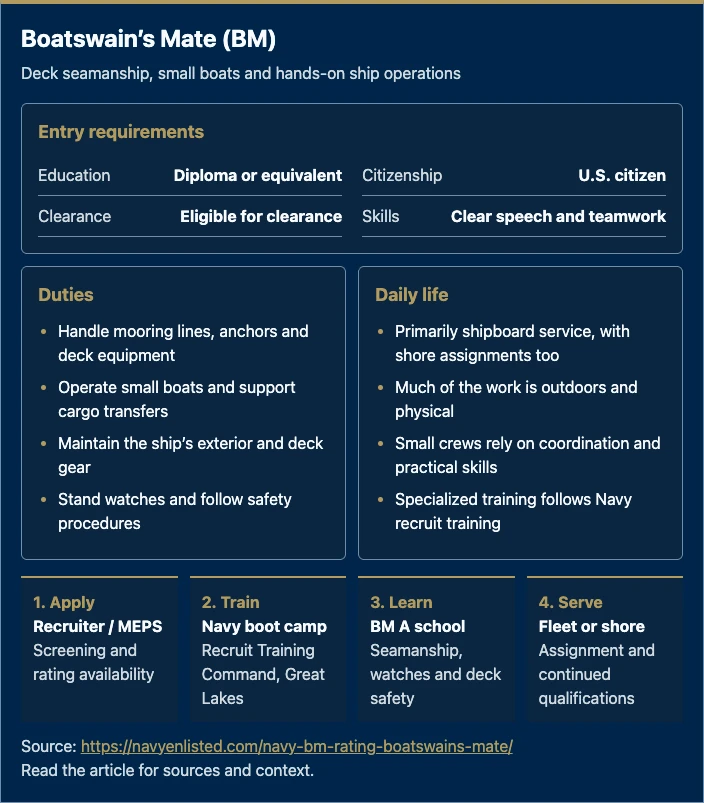
Entry requirements
- Education
- Diploma or equivalent
- Citizenship
- U.S. citizen
- Clearance
- Eligible for clearance
- Skills
- Clear speech and teamwork
Duties
- Handle mooring lines, anchors and deck equipment
- Operate small boats and support cargo transfers
- Maintain the ship’s exterior and deck gear
- Stand watches and follow safety procedures
Daily life
- Primarily shipboard service, with shore assignments too
- Much of the work is outdoors and physical
- Small crews rely on coordination and practical skills
- Specialized training follows Navy recruit training
- ApplyRecruiter / MEPSScreening and rating availability
- TrainNavy boot campRecruit Training Command, Great Lakes
- LearnBM A schoolSeamanship, watches and deck safety
- ServeFleet or shoreAssignment and continued qualifications
Source: https://navyenlisted.com/navy-bm-rating-boatswains-mate/
Read the article for sources and context.
Job Role and Responsibilities
Boatswain’s Mates (BM) are Navy enlisted Sailors who conduct, direct, supervise, and train various operations and tasks, such as ship handling, boat operations, cargo handling, equipment maintenance, and administration.
The Navy tracks this rating as EMC B400. Sailors call Boatswain’s Mates “Bos’n” or “Boats” for short. Every surface ship carries BMs. Shore stations with boats or harbor operations need them too.
Fun Fact: Boatswain’s Mate is one of the oldest enlisted jobs in the U.S. Navy, with continuous service since 1794.
Daily Tasks
Morning quarters on the fo’c’sle starts most days. BMs coordinate the day’s deck work, assign maintenance crews, and review the watch schedule. From there, the job varies by assignment.
Watchstanding
Watchstanding keeps ships secure. BMs:
- Stand lookout watches
- Serve as BM of the Watch on the bridge
- Supervise quarterdeck operations during port calls
Standing a midwatch at 0200 in heavy seas tests your alertness.
Small Boat Operations
BMs take the helm of:
- Rigid-hull inflatables
- Landing craft
- Tugboats
They drive boats during personnel transfers, maritime interdiction boardings, and search-and-rescue missions.
Cargo Handling
Moving supplies between ships at sea requires:
- Precise rigging
- Winch operations
- Coordination between deck crews on both vessels
One mistake can send a pallet into the ocean.
Deck Maintenance
BMs maintain:
- Exterior surfaces
- Metal and wood preservation from corrosion
- Deck machinery (including cranes, capstans, and mooring equipment)
Training Junior Sailors
Senior BMs train new deck seamen in:
- Knots
- Line handling
- Basic seamanship
Knowledge transfers through hands-on instruction with experienced Bos’ns.
Specific Roles and NEC Codes
The Navy Enlisted Classification (NEC) system tracks specialized skills within the BM rating. These codes identify qualified personnel for specific billets.
| NEC Code | Description |
|---|---|
| 0161 | Harbor/Docking Pilot |
| 0171 | Craftmaster - LCM/MTM/LCU |
| 0172 | Boat Coxswain |
| 0173 | Rigid Hull Inflatable Boat (RHIB) Coxswain |
| 0174 | Surfman |
| 0175 | Search and Rescue (SAR) Boat Coxswain |
| 0176 | Light Airborne Multi-Purpose System (LAMPS) Mk III RAST/RADS Operator |
| 0180 | Deck Supervisor |
| 0181 | Maintenance Person |
| 0182 | Amphibious Craftmaster |
| 0183 | LCAC Deck Mechanic |
| 0184 | LCAC Operator |
| 0185 | Landing Craft Air Cushion (LCAC) Loadmaster |
| 0186 | LCAC Engineer |
| 0187 | LCAC Navigator/Communication Watch |
| 0188 | LCAC Craftmaster |
Different NECs unlock different assignments. Coxswains drive boats. Craftmasters command landing craft. LCAC operators work with hovercraft. Each specialization requires additional training beyond A School.
Mission Contribution
Surface ships depend on BMs for operational readiness. Without proper line handling, ships cannot moor or get underway. Without trained boat crews, missions involving small craft fail before they start.
BMs enable various critical operations, including:
- Anti-terrorism operations through maritime interdiction boardings
- Search-and-rescue missions that save lives at sea
- Handling cargo that keeps fleets supplied during extended deployments
The rating bridges seamanship traditions with modern naval operations. Ancient skills like knot tying mix with contemporary techniques such as helicopter deck operations and rigid-hull inflatable boat navigation.
Technology and Equipment
BMs work with equipment that spans from centuries-old tools to cutting-edge technology:
- Traditional tools: mooring lines, fenders, and deck machinery
- Modern equipment: hydraulic cranes, synthetic rigging, and electronic navigation aids
Small boats come equipped with advanced systems including radar, GPS, and communication devices. Landing craft use complex ballast and propulsion systems. Among the most advanced surface craft are LCAC hovercraft.
Flight deck operations demand knowledge of helicopter handling, chock and chain procedures, and landing signals. BMs collaborate closely with aviation personnel during VERTREP (vertical replenishment) operations.

Work Environment
Setting and Schedule
Deck work happens outside and exposes Sailors to all kinds of weather, including rain, snow, blistering heat, and freezing spray. Boatswain’s Mates (BMs) handle pitching decks even in sea states that force others below deck. This environment demands both physical toughness and mental resilience.
Shipboard life follows a watch rotation, typically four hours on and eight hours off for many deck divisions. Port calls may shift this rhythm, but maintenance work never stops—there is always something that needs painting, repairing, or inspecting.
Shore duty assignments vary and can include:
- Harbor operations units maintaining port facilities
- Training commands instructing new BMs
- Shore billets involving administrative work or liaison duties
Leadership and Communication
The deck division chain of command is structured through the Boatswain’s Mates:
- First Class BMs supervise deck crews
- Chiefs run divisions
- Senior Chiefs and Master Chiefs shape policy and training across the rating
Communication takes place via sound-powered phones, radios, and face-to-face interaction. BMs serve as the vital link, passing information between the bridge and deck, boats and parent ships, and among various teams working the same evolution.
Performance feedback is provided through:
- Regular evaluations
- Counseling sessions
- On-the-spot correction
The Navy advancement system rewards strong performers with promotion opportunities.
Team Dynamics and Autonomy
Teamwork is essential in deck operations. For example, rigging a kingpost for underway replenishment requires the coordinated effort of multiple Sailors. Each person must execute their role precisely while maintaining awareness of the bigger picture.
Individual responsibility carries significant weight. A coxswain operating a small boat must make autonomous decisions, as wrong choices can endanger the crew and mission.
BMs often work with minimal direct supervision; experienced Sailors know their jobs and perform without constant oversight. Junior BMs learn progressively by:
- Watching
- Doing
- Teaching
Job Satisfaction and Retention
Boatswain’s Mates commonly report high job satisfaction due to the hands-on nature of their work. The rating attracts individuals who prefer action over office work, valuing physical labor, visible results, and operational missions.
Retention can fluctuate based on sea-shore rotation and advancement opportunities. Typically, BMs spend about 60 percent of their careers at sea and 40 percent ashore. While the advancement pipeline is competitive, it remains achievable for strong performers.
Training and Skill Development
Initial Training
Every Boatswain’s Mate starts at Recruit Training Command Great Lakes. Boot camp transforms civilians into Sailors over eight weeks of physical training, classroom instruction, and military indoctrination.
After boot camp, future BMs attend A School at Surface Warfare Engineering School Command Great Lakes. The training pipeline provides foundational skills for the rating.
| Training Phase | Location | Duration | Key Skills |
|---|---|---|---|
| Recruit Training | RTC Great Lakes, IL | 8 weeks | Military discipline, physical fitness, basic seamanship |
| BM “A” School | SWESC Great Lakes, IL | 5-6 weeks | Deck operations, line handling, small boats, maintenance |
A School curriculum covers basic seamanship, watchstanding procedures, underway replenishment operations, and preventive maintenance. Students practice knots until they tie them blindfolded. They learn boat handling through simulator training and practical exercises.
Advanced Training
C School opportunities open after gaining fleet experience. These specialized courses award NEC codes and qualify BMs for specific assignments.
Training options include:
- Coxswain training: Teaches small boat operations in various sea states.
- LCAC training: Prepares BMs for hovercraft operations.
- Harbor operations courses: Covers docking, tug operations, and port management.
Professional development continues throughout a BM’s career. Leadership courses prepare senior enlisted for increased responsibility, while advanced technical training keeps skills current with evolving equipment.
The Navy also supports off-duty education through:
- Tuition Assistance: Pays for college courses while serving.
- The GI Bill: Provides benefits after discharge for further education or vocational training.

Physical Demands and Medical Evaluations
Physical Requirements
Deck work breaks bodies that cannot handle stress. BMs lift heavy equipment, climb vertical ladders, and work in awkward positions for extended periods. Upper body strength, core stability, and cardiovascular endurance all matter.
Physical demands stack up fast on deck. Consider the following:
- A single mooring line weighs 50 to 100 pounds.
- Climbing vertical ladders between decks happens dozens of times daily.
- Four-hour watches in driving rain or blistering heat drain energy.
- Heavy machinery requires both strength and precision.
- Boat operations demand swimming competency.
- Confined spaces and working heights add risk to every task.
The Physical Readiness Test (PRT) establishes minimum fitness standards. BMs must pass semi-annual assessments to remain in the Navy.
| Event | Male (17-19) Minimum | Male (17-19) Maximum | Female (17-19) Minimum | Female (17-19) Maximum |
|---|---|---|---|---|
| Forearm Plank | 1:03 | 3:20 | 1:03 | 3:20 |
| Push-ups | 42 | 92 | 19 | 51 |
| 1.5-Mile Run | 12:15 | 8:15 | 14:45 | 9:29 |
Forearm planks replaced sit-ups as the core strength assessment. Sailors may substitute the 2-kilometer row or 500-yard swim for the run. Performance category affects overall score.
Medical Evaluations
Initial medical screening at Military Entrance Processing Station (MEPS) determines basic eligibility. Vision, hearing, cardiovascular health, and musculoskeletal function all factor into qualification.
Periodic health assessments continue throughout service. BMs working in specific environments may require additional medical monitoring. Annual physical health assessments and dental examinations maintain readiness.
Deployment and Duty Stations
Deployment Details
Surface ships deploy for 6-9 months on average, though individual schedules vary by ship class, operational tempo, and global requirements. Aircraft carriers and amphibious ships maintain more predictable cycles, while smaller vessels deploy as needed.
Overseas deployments take BMs to various operational areas, including:
- The Mediterranean
- Persian Gulf
- Western Pacific
- Other operational regions
Homeported ships in Japan, Spain, and Bahrain offer forward-deployed lifestyles with distinct deployment patterns.
Shore duty provides respite from sea time; however, operational units require sea-going billets. Most BMs alternate between ship and shore assignments throughout their careers.
Location Flexibility
Duty station assignments depend on Navy needs and individual qualifications. Detailers match available billets with Sailor preferences when possible. Career progression often requires willingness to relocate.
Major concentrations of BM billets include:
- Norfolk, Virginia (largest naval base)
- San Diego, California
- Mayport, Florida
- Everett and Bremerton, Washington
- Yokosuka, Japan
- Rota, Spain
- Pearl Harbor, Hawaii
Career Progression and Advancement
Career Path
The BM career path progresses through distinct phases from apprentice to master technician and leader.
| Pay Grade | Rate | Typical Responsibilities | Timeline |
|---|---|---|---|
| E-1 to E-3 | Seaman Recruit to Seaman | Learning basic seamanship, standing watches, assisting deck operations | First 12-18 months |
| E-4 | BM3 (Petty Officer Third Class) | Supervising small work parties, qualifying as coxswain, leading junior Sailors | 2-3 years |
| E-5 | BM2 (Petty Officer Second Class) | Deck supervisor, training coordinator, boat crew leader | 4-6 years |
| E-6 | BM1 (Petty Officer First Class) | Work center supervisor, divisional lead petty officer | 6-9 years |
| E-7 | BMC (Chief Petty Officer) | Division leadership, training management, policy implementation | 8-12 years |
| E-8 | BMCS (Senior Chief) | Department leadership, senior enlisted advisor | 12-16 years |
| E-9 | BMCM (Master Chief) | Command master chief, rating technical expert | 16+ years |
Advancement depends on performance, examination scores, and billet availability. The Navy uses a combination of rating knowledge exams, service-in-paygrade requirements, and performance evaluations.
Billet-Based Advancement (BBA) now applies to BM promotions. Sailors advance by filling specific billets rather than purely through examination. This system matches qualifications to job requirements more precisely.
Rank Structure
| Pay Grade | Rate | Abbreviation | Title |
|---|---|---|---|
| E-1 | Seaman Recruit | SR | Seaman Recruit |
| E-2 | Seaman Apprentice | SA | Seaman Apprentice |
| E-3 | Seaman | SN | Seaman |
| E-4 | Boatswain’s Mate Third Class | BM3 | Petty Officer Third Class |
| E-5 | Boatswain’s Mate Second Class | BM2 | Petty Officer Second Class |
| E-6 | Boatswain’s Mate First Class | BM1 | Petty Officer First Class |
| E-7 | Chief Boatswain’s Mate | BMC | Chief Petty Officer |
| E-8 | Senior Chief Boatswain’s Mate | BMCS | Senior Chief Petty Officer |
| E-9 | Master Chief Boatswain’s Mate | BMCM | Master Chief Petty Officer |
Role Flexibility and Transfers
Lateral conversion to other ratings remains possible for qualified BMs. The skills transfer well to Quartermaster, Operations Specialist, or other surface ratings. Some BMs cross over to Master-at-Arms for law enforcement careers.
The Navy’s Perform to Serve program allows Sailors to reenlist in different ratings if their current rating is overmanned. This provides flexibility for career adjustments based on personal goals and Navy needs.
Performance Evaluation
The Navy evaluates Sailors through regular fitness reports and counseling. Evaluations cover:
- Professional knowledge
- Leadership
- Military bearing
- Mission accomplishment
Strong evaluations accelerate advancement, while weak evaluations stall careers.
Meritorious advancement programs recognize exceptional performers. Command Advancement Programs enable commanding officers to promote standout Sailors ahead of schedule.
How to Succeed
Advancement in the BM rating requires more than passing exams. Successful BMs:
- Demonstrate leadership early
- Qualify in multiple watch stations
- Pursue advanced NECs
- Volunteer for challenging assignments
- Deliver consistent performance
Physical fitness matters. BMs who fail PRTs cannot advance regardless of other qualifications. Maintaining weight standards and passing fitness tests remains non-negotiable.
Collateral duties provide leadership opportunities. Command involvement, community service, and professional development show initiative that evaluators notice.
Salary and Benefits
Financial Benefits
Base pay depends on pay grade and years of service. The 2026 military pay raise of 3.8 percent reflects congressional authorization and presidential approval.
| Pay Grade | 2 Years or Less | Over 2 Years | Over 3 Years | Over 4 Years | Over 6 Years |
|---|---|---|---|---|---|
| E-1 | $2,407.20 | $2,407.20 | $2,407.20 | $2,407.20 | $2,407.20 |
| E-2 | $2,697.90 | $2,697.90 | $2,697.90 | $2,697.90 | $2,697.90 |
| E-3 | $2,836.80 | $3,015.30 | $3,198.30 | $3,198.30 | $3,198.30 |
| E-4 | $3,142.20 | $3,302.40 | $3,481.80 | $3,658.20 | $3,814.80 |
| E-5 | $3,426.90 | $3,657.90 | $3,835.20 | $4,016.10 | $4,297.80 |
| E-6 | $3,741.30 | $4,117.80 | $4,299.30 | $4,476.60 | $4,660.20 |
Special pays and allowances supplement base salary:
- Basic Allowance for Housing (BAH): Tax-free payment based on location, rank, and dependency status
- Basic Allowance for Subsistence (BAS): $476.95 monthly for enlisted members
- Career Sea Pay: Additional compensation for qualifying sea duty, ranging from $50 to $750 monthly based on pay grade and cumulative sea time
- Family Separation Allowance: $250 monthly when stationed away from dependents
- Enlistment/Reenlistment Bonuses: Variable amounts based on rating needs
Additional Benefits
Healthcare coverage through TRICARE includes medical and dental care at no cost for active duty members. Dependents receive care at reduced rates through TRICARE Prime, Select, or other available options.
The Blended Retirement System combines a pension after 20 years with Thrift Savings Plan contributions. Service members receive automatic and matching contributions to their TSP accounts, creating portable retirement benefits even for shorter careers.
Education benefits include:
- Tuition Assistance: Up to $4,500 annually for college courses while serving
- GI Bill: Comprehensive education benefits after service
- Navy College Program: Counseling and support for degree completion
- Credentialing Opportunities On-Line (COOL): Professional certification funding
Work-Life Balance
Thirty days of annual leave accrues for every year of service. Federal holidays provide additional time off when operational schedules permit. Paternity and maternity leave policies have expanded significantly in recent years.
Sea duty demands sacrifice. Six-month deployments strain families and disrupt routines. Shore duty provides stability and regular schedules. The alternating rhythm challenges but also provides variety.

Risk, Safety, and Legal Considerations
Job Hazards
Deck work ranks among the Navy’s more dangerous occupations. Hazards include:
- Working at heights without fall protection during rigging operations
- Heavy equipment and moving machinery that can crush or sever limbs
- Severe weather exposure causing hypothermia or heat injury
- Line handling accidents where tensioned cables snap with lethal force
- Small boat operations in rough seas with risk of capsizing
- Falls overboard during night operations or heavy weather
The Safety Department tracks injuries and develops mitigation strategies. Yet accidents still happen when complacency creeps in or procedures get rushed.
Safety Protocols
Personal protective equipment requirements are strict. Hard hats, safety shoes, gloves, and eye protection are mandatory for most deck operations. Hearing protection guards against machinery noise. Life jackets are required for small boat operations and working near unprotected edges.
Safety observers monitor hazardous evolutions. Tag-out procedures lock down equipment undergoing maintenance. Operational risk management assesses hazards before major evolutions.
Training emphasizes situational awareness. BMs learn to recognize danger signs, to speak up when they see unsafe conditions, and to stop operations rather than proceed dangerously.
Security and Legal Requirements
Boatswain’s Mates require a Secret security clearance for most positions. The clearance investigation examines criminal history, financial responsibility, foreign contacts, and personal conduct.
The clearance process involves:
- Completing Standard Form 86 (SF-86) questionnaire
- Credit checks and criminal background investigations
- Personal interviews with investigators
- Verification of employment, education, and residence history
Clearance adjudication considers the whole person. Minor issues usually do not disqualify if the applicant demonstrates reliability and integrity. Serious criminal history, financial irresponsibility, or foreign preference may prevent clearance.
Service obligations for BM include a 60-month (5-year) active duty commitment. This ensures the Navy recoups training investment and maintains adequate manning.
Impact on Family and Personal Life
Family Considerations
Sea duty separates BMs from families for extended periods. Six-month deployments strain marriages and complicate parenting. Frequent moves disrupt spouse careers and children’s education.
Family support programs help mitigate challenges:
- Fleet and Family Support Centers provide counseling and resources
- Ombudsman programs connect families with command information
- Navy-Marine Corps Relief Society offers emergency financial assistance
- Child Development Centers provide quality childcare
Communication technology helps deployed Sailors stay connected. Email, video calls, and social media bridge distances that once meant complete isolation.
Relocation and Flexibility
Permanent Change of Station (PCS) moves occur every 2-4 years typically. Some BMs seek geographic stability through extended shore duty or consecutive tours in the same region. Others embrace the opportunity to see different parts of the world.
Geographic bachelors arrangements allow Sailors to serve unaccompanied tours while families remain in established locations. This reduces disruption but creates separation challenges.
Post-Service Opportunities
Transition to Civilian Life
Boatswain’s Mates develop skills that transfer directly to maritime industries. Leadership, boat handling, maintenance expertise, and safety consciousness appeal to civilian employers.
Transition assistance programs help departing Sailors:
- Transition Assistance Program (TAP) workshops cover resume writing and job searching
- SkillBridge allows final months of service for civilian internships
- Veterans Employment Centers connect veterans with opportunities
- Hiring preferences give veterans advantages in federal employment
Civilian Career Prospects
The maritime industry offers multiple career paths for former BMs:
| Civilian Occupation | Median Annual Salary (2024) | Growth Outlook |
|---|---|---|
| Captains, Mates, and Pilots of Water Vessels | $95,210 | Stable |
| Sailors and Marine Oilers | $52,350 | Stable |
| Ship Engineers | $87,300 | Stable |
| First-Line Supervisors of Transportation Workers | $63,430 | Growing |
| Motorboat Operators | $47,120 | Stable |
Maritime academies and union apprenticeships offer pathways to merchant marine careers. Coast Guard credentials transfer military sea time toward civilian licenses. Many former BMs work as captains, mates, or deckhands on tugboats, ferries, offshore supply vessels, and merchant ships.
Port operations provide shoreside opportunities, where stevedoring companies, terminal operators, and maritime logistics firms value Navy deck experience. Safety coordinator positions leverage the hazard awareness BMs develop.
Industrial maintenance roles suit BMs with strong mechanical skills. Shipyards, manufacturing plants, and construction companies hire veterans for equipment operation and maintenance.
Career Pathways for BMs:
Merchant Marine Careers
- Maritime academies and union apprenticeships as entry routes
- Coast Guard credentials transfer military sea time to civilian licenses
- Positions: captains, mates, deckhands on tugboats, ferries, offshore supply vessels, merchant ships
Port Operations
- Opportunities shoreside with stevedoring companies, terminal operators, maritime logistics firms
- Roles include safety coordinators leveraging hazard awareness
Industrial Maintenance
- Suitable for BMs with strong mechanical skills
- Employment with shipyards, manufacturing plants, construction companies for equipment operation and maintenance
Qualifications and Eligibility
Basic Qualifications
| Requirement | Details |
|---|---|
| Education | High school diploma or equivalent (GED accepted) |
| Citizenship | U.S. citizen |
| Security Clearance | Eligible for Secret clearance |
| ASVAB Score | AR + AS + MK + VE = 175 OR AS + MK + AO = 135 |
| Service Obligation | 60 months (5 years) active duty |

Application Process
Joining the Navy as a Boatswain’s Mate follows this path:
- Contact a Navy recruiter to discuss eligibility and opportunities
- Take the ASVAB at a Military Entrance Processing Station (MEPS)
- Complete medical examination and physical screening
- Select BM rating if qualified and available
- Sign enlistment contract with ship date
- Attend boot camp at Recruit Training Command Great Lakes
- Complete BM “A” School at SWESC Great Lakes
- Report to first duty station
The process from initial contact to boot camp typically takes 3-9 months depending on applicant qualifications and rating availability.
Selection Criteria and Competitiveness
BM remains moderately competitive for accessions. The rating accepts many recruits but maintains standards for physical fitness and ASVAB performance.
Strengthening your application:
- Score well on the ASVAB, particularly the relevant line scores
- Maintain physical fitness before shipping to boot camp
- Demonstrate leadership through school activities, sports, or work experience
- Obtain water safety certifications (lifeguard, swimming instructor)
- Show mechanical aptitude through vocational courses or hobbies
Prior experience with boats, construction, or team sports indicates potential fit for the rating.
Upon Accession into Service
New recruits enter at pay grade E-1 (Seaman Recruit) unless qualifying for advanced rank through college credits, JROTC, or other programs. Maximum advanced enlistment rank is E-3.
The 60-month service obligation begins upon completion of boot camp. This includes time spent in “A” School and any additional training.
Is This a Good Job for You? The Right (and Wrong) Fit
Ideal Candidate Profile
Boatswain’s Mate suits specific personalities and preferences. Consider this rating if you:
- Enjoy physical work and outdoor environments
- Prefer hands-on tasks over desk work
- Handle stress well and think clearly under pressure
- Like working with your hands and seeing tangible results
- Value tradition and camaraderie
- Accept that you will get dirty, wet, and tired regularly
Technical aptitude helps but matters less than mechanical common sense and willingness to learn. The Navy teaches specific skills. It cannot teach work ethic or physical toughness.
Potential Challenges
This rating frustrates people who expect:
- Regular schedules and predictable routines
- Clean, climate-controlled workspaces
- Individual recognition over team success
- Rapid advancement without demonstrated competence
- Shore duty immediately after training
The physical demands disqualify those with certain medical conditions. Chronic back problems, severe motion sickness, or inability to pass swimming tests make deck service difficult.
Career and Lifestyle Alignment
Long-term career satisfaction depends on matching expectations to reality. BMs who thrive accept that:
- Ships come first, personal plans come second
- Promotion requires proving leadership through tough assignments
- Sea time builds credentials that shore duty cannot
- The work is unglamorous but essential
Retirement after 20 years provides a pension and transition benefits. Many BMs serve full careers, advancing to Chief and beyond. Others use the rating as a foundation for maritime civilian careers.

More Information
Contact your local Navy Enlisted Recruiter to explore Boatswain’s Mate opportunities. Recruiters provide current information about enlistment incentives, training wait times, and assignment options that change based on Navy needs.
You may also be interested in these related Navy ratings:
Mineman (MN) – Specializes in mine countermeasures and underwater explosive ordnance disposal
Quartermaster (QM) – Navigation specialists who assist with ship handling and chart work