How To Become A United States Naval Officer (Active Duty or Reserve)
You want to lead Sailors, not just join the Navy. That goal is realistic, but it is not simple. Officer selection is competitive, and each job has its own gate. Your age, degree, health, and testing can change what is possible. The Navy also changes openings by year, so the “best path” depends on timing.
This guide gives you a clean map for Active Duty and the Navy Reserve. It covers what to pick first, what to gather, what to expect at boards, and what training looks like after selection. It also flags the common traps that waste months.
If you are in high school, you will focus on USNA and NROTC steps early. If you are in college or already graduated, you will likely focus on OCS or a collegiate pipeline. If you are prior enlisted, you have additional routes that civilians do not. If you are an experienced professional, the Reserve may offer direct commission options in specific communities.
Use this as a checklist you can work through in order. It will help you move fast without guessing.
1) Start with the decision that drives everything: Active Duty, Navy Reserve, or full-time reserve support
You should pick a lane before you pick a job. The lane controls your lifestyle, your training timing, and your application route.
Active Duty means full-time service. You will PCS, train, and deploy as the Navy needs. Your day job becomes Navy work, and your pay and benefits are full-time. You compete for officer communities that operate ships, aircraft, submarines, and special operations. You can also serve in technical, support, and professional fields.
Navy Reserve (SELRES) means part-time drilling with the possibility of mobilization. Your normal rhythm is monthly drills plus annual training days. Many reservists complete at least 48 drill periods per year and about 12 to 14 days of annual training. Drill periods often stack into a weekend, but units can schedule differently. You still must meet fitness, medical, and readiness requirements, and you can be activated when the nation needs you.
TAR (Training and Administration of the Reserve) is a separate concept many people miss. TAR members serve full-time on active duty while supporting Navy Reserve readiness and administration. TAR exists for enlisted and officers. TAR officers fill billets that manage Reserve manpower, mobilization readiness, and training support. TAR feels like active duty because it is active duty service. The mission focus stays tied to Reserve support.
This lane choice matters because some officer communities are mostly Active Duty accessions. Other communities bring in many Reserve officers through direct commission routes. Some jobs exist in both components but have different selection criteria.
Use this quick guide to narrow your lane.
- Choose Active Duty if you want full-time operational leadership and global assignments.
- Choose SELRES if you want to keep a civilian career and serve part-time.
- Consider TAR if you want active duty service focused on Reserve support missions.
Tip: do not lock yourself into a lane until you confirm designator eligibility and age limits. Age windows vary by community, and waivers vary by program.
2) Understand Navy officer types and designators before you apply
Most confusion comes from one word: designator. A designator is the code that marks your officer career field. Your designator controls entry requirements, training pipeline, and service obligation. It also controls medical standards and security requirements.
Navy officer communities fall into three broad groups.
Unrestricted Line (URL) officers lead combat forces and operational units. These roles include warfare leadership paths like Surface Warfare, Aviation, Submarine, and Special Warfare. These communities often require specific medical standards and long training pipelines.
Restricted Line (RL) officers lead specialized operational support functions. These roles can include Intelligence, Information Professional, Information Warfare, Public Affairs, and Human Resources. Many of these communities exist on Active Duty and in the Reserve. Some Reserve accessions happen through direct commissioning for experienced professionals.
Staff Corps officers are licensed or credentialed professionals. These roles include physicians, nurses, dentists, chaplains, attorneys, and Civil Engineer Corps officers. Staff Corps accessions often depend on professional education, credentials, and community-specific screening.
Here is a practical way to think about commissioning routes by community type.
| Community type | Typical entry background | Common commissioning route |
|---|---|---|
| Unrestricted Line (URL) | College grads with strong fitness and leadership | USNA, NROTC, OCS |
| Restricted Line (RL) | College grads or experienced professionals | OCS (some), Reserve DCO (many) |
| Staff Corps | Licensed or credentialed professionals | Direct commission + ODS, or OCS for some |
Your best match usually comes from a simple sequence.
- List what you qualify for on paper. Focus on degree, GPA, citizenship, and medical history.
- List what you can commit to in real life. Think about full-time moves, deployments, and training length.
- Pick two or three designators that fit both lists. Then build the strongest package for those.
Avoid choosing a designator because it sounds interesting. Many applicants lose months chasing a community they cannot enter. Start with eligibility, then move to preference.
3) Universal requirements you should verify early (reality check)
Most officer paths share the same baseline gates, even though details vary by community. You will move faster if you verify these early and collect proof.
Citizenship and trustworthiness. Many officer roles require a background investigation for access to classified information or sensitive duties. The investigation looks at your history and helps determine clearance eligibility and suitability. Foreign contacts, finances, and legal history can matter, even if you think they are minor.
Education. Most officer accessions require a four-year degree. That includes both the Navy and the Navy Reserve for typical officer routes. Prior enlisted commissioning paths like LDO and CWO are different. Those programs can commission exceptional senior enlisted Sailors without requiring a college degree.
Age. Age limits vary by designator. Some communities have tight windows. Some have broader windows and sometimes allow waivers. Reserve direct commission programs can also set specific maximum ages by community. Treat age as a designator rule, not a Navy-wide rule.
Medical qualification. You must be medically qualified for accession. Standards vary by community. Aviation and special operations programs are typically more restrictive. Vision standards can be a decisive factor. Past asthma history, ADHD medication history, and orthopedic injuries can trigger extra review.
Fitness. The Navy uses a Physical Readiness Test structure that includes muscular endurance and cardio. The Physical Readiness Test events include push-ups, a forearm plank, and a primary cardio event like the 1.5-mile run or walk. Alternate cardio options can exist under command policy, but you should train for the main events.
Testing. Many officer programs use the ASTB-E. The OAR score comes from three ASTB-E subtests and supports selection into certain non-aviation officer programs. Aviation applicants also use aviation-specific ASTB-E scores.
Use this one-sitting pre-application checklist.
- Government photo ID and birth certificate or passport
- All college transcripts, including community college and transfer credits
- Resume with dates, locations, and supervisor contacts
- Three to five references who can speak to leadership and character
- Medical history list with dates, diagnoses, and treatments
- Basic fitness baseline results for push-ups, plank, and 1.5-mile run
- A clean explanation for any legal, financial, or conduct issues
- A list of your top 2 to 3 designators, with reasons that fit your record
Paper cuts that kill applications are predictable.
- Missing transcripts or missing degree conferral dates
- Unresolved traffic warrants or “closed” cases without documents
- Credit problems you cannot explain with a plan
- Inconsistent employment dates that look dishonest
- Medical paperwork gaps that force repeated follow-ups
Fix these before you ever submit a package.

4) Active Duty commissioning paths (which one fits you)
Active Duty commissioning comes through a few primary pipelines. Each one fits a different stage of life.
4.1 U.S. Naval Academy (USNA)
USNA is a full-time undergraduate path to a commission. It is designed for students coming from high school or early college. The process is highly structured and starts early.
A key feature of USNA is the nomination requirement. You need a nomination from an official source to receive an offer of appointment. Many candidates seek nominations through their congressional representatives. Some also qualify through other nomination categories, including the Vice President nomination route.
The USNA timeline usually begins well before senior year deadlines. You will complete academic steps, physical and medical screening, and an evaluation interview process. Candidates should build a record that shows strong grades, sustained athletics or fitness, and leadership roles with measurable impact.
After graduation, you commission and enter initial training for your assigned community. Your service commitment depends on your warfare path and any specialized training.
4.2 NROTC (Navy ROTC)
NROTC is a college-based path to a commission. It exists as a scholarship track and as a college program track. You attend a civilian university with an NROTC unit and complete required training while earning your degree.
NROTC requires consistent participation. You will complete naval science coursework, leadership labs, and physical fitness expectations. You will also complete summer training events that build military familiarity and evaluate leadership.
Many students like NROTC because it provides a commission pathway while keeping the traditional college experience. It also gives you time to grow into officer standards. NROTC can commission into many communities, and the Navy’s needs influence what is available each year.
Service obligations depend on option and community. For example, Navy Option scholarship midshipmen commonly incur a multi-year active duty obligation.
4.3 Officer Candidate School (OCS)
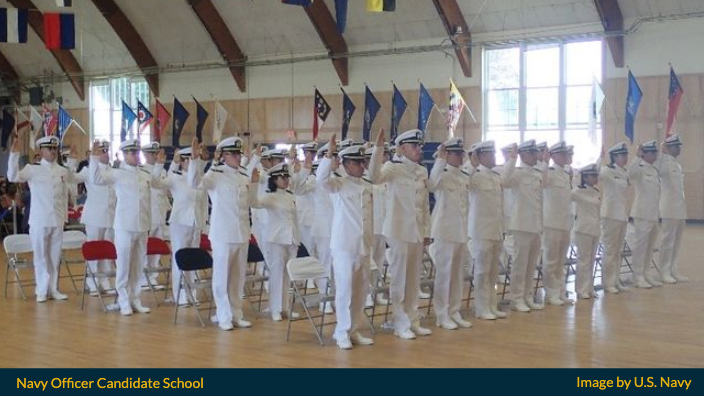
Officer Candidate School (OCS) is the most common path for college graduates seeking an Active Duty commission. It is based at Officer Training Command Newport in Rhode Island. The program is a 13-week accession course designed to train and commission officers.
OCS is not a generic leadership boot camp. It is a selection-based pipeline tied to specific communities. You apply for a designator and compete at a selection board. If selected, you complete medical and security processing steps, then you ship to OCS with a class date.
A simple way to think about OCS is “package to board, board to training, training to job school.”
- Package building: documents, testing, interviews, and endorsements
- Board selection: you are chosen for a specific designator
- Accession training: you earn a commission at OCS
- Follow-on training: you attend designator-specific schools after commissioning
Many applicants misunderstand job choice. You do not arrive at OCS and then pick a job from a menu. Your designator is tied to your selection and contract.
4.4 Collegiate and specialty pipelines (when you are still in school)
Some communities offer paid pathways while you finish college. Availability can change by year because it depends on manning needs.
BDCP-style programs pay selected students while they complete their degrees. Eligibility rules depend on the designator. These programs generally target students who are not in NROTC but want a direct pipeline to commissioning after graduation.
NUPOC is a collegiate path for students pursuing technical degrees who want to become officers in the nuclear propulsion communities. NUPOC pays selected students while they stay in school full-time. The screening is demanding and includes technical interviews.
Civil Engineer Corps collegiate options exist for engineering and architecture students close to graduation. These programs target candidates within a window before graduation and lead into Civil Engineer Corps accessions.
Treat all collegiate pipelines as designator-specific. You should ask for the current program authorization and current open quotas for the cycle you plan to apply in.
5) Navy Reserve commissioning paths (how Reserve officer accessions really work)
Reserve officer accessions often work differently than people expect. Many Reserve officers are not brand-new graduates. Many are experienced professionals who bring civilian skills into a Navy mission.
The Navy Reserve still requires readiness and deployability, but the accessions paths reflect Reserve needs.
5.1 Direct Commission Officer (DCO) programs
Direct Commission Officer (DCO) programs are common in the Reserve, especially in Restricted Line and Staff Corps communities. DCO is designed for people who already have relevant education and professional experience. That can include civilians and prior enlisted candidates.
You compete for a specific designator, not for “the Reserve” in general. Selection often includes designator interviews, and the community may request proof of professional work that fits its mission. Some communities publish clear age limits and minimum degree requirements.
Do not assume prior military experience is required. Some Reserve communities select people with no prior service, as long as they meet qualifications and show strong performance.
5.2 Officer Development School (ODS)
Many direct commissions attend Officer Development School at Officer Training Command Newport. ODS is a five-week course designed to prepare newly commissioned officers for service as Navy officers. It is aimed at officers who already hold a commission and are entering in professional or specialized communities.
In Reserve DCO onboarding guidance, newly commissioned DCOs are typically required to attend ODS within a set time window after commissioning. That window is commonly within one year, so you should plan work and family timelines early.
ODS is not the same as OCS. ODS is shorter and assumes you entered through direct commissioning based on professional qualifications. OCS is longer and is the accession path for many line and operational communities.
5.3 Reserve OCS accessions (when applicable)
Some Reserve designators can access through OCS depending on the year and program authorization. This tends to be more common when the Navy wants younger accessions into certain Reserve communities, or when a designator aligns with standard OCS pipelines.
The practical point is simple. Reserve accessions change based on policy and manning. Your officer recruiter should confirm the current Reserve accessions route for your target designator before you build a package.
5.4 Prior-service Reserve paths and component switches
If you are prior enlisted, you may have additional commissioning routes. Programs like LDO and CWO exist for senior enlisted Sailors who bring deep technical mastery. Those programs are separate from DCO.
Component switches also happen, but they are not guaranteed. Active Duty officers can affiliate with the Reserve later, and Reserve officers can sometimes pursue active opportunities. These moves depend on policy, quotas, medical readiness, and community needs. You should treat them as competitive opportunities, not automatic options.
6) Step-by-step application process (Active and Reserve), from first call to commissioning day
You will move faster if you treat your application like a project with fixed deliverables. The sequence below fits most Active Duty and Reserve paths, with small differences.
Talk to the right recruiter. Officer programs are handled by officer recruiters. Enlisted recruiters can help route you, but you need the officer pipeline to build a package.
Choose designator targets. Pick two or three designators you can qualify for now. Your recruiter can help confirm current eligibility and whether the designator is open.
Gather documents early. Plan to collect:
- Official transcripts from every school attended
- Resume with complete employment and address history
- Letters of recommendation or references, based on program rules
- Prior service records if applicable
- Proof of citizenship
- Any legal documents, even for dismissed cases
Complete required testing. Many programs use the ASTB-E. If you only need the OAR, you still take the relevant ASTB-E subtests. Plan time for a retest policy and waiting periods if you need improvement.
Medical screening and follow-ups. Expect a full medical evaluation and extra documentation requests. If you have past diagnoses, collect records in advance. Follow-up testing can add weeks if you wait to start.
Interviews. Reserve DCO packages often require designator interviews with currently serving officers. Some communities require multiple interviews. Treat interviews like a job panel and prepare your story with specifics.
Package submission to a selection board. Boards review your whole record. They look for leadership, performance, maturity, and readiness. Weak writing and incomplete packages can sink a strong candidate.
Selection notice and final processing. After selection, you still have a long tail. You may need final medical clearance, background forms, and class scheduling.
Swearing in and accession training. Your path depends on route:
- USNA and NROTC commission at graduation
- OCS candidates ship to Newport for accession training
- Many DCO officers commission first, then attend ODS
A realistic timeline range is wide. Some candidates complete the process in a few months. Others take closer to a year. The biggest delays come from medical records, background paperwork, and waiting for board dates or class dates.
You can avoid delays with two habits. First, submit complete documents the first time. Second, respond to follow-ups within 24 hours whenever possible.
7) What training looks like after selection (so you can plan your life)
Officer training has two layers. First is accession training, where you learn Navy fundamentals and officer expectations. Second is job training, where you learn your community’s technical role.
OCS is a high-tempo accession course. It runs in phases and combines physical training, academics, military customs, inspections, and leadership evaluation. You will be graded in multiple areas, and you will be expected to manage stress while still performing. The environment rewards preparation. Candidates who arrive underprepared on fitness or basic military bearing often spend the first weeks trying to catch up.
ODS is a shorter accession course for newly commissioned officers entering in specialized or professional communities. It focuses on Navy culture, leadership foundations, and the duties of commissioned service. It is still physically demanding, but it is not the same pipeline as OCS. ODS assumes you were selected based on a professional role and commissioning authority.
After commissioning, you move into follow-on schools. The pipeline length depends on designator.
- Warfare communities can require long sequences of schools and qualifications.
- Some restricted line communities require technical schools and security processing before full integration.
- Staff Corps communities often include professional onboarding plus Navy-specific training.
Plan your life around the reality that training schedules can shift. Medical processing, security processing, and school seat availability can move dates.
A preparation plan that works without gimmicks looks like this.
Fitness baseline goals
- Train for push-ups, forearm plank, and a strong 1.5-mile run time.
- Build durability with steady running and sensible strength work.
- Practice in the same order you will test, under a timer.
Paperwork readiness
- Build a single folder with transcripts, IDs, and medical records.
- Keep a clean list of addresses and jobs for the last 10 years.
- Write a short explanation for any issues, with documents ready.
Life admin
- Active Duty: plan for moving and a gap between selection and shipping.
- Reserve: plan for time away for ODS and later schools.
- Employer: discuss Reserve obligations early and in writing.
If you plan this well, training becomes hard but manageable. If you plan it late, training becomes chaos.
8) Service obligations, drills, deployments, and career progression (Active vs Reserve)
You should understand commitment before you sign anything. Commitment is not only about years. It is also about time, mobility, and readiness standards.
Active Duty obligations vary by designator and training cost. Some communities require longer commitments because training is expensive and lengthy. Aviation and nuclear paths are common examples of longer pipelines. Other communities may have shorter initial obligations. Your commissioning document and designator program rules define your obligation.
Active Duty life includes global assignments. You will PCS when the Navy directs. You can deploy on ships, aircraft, submarines, or expeditionary units. Even in shore-heavy jobs, you should expect operational tours and high readiness demands.
Reserve obligations include scheduled drills, annual training, and readiness requirements that continue year-round. Many reservists complete four drill periods per month, commonly stacked into one weekend. They also complete annual training days each fiscal year. Reserve mobilization is real. Units can be activated for contingencies, and individual augmentee opportunities exist in many communities.
Reserve pay and benefits differ from Active Duty. Drill pay is tied to drill periods and rank. Certain benefits depend on orders status, duty time, and eligibility rules. You should plan for benefits as a layered system that changes when you go on active orders.
Career progression also differs.
- Active Duty officers move through structured career gates and sea or operational tours.
- Reserve officers often build careers through unit billets, mobilizations, qualifications, and professional contributions.
- Promotions are competitive in both components and depend on performance and record strength.
A key Reserve reality is time management. Your unit may need work between drills. Your designator may require training completion, security renewals, and medical readiness tasks on your own time. You should treat the Reserve as part-time service with full-time accountability.
If you want a Reserve career that feels stable, pick a unit and community that aligns with your civilian schedule. If you want a Reserve career with faster growth, volunteer for hard billets, mobilizations, and qualifications early.
9) Common reasons people get stuck, and how to fix them fast
Most candidates who stall do not fail on talent. They fail on process. Use this troubleshooting guide to diagnose the problem and fix it.
Symptom: “I just found out I am too old for my dream job.”
Likely cause: you assumed one Navy age limit applies to all communities. What to do next: ask for the designator’s exact age rule and waiver policy. Then pivot to a nearby designator that fits your profile.
Symptom: “My recruiter says my degree does not match.”
Likely cause: some designators require specific majors or technical coursework. What to do next: pull your transcripts and map coursework to requirements. If you lack a class, consider taking it now. If you are already graduated, consider a different designator.
Symptom: “Medical keeps dragging on with more paperwork.”
Likely cause: missing records, incomplete history, or unclear treatment dates. What to do next: request full records from every provider and submit them together. Write a clean timeline of diagnosis, meds, and outcomes. Do not guess dates.
Symptom: “I am worried about clearance or background issues.”
Likely cause: you have unresolved financial problems, a legal history, or complex foreign ties. What to do next: gather documents, show resolution, and explain honestly. A pattern of concealment is often worse than the issue itself.
Symptom: “I got a non-select and do not know why.”
Likely cause: weak leadership evidence, weak interviews, or an unfocused personal statement. What to do next: request feedback through your recruiter if possible. Then rebuild the package with measurable leadership and stronger writing.
Symptom: “I keep getting sent to an enlistment office.”
Likely cause: you contacted the wrong pipeline. What to do next: ask directly for an officer recruiter appointment and confirm the program you are applying for.
Here is a “make your package stronger in 90 days” plan that works.
- Weeks 1 to 2: run a timed baseline for push-ups, plank, and 1.5-mile run. Start a simple training plan.
- Weeks 1 to 4: take a leadership role at work, school, or a community group. Document outcomes and hours.
- Weeks 3 to 6: draft your motivation statement with specific examples of leadership and service.
- Weeks 4 to 8: interview prep. Practice answers, then practice follow-up questions.
- Weeks 6 to 10: clean up your resume. Use numbers and outcomes, not duties.
- Weeks 8 to 12: finalize documents and submit a complete package with no gaps.
The goal is not perfection. The goal is a record that looks mature, prepared, and reliable.
10) FAQ that answers what people actually ask recruiters
Can I choose my job as a Navy officer? You apply for specific designators and compete for selection. You can express preferences, but selection and openings control what you receive.
Do I need a specific major? Some designators accept many majors. Others require technical degrees or specific coursework. Your transcripts can matter more than your diploma title.
Can I commission without a degree? Most officer accessions require a four-year degree. LDO and CWO programs are different and can commission qualified senior enlisted Sailors without a degree.
What is the difference between OCS and ODS? OCS is a 13-week accession program that trains and commissions many officer candidates. ODS is a five-week course for many direct commissions entering specialized or professional communities.
Is the Reserve easier to get into? Not automatically. Some Reserve communities are highly competitive. DCO programs often expect proven professional performance and strong interviews.
Can I go Reserve first, then Active later? Sometimes, but it is not guaranteed. Component changes depend on policy, quotas, and community needs.
What if I have tattoos, ADHD history, asthma history, or prior legal issues? Many issues are case-by-case. Some require waivers. Documentation and honesty matter. Early disclosure with records usually saves time.
What if I am over the typical age limit? Age limits are designator-specific. Some communities allow waivers in certain conditions. You should check the exact designator rule and pivot if needed.
Do I need prior military experience for Reserve DCO? Not always. Some Reserve communities select civilians with no prior service if they meet education, experience, and readiness standards.
11) Action checklists (print-friendly)
High school to USNA or NROTC checklist
This week
- Build a one-page activity list with leadership roles and dates.
- Start a simple fitness routine and track weekly progress.
- Identify your two best recommenders and ask early.
This month
- Map nomination sources in your state and note deadlines.
- Schedule test prep for SAT or ACT and set a retake plan.
- Plan a leadership project with a measurable outcome.
Before you submit
- Confirm medical and fitness screening steps and complete them early.
- Finish essays with specific leadership examples, not generic motivation.
- Submit nomination applications ahead of deadlines, not on deadline day.
College student or graduate to Active Duty OCS checklist
This week
- Request official transcripts from every school you attended.
- Write a resume with complete addresses and employment dates.
- Run a timed baseline for push-ups, plank, and 1.5-mile run.
This month
- Meet an officer recruiter and confirm designator eligibility.
- Schedule ASTB-E testing if required for your designator.
- Collect medical records for any past diagnoses or injuries.
Before you submit
- Build a clean motivation statement tied to your designator choice.
- Practice interviews and prepare stories that show leadership under stress.
- Submit a complete package with zero missing documents.
Experienced professional to Navy Reserve DCO checklist
This week
- Write a skills inventory that matches Navy missions in your field.
- Gather your degree documents, licenses, and certifications.
- Update your resume to show outcomes, scope, and leadership.
This month
- Confirm which Reserve designators accept DCO accessions now.
- Identify required designator interviews and schedule them early.
- Plan time off for commissioning steps and a five-week ODS window.
Before you submit
- Create a portfolio of work products that prove expertise, if appropriate.
- Gather strong references who can speak to character and performance.
- Ensure your medical readiness and background history are clean and documented.
Bring your documents to the first serious recruiter meeting. You will get faster answers, faster eligibility checks, and faster submission.
Learn More About Specific Navy Officer Jobs
Choose from the job communities below to view the list of compelte job profiles: