How the U.S. Navy Leads Global Humanitarian Aid Efforts
The U.S. Navy is not only a military force. It also supports people in need around the world.
The Navy plays a major role during emergencies. Sailors deliver large amounts of aid. They respond to natural disasters. They also help save lives.
Yes. The U.S. Navy provides humanitarian aid around the world.
The Navy does not act alone. It supports crisis recovery. It provides emergency medical care. It helps repair critical infrastructure.
The Navy also works with other groups. These include the U.S. Marine Corps, Coast Guard, and Air Force. It also partners with international organizations such as the Red Cross and the United Nations.
This article explains the Navy’s humanitarian work across many regions and missions.
Topics Covered
[TOC]

History of the U.S. Navy Humanitarian Aid Efforts
1923: The Great Kanto Earthquake
A major earthquake struck Japan in 1923. The event became one of the earliest examples of the U.S. Navy supporting large disaster relief.
The U.S. government and military worked with the American Red Cross. They moved relief supplies into affected areas. Those supplies included fresh water and medical equipment.
1954 to 1955: Operation Passage to Freedom
During the Vietnam era, the U.S. Navy helped move Vietnamese refugees from North Vietnam to South Vietnam. The Seventh Fleet played a central role in the effort.
More than 300,000 people relocated during the operation. naval personnel supported transportation, planning, and on-the-ground coordination. Naval Beach Group 1 and Seabees also helped build temporary camps and basic infrastructure to support incoming families and aid delivery.
2004: Operation Unified Assistance
In late 2004, a powerful undersea earthquake triggered a tsunami across parts of Southeast Asia. The U.S. military launched Operation Unified Assistance to support relief efforts.
The USS Abraham Lincoln Carrier Strike Group delivered key supplies each day. The group also brought medical personnel, provided treatment, and moved large quantities of food and other necessities to impacted communities.
2010: Operation Unified Response
A severe earthquake hit Haiti in 2010. The U.S. Navy and U.S. Southern Command responded with hospital ships, including the USNS Comfort, plus critical medical supplies.
Coast Guard and Marine Corps units supported the mission. Teams set up field hospitals, transported large loads of supplies, and helped restore essential services and infrastructure.
Recent Humanitarian Missions
2024: Humanitarian Aid to Gaza
The U.S. military set up a temporary pier off Gaza’s coast to support the movement of food, water, and medical supplies. Navy and partner ships helped assemble, secure, and operate the system.
The mission focused on keeping aid moving to civilians during a high-need period.
2024: Goodwill Mission in Latin America and the Caribbean
Navy teams conducted a two-month mission in Latin America and the Caribbean. They provided medical care in local communities. Crews also supported repairs at schools and other public facilities.
Training was part of the work. Teams helped local groups strengthen disaster response skills while building regional partnerships through practical, on-the-ground support.
Contemporary Humanitarian Activity
2005: Hurricane Katrina
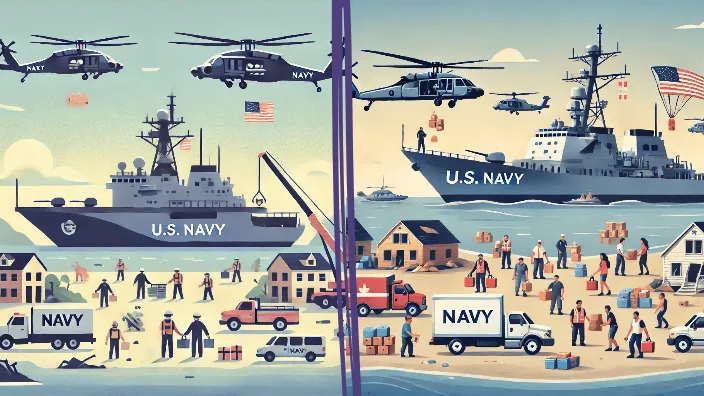
After Hurricane Katrina, the U.S. Navy and U.S. Northern Command coordinated rescue and recovery operations.
The Navy used amphibious assault ships and Helicopter Sea Combat Squadrons to evacuate survivors. Crews also helped remove debris and restore essential services.
2020: Response to the COVID-19 Pandemic
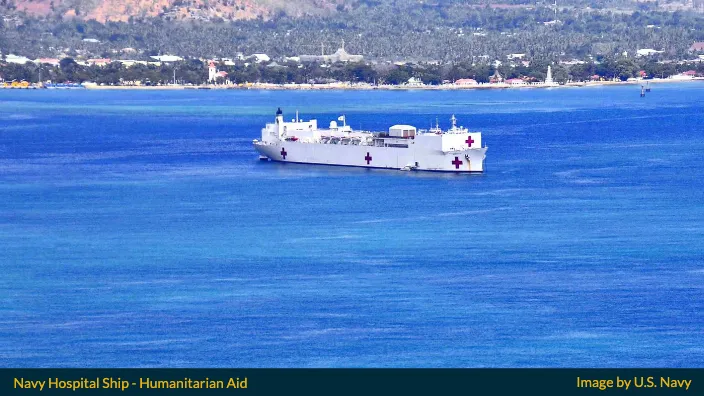
During the COVID-19 pandemic, the U.S. Navy deployed hospital ships to support overwhelmed health systems. The USNS Mercy went to Los Angeles. The USNS Comfort went to New York City.
The mission showed how the military can support complex humanitarian operations. It also showed how Navy medical capability can help during public health emergencies, not only after storms, earthquakes, or other natural disasters.
Increasing Humanitarian Efforts: Notable Projects and Programs
1. Humanitarian Assistance Engineering and Logistics
The U.S. Navy supports humanitarian work through engineering and logistics. The Naval Construction Force (Seabees) plays a key role.
Seabees build practical projects that communities can use right away. These projects include bridges, roads, wells, and sanitation facilities. Their work also supports civil-military cooperation during relief missions. Past efforts in places like Costa Rica, San Diego, and other locations show how construction teams can speed up recovery and improve local services.
2. Emergency Response Teams Used in Medicine
The Navy uses specialized medical teams to move fast during crises.
- Forward-Deployable Preventive Medicine Units (FDPMUs) assess health risks and help manage disease and sanitation issues during disasters.
- Humanitarian Support Teams (HSTs) deliver urgent medical supplies and basic care support when local systems cannot keep up.
- Forward Resuscitative Surgery System (FRSS) teams bring mobile surgical capability to difficult and remote conditions.
- Hospital ships such as USNS Mercy and USNS Comfort provide large-scale care, including surgery and critical treatment, when hospitals on shore face major strain.
3. Civil-Military and Global Cooperation
The Navy rarely works alone during large relief operations. It partners with U.S. agencies, international groups, and joint military teams to improve speed and coordination.
- USAID supports disaster planning and humanitarian relief coordination.
- United Nations humanitarian agencies support longer-term recovery and assistance programs.
- The Red Cross helps coordinate medical support and emergency response needs.
- Joint Task Forces help organize rapid crisis response across services and partners.
These partnerships help align medical, engineering, and civic support. They also strengthen working relationships between military teams and local communities. This work often includes Subject Matter Expert Exchanges (SMEEs) and Community Relations (COMREL) activities.
Humanitarian Activities Throughout Global Waters
Many humanitarian missions happen at sea or near coastlines. Naval forces can move quickly, operate in rough conditions, and support rescue operations across long distances.
A few noteworthy mission types include:
Saving Refugees During Maritime Crises
- U.S. Navy forces rescued thousands of Vietnamese refugees in the South China Sea during and after the Vietnam War.
- Naval forces also supported efforts to stop and assist people fleeing Cuba during the 1980s and 1990s.
Response to Marine Disasters
- Navy personnel supported the rescue of a British commercial ship that became stuck in the Western Pacific.
- The Navy has also assisted U.S. commercial ships during emergencies at sea, including situations involving distress, damage, or safety threats.
Technology’s Function in Humanitarian Projects
The U.S. Navy uses modern technology to strengthen humanitarian missions. These tools help teams respond faster. They also help crews work safely and move aid more efficiently during disasters.
Novel Disaster Response Instruments
- Unmanned Aerial Vehicles (UAVs) support airborne observation over disaster zones. They help map damage, locate survivors, and assess infrastructure needs. This reduces risk to responders.
- Real-time coordination systems help Navy units work in sync with the U.S. Department of War, USAID, foreign militaries, and other partners. These systems improve logistics, timing, and delivery of relief supplies.
- Autonomous Surface Vehicles (ASVs) can support coastal assessments and reach areas that standard ships cannot access. They help crews check damage in shallow or blocked waters. They can also support delivery of fresh water and medical aid when access is limited.
Medical Novelties for Humanitarian Aid
- Telemedicine aboard a hospital ship: The USNS Mercy and USNS Comfort use telehealth tools to connect with medical specialists in other locations. This support helps shipboard teams make faster, better-informed care decisions during humanitarian missions.
- 3D printing for medical supplies: 3D printers can produce some medical tools, prosthetics, and replacement parts for critical equipment. Crews can make these items on amphibious assault ships and aircraft carriers when supply lines run slow or break.
- Portable water purification systems: These compact systems help produce safe drinking water during flood response. They support communities where floodwaters or polluted sources make local water unsafe.
Enhanced Focus on Infrastructure and Engineering Efforts
Seabees support disaster recovery across many types of infrastructure work.
Washed-out roads can block aid. Seabees repair roads so supply trucks and emergency teams can move.
Bridge damage can cut off whole communities. Seabees rebuild key links or set up temporary routes so relief can reach isolated areas.
Contaminated water can trigger disease. Seabees install sanitation and water support systems to reduce the risk of outbreaks.
Their work stays organized and fast. Seabees coordinate with military units, humanitarian groups, and local governments to focus on the most urgent needs first.
Each completed project speeds up relief delivery. It also helps stabilize daily life and reduces follow-on risks, such as delayed medicine deliveries or food shortages. Without engineering support, disaster areas can remain cut off. When Seabees arrive, recovery can begin sooner.
More Global Maritime Aid Efforts to Help People in Need
Getting Refugees Out of Conflict Zones
The U.S. Navy has supported refugee rescue missions during periods of conflict and instability. After the Vietnam War, many Vietnamese refugees fled by small, overcrowded boats. Navy forces rescued many of these people, provided food and basic medical care, and helped move them to safer locations.
Similar efforts occurred during waves of Cuban migration. Many people attempted dangerous crossings on rafts and small boats due to political and economic pressures. Navy forces helped locate vessels in distress, provided emergency support, and worked to reduce loss of life during hazardous sea conditions.
How to Respond to Maritime Disasters
The Navy also assists when civilian ships face emergencies at sea. Mechanical failure, onboard fires, and severe storms can leave crews without safe options. In these situations, Navy ships and aircraft have supported rescue operations.
Support can include sending medical teams, providing emergency supplies, or towing disabled vessels when conditions allow. In some cases, Navy aircraft have evacuated injured crew members from damaged ships and transported them to hospitals for urgent care.
Across many missions, the Navy’s maritime reach allows it to respond quickly when trouble happens far from shore.
Humanitarian Mission Training and Preparedness
The U.S. Navy and Marine Corps rely on strict training to prepare for humanitarian assistance and disaster relief. This training helps units operate in unstable conditions and deliver aid effectively during emergencies.
Military Personnel: Specific Training
- Humanitarian Assistance Response Training (HART): This Department of War program trains personnel on civil-military coordination, basic medical support, and the logistics needed to move and distribute aid.
- Joint military exercises with foreign forces: The Navy often trains with partner nations to prepare for large humanitarian missions. These exercises also involve combatant commands such as U.S. Southern Command and U.S. Northern Command.
- Disaster scenarios in naval medical training: Medical teams, including staff assigned to hospital ships, train for trauma care, complex emergency conditions, and mass-casualty response.
Drills in Simulation-Based Disaster Response
- Large-scale natural disaster simulations: Exercises with the Sixth and Seventh Fleets prepare sailors for rapid deployment after hurricanes, earthquakes, and other major disasters.
- Simulations aboard the USNS Mercy and USNS Comfort: These drills let teams practice triage, surgery support, and infectious disease control during humanitarian operations.
- Training in logistics and aid delivery: This training focuses on moving large volumes of supplies, coordinating airlift and sealift, and running flight operations at sea to support delivery into hard-to-reach areas.
The Future Humanitarian Role of the U.S. Navy
Climate Change and How to Handle Disasters
The Navy is preparing for more frequent and more severe natural disasters. Stronger storms, higher sea levels, and less predictable weather increase risk, especially in coastal regions.
The Navy is improving readiness in several ways. It aims to deploy ships faster. It keeps more emergency supplies positioned for quick use. It also expands specialized training focused on humanitarian support.
Aircraft carriers and amphibious ships can support early response. Many have medical spaces and water production capability. These platforms can help deliver care and supplies when ports and roads are damaged.
More Navy-led relief missions may occur in storm-prone regions, including areas from the Pacific to the Gulf Coast.
Improvements in Medical Technology for Handling Crises
Medical care becomes harder to deliver when disaster zones are far away, infrastructure is damaged, and patient needs rise quickly.
The Navy is addressing these challenges through new tools and updated procedures. Telemedicine supports real-time consultation with medical specialists, even when local hospitals are not available.
3D printing also supports faster response. Portable printers can produce some medical tools and prosthetics on demand. This reduces delays when standard supply chains cannot meet urgent needs.
As crises grow more complex, the Navy continues to adapt its training, technology, and operations. The goal stays practical: deliver faster, more capable care and support to people who need help most.
Dedication to Humanitarian Superiority
The U.S. Navy is a major military force. It also plays a leading role in disaster response and humanitarian support worldwide.
During crises, the Navy works with the Department of War to run rescue operations, support firefighting efforts, and move large amounts of aid. These missions often require quick decisions and steady coordination across many teams.
Sailors train for earthquakes, floods, and other emergencies. They also train to move and distribute large shipments of relief supplies. Operations can span wide regions, from the Pacific Ocean to the South China Sea.
The Navy’s crisis response role continues to expand as technology and tactics evolve. The focus stays practical: deliver critical aid to the right place at the right time.
If you want to learn more about joining, contact your local Navy officer recruiter.
References: NAVY HUMANITARIAN AND CIVIC ASSISTANCE OPERATIONS NTTP 3-57.3 (2014): A. B. Siegel. Center for Naval Analyses: Naval History and Heritage Command: