Hospital Corpsman (HM): Navy Reserve
When you purchase through links on our site, we may receive compensation at no extra cost to you.
If you want a Navy role that blends medical training with work in both field and clinic settings, Navy Reserve Hospital Corpsman stands out.
You do more than support doctors. You provide hands-on care, including emergency treatment when the situation turns serious. You also build medical skills that can carry over into civilian healthcare jobs.
This is not routine work. The training and experience can put you in a position to help save lives in uniform and back at home.
Now let’s walk through what the job involves.

Job Role and Responsibilities
Job Description
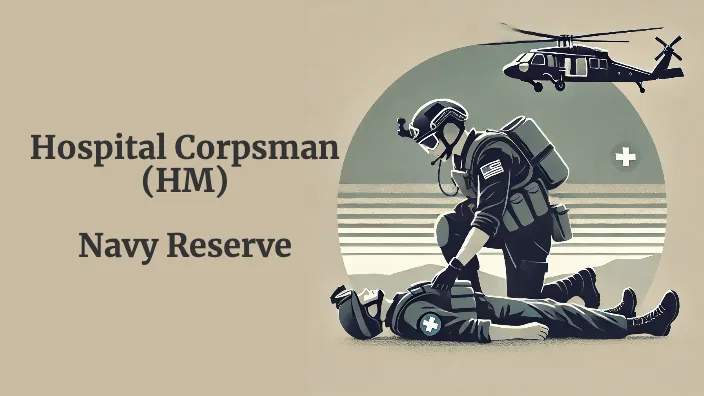
Navy Reserve Hospital Corpsmen (HM) complete emergency medical procedures during surgical operations and provide healthcare support in hospitals, clinics, and battlefield settings. Corpsmen deliver essential life-saving medical care in both military combat environments and hospitals nationwide.
Daily Tasks
- Trauma Response: Handle bleeding control and burn treatment and stabilize fractures before managing shock.
- Medical Procedures: Provide surgical assistance alongside wound suturing and the administration of IVs and medications.
- Routine Care: Execute physical assessments while administering necessary vaccinations and treating infectious diseases.
- Diagnostics & Imaging: Perform laboratory tests and X-ray operations while analyzing patient samples.
- Medical Logistics: Keep health records updated while tracking medical supplies and preparing treatments for immediate use.
Specialized Roles
| Role | Primary Duties | Civilian Equivalent |
|---|---|---|
| Field Medical Technician (FMF Corpsman) | Provides frontline medical care in combat zones. | EMT, Paramedic |
| Dental Technician | Assists with oral surgery, cleanings, and dental care. | Dental Assistant, Hygienist |
| Radiology Technician | Performs X-rays and medical imaging for diagnostics. | Radiologic Technologist |
| Laboratory Technician | Conducts blood tests, disease screenings, and microbiological analysis. | Medical Lab Technician |
| Aerospace Medical Technician | Provides aviation-related medical support. | Aerospace Medicine Specialist |
| Preventive Medicine Technician | Manages disease control, sanitation, and epidemiology efforts. | Public Health Specialist |
Mission Contribution
No Corpsmen, no medical support. No rapid trauma response. No operational readiness. Whether treating combat wounds, preventing disease outbreaks, or keeping a ship’s crew healthy, Corpsmen ensure the Navy and Marine Corps stay in the fight.
Technology and Equipment
- Field Trauma Kits – Tourniquets, chest seals, and wound-packing materials.
- Advanced Medical Systems – Defibrillators, ventilators, ultrasound machines.
- Portable Diagnostics – X-ray machines, blood analyzers, and telemedicine units.
- Casualty Evacuation Gear – Stretchers, litters, and field surgical kits.

Work Environment
Setting and Schedule
Navy Reserve Hospital Corpsmen work in many settings, including hospitals, clinics, ships, aircraft carriers, field medical units, and combat zones.
During drill weekends, they keep skills fresh. They run patient checks, practice emergency care, and train for the kinds of cases they may face on orders.
On deployment, the pace can change fast. Corpsmen may treat patients in a mobile field setup or respond to an emergency at sea, where time, space, and supplies can be limited.
- Drill Weekends (One Weekend Per Month): Medical training, patient care, and operational readiness exercises.
- Annual Training (Two Weeks Per Year): Intensive medical field training, simulated casualty response, or hospital rotations.
- Deployment (As Required): Can range from short-term disaster relief missions to year-long combat zone assignments.
Leadership and Communication
- Chain of Command: Corpsmen report to senior enlisted medical personnel, Navy officers, or Marine unit commanders, depending on assignment.
- Medical Teams: Work directly with doctors, nurses, and combat medics.
- Performance Feedback: Evaluations come from medical supervisors, unit commanders, and mission readiness assessments.
Team Dynamics and Autonomy
- Tight-Knit Units: Corpsmen work in small teams, often relying on each other in high-pressure situations.
- Independent Decision-Making: In combat or emergency situations, Corpsmen make critical medical calls with little oversight.
- Balance of Individual vs. Team Roles: While routine medical tasks involve collaboration, emergency response often requires split-second individual action.
Job Satisfaction and Retention
- Retention Rates: Corpsmen stay in because the skills, training, and experience translate directly into civilian healthcare careers.
- Success Measurement: Based on medical readiness, patient outcomes, and ability to perform under pressure.
- Corpsmen’s Perspective: The work is intense, but the skills gained are unmatched—emergency medicine, trauma care, and hands-on medical experience that most civilian medics won’t see for years.
Training and Skill Development
Initial Training
Every Hospital Corpsman starts with nine weeks of Recruit Training (Boot Camp) at Great Lakes, Illinois. From there, you move to Corpsman “A” School—where medical training gets real.
Corpsman “A” School (14 Weeks – Fort Sam Houston, TX)
- Emergency Medicine – Stopping severe bleeding, treating shock, and handling battlefield trauma.
- Patient Assessment – Diagnosing injuries, taking vitals, and performing medical evaluations.
- Basic Pharmacology – Administering medications, IVs, and injections.
- Wound Care & Suturing – Closing lacerations, dressing burns, and handling fractures.
- Field & Hospital Operations – Working in Navy hospitals, aboard ships, and with Marine units.
Advanced Training
If you want to specialize, the Navy offers “C” Schools that train you for specific medical roles. These programs build deeper skills and can line up well with civilian healthcare jobs.
| Specialty Training (“C” Schools) | Additional Skills | Civilian Crossover |
|---|---|---|
| Field Medical Service Technician (FMF Corpsman) | Tactical casualty care, combat medicine, care in austere settings | Paramedic, EMT |
| Surgical Technologist | Support in major surgeries, instrument sterilization, operating room setup | Surgical Tech |
| Radiology Technician | X-ray imaging, diagnostic scans, basic ultrasound support | Radiologic Technologist |
| Medical Laboratory Technician | Lab testing, disease screening, microbiology basics | Medical Lab Tech |
| Preventive Medicine Technician | Disease prevention, biohazard defense, public health monitoring | Public Health Specialist |
| Aerospace Medical Technician | Aviation physiology, high-altitude medicine, flight health support | Aerospace Medicine Specialist |
Military Support for Professional Growth
- Tuition Assistance (TA): Covers college courses in medical fields.
- Credentialing Assistance (COOL Program): Get civilian certifications while in uniform.
- On-the-Job Training (OJT): Gain experience in real hospital settings.
- GI Bill: Pays for nursing school, paramedic training, or advanced medical degrees post-service.

Physical Demands and Medical Evaluations
Physical Requirements
Hospital Corpsmen need strength, endurance, and mental resilience. Whether carrying a wounded Marine under fire or working 12-hour hospital shifts, the job is physically and mentally demanding.
Minimum Fitness Standards (Navy PRT – Reserve Standards)
| Event | Male (Ages 17-39) | Female (Ages 17-39) |
|---|---|---|
| 1.5-Mile Run | 12:00 – 13:45 | 13:30 – 15:30 |
| Push-Ups (2 min) | 42 – 50 | 17 – 20 |
| Plank Hold | 2:05 – 3:00 | 1:30 – 2:45 |
- FMF (Field Medical Service) Corpsmen have tougher requirements. Expect ruck marches, casualty drags, and long hours under heavy gear.
- Hospital-based Corpsmen still need endurance. Long shifts, rapid response situations, and patient transport require strength and stamina.
Medical Evaluations
Corpsmen handle life-or-death situations. Your own health has to be at 100%.
- Initial Military Entrance Processing (MEPS): Full-body medical exam, vision, hearing, and background check.
- Annual Physical Health Assessments (PHA): Ensures Corpsmen are medically fit for duty.
- Deployment Readiness Medical Exams: Must meet combat-zone health standards before deploying.
- Immunizations & Exposure Testing: Required for disease prevention, especially for overseas assignments.
Daily Physical Demands
- In the field: Running with full medical gear, carrying casualties, setting up field hospitals.
- On ships: Tight spaces, moving patients during rough seas, assisting in surgeries under pressure.
- In hospitals: Long shifts, standing for hours, lifting patients, responding to emergencies.
Deployment and Duty Stations
Deployment Details
Navy Reserve Hospital Corpsmen can deploy in many settings. Orders may place them in combat areas, disaster response missions, or shipboard medical teams. The mission drives the assignment, and the work can move fast.
Common deployment environments include:
- Combat zones: Support Marine units and treat trauma injuries in forward locations.
- Naval ships and carriers: Provide urgent care at sea, including trauma response and shipboard medical support.
- Overseas military bases: Work in Navy hospitals, busy clinics, and rapid-response medical teams.
- Disaster relief missions: Support responses to hurricanes, earthquakes, pandemics, and other large-scale emergencies.
Deployment length often runs 6 to 12 months. Some orders last longer. How often you deploy depends on unit needs and real-world events.
Location Flexibility
Drill weekends usually stay local. Annual training and deployments can send you elsewhere.
- Home drilling location: Set during enlistment and often close to where you live.
- Annual Training (AT) sites: Can include military hospitals, field exercises, or humanitarian missions.
- Deployment assignments: Based on Navy requirements first. You can submit preferences, but mission needs decide the final location.
Career Progression and Advancement
Career Path
Hospital Corpsmen do not stay in one narrow role. Most start with the basics: emergency care, routine patient treatment, and daily medical support for their unit.
With time and strong performance, the job expands. Corpsmen take on more responsibility, support higher-risk missions, and move into tougher assignments when the Navy needs their skills. Many also attend specialized training that opens doors to areas like field medicine, surgery support, lab work, radiology, or preventive medicine.
- E-1 to E-3 (Apprentice Level): Learning the fundamentals. Trauma care, clinical work, medical logistics.
- E-4 to E-5 (Journeyman Level): More independence. Running sick bays, assisting in surgeries, handling patient cases solo.
- E-6 to E-9 (Senior Leadership): Supervising medical teams, managing hospital departments, overseeing combat medical readiness.
Hospital Corpsman (HM) Fleet Marine Force (FMF) insignia. Credit: U.S. Navy.
Corpsmen in the Fleet Marine Force (FMF) gain combat medicine expertise, while those in hospitals move toward surgical, laboratory, or radiology specializations.
Promotion & Specialization
Advancement isn’t automatic. It’s earned. More training, higher qualifications, stronger leadership.
| Promotion Factor | What It Takes |
|---|---|
| Time in Service | Each rank has a minimum time requirement. |
| Performance Evaluations | High marks on evaluations mean faster promotions. |
| Professional Military Education (PME) | Required courses at each rank level. |
| Certifications & Training | Completing “C” Schools or advanced medical training boosts rank eligibility. |
Specializations Open the Door to Bigger Roles:
- Special Amphibious Reconnaissance Corpsman (SARC): Elite combat medic role with Marine Recon units.
- Independent Duty Corpsman (IDC): Provides solo medical support on submarines and remote bases.
- Surgical Technologist: Assists in major surgeries, preps operating rooms, and handles surgical tools.
- Radiology or Laboratory Specialist: Focuses on diagnostic imaging or disease detection.
Role Flexibility & Transfers
A Corpsman’s career isn’t locked into one track. Specializing in a specific field, transferring to a new duty station, or even switching to a different Navy medical role is possible.
- Lateral Transfers: Move into a different medical specialty if openings exist.
- Officer Programs: Become a Physician Assistant (PA), Nurse, or Medical Service Corps Officer through Navy-funded education.
- Civilian Crossover: Every medical specialty translates directly into a civilian healthcare job.
Salary and Benefits
Financial Benefits
Reserve pay is based on your pay grade, years of service, and the type of orders you are on. DFAS publishes the 2026 reserve drill pay table.
The examples below use 2 years or less of service, a standard drill weekend (4 drills), and 14 days of annual training.
| Pay Grade | Drill Weekend (4 drills) | Annual Training (14 days) | Estimated Annual Total* |
|---|---|---|---|
| E-3 | $378.24 | $1,323.84 | $5,862.72 |
| E-4 | $418.96 | $1,466.36 | $6,493.88 |
| E-5 | $456.92 | $1,599.22 | $7,082.26 |
| E-6 | $498.84 | $1,745.94 | $7,732.02 |
Estimated annual total assumes 12 drill weekends (48 drills) and 14 days of annual training. Taxes, allowances, and special pays can change the total.
When you are on active duty orders, you are paid using the 2026 active duty basic pay table and may qualify for allowances like housing (BAH) and food (BAS). See the BAS rates.
Other pay items can apply based on your assignment and qualifications:
- Career Sea Pay: If you are assigned to qualifying sea duty while on active orders, you may receive career sea pay.
- Submarine Duty Incentive Pay: Qualified Sailors assigned to submarine duty can receive monthly submarine pay while on active orders.
Additional Benefits
- Healthcare: TRICARE Reserve Select is available for many drilling Reservists, with premiums and eligibility that can change by plan year.
- Retirement: Retirement points and a Reserve retirement for qualifying service (often described as 20 good years).
- Education: GI Bill and other education benefits may be available based on eligibility and service.
- Other benefits: Commissary and exchange access, VA home loan eligibility, and other benefits based on status and time in service.

Risk, Safety, and Legal Considerations
Job Hazards
Hospital Corpsmen face real risk, and it depends on where they serve. Some work in clinics and focus on routine care. Others deploy with Marines or join teams that respond to crises.
In combat areas, they may treat trauma injuries in dangerous conditions. In biohazard situations, they follow strict safety rules while supporting disease control and exposure response. On ships, they handle emergencies in tight spaces, where time and equipment can be limited.
- Gunfire. Explosions. Combat injuries. FMF Corpsmen treat wounds while under fire.
- Infectious diseases. Bloodborne pathogens, airborne viruses, field sanitation issues.
- Shipboard emergencies. Rough seas. Confined spaces. Medical care in high-pressure conditions.
- Physical strain. Heavy lifting. Long shifts. Trauma cases that don’t stop coming.
Safety Protocols
Training and equipment keep Corpsmen alive. The Navy prepares them for chaos.
- Tactical Combat Casualty Care (TCCC). Treats massive trauma under fire.
- Personal Protective Equipment (PPE). Gloves, masks, face shields, combat medical gear.
- Operational Risk Management (ORM). Every mission analyzed, every risk assessed.
- Constant medical screenings. Stay healthy. Stay fit. Stay deployable.
Security and Legal Requirements
Corpsmen handle classified information. Lives depend on their training. The law backs it all up.
- Security clearance. Secret or higher—access to patient records, mission details, and classified operations.
- Military contracts. Three to six-year commitments. No easy way out.
- Deployment orders. When the call comes, you go. Refusing isn’t an option.
- Medical ethics. HIPAA is law. No loose talk about patient info—ever.
Impact on Family and Personal Life
Family Considerations
The Navy Reserve feels part-time, until a mobilization changes the plan. Drill weekends are usually predictable. Deployments are not always.
When the Navy activates a unit, schedules can shift with little notice. That can affect work, school, and childcare. Families do best when they plan early, keep important documents ready, and talk through what support they may need during a long absence.
- Drill weekends – One weekend a month. Family life stays mostly normal.
- Annual training (AT) – Two weeks away. Location varies. Sometimes stateside, sometimes overseas.
- Deployments – Can last 6 to 12 months. Some get notice. Others deploy fast.
Spouses and kids adjust. Support systems help. But the separation is real.
Support Systems
The Navy doesn’t leave families stranded. Military programs help with stress, finances, and childcare.
- Family Readiness Groups (FRGs) – Connects spouses and families for support.
- Navy-Marine Corps Relief Society (NMCRS) – Financial assistance when emergencies hit.
- Childcare Assistance – Discounts and priority placement at on-base daycare.
- Deployment Support Programs – Counseling, family events, and reintegration help.
Relocation and Flexibility
Reservists don’t move like active duty, but assignments still shift.
- Drill locations are usually local. But transfers happen.
- Annual training varies. Some travel required.
- Deployments can override everything. Civilian jobs, school plans, and family events all take a backseat.
The Navy works with service members, but mission needs come first.
Post-Service Opportunities
Transition to Civilian Life
Hospital Corpsmen often leave the service with strong, job-ready medical skills. Many build experience in trauma care, emergency medicine, and basic diagnostics. That background can translate into civilian work.
- Paramedic or EMT – Corpsmen already have battlefield trauma experience. Civilian EMT certification comes fast.
- Nursing Careers – Patient care, medication administration, and hospital operations all transfer over.
- Medical Lab Tech or Radiology Tech – Corpsmen trained in diagnostics step straight into hospital roles.
- Physician Assistant (PA) Programs – Corpsmen with experience can get fast-tracked into PA schools.
Military to Civilian Certifications
The Navy helps Corpsmen translate military training into civilian credentials. You do not have to start over. You just prove what you already know.
| Military Training | Civilian Certification Equivalent |
|---|---|
| Combat Medic (FMF Corpsman) | EMT, Paramedic |
| Radiology Technician | Certified Radiologic Technologist (ARRT) |
| Laboratory Technician | Medical Laboratory Technician (MLT) |
| Surgical Technologist | Certified Surgical Technologist (CST) |
| Preventive Medicine Technician | Public Health Specialist |
Navy & VA Transition Assistance
Leaving the military can be rough. The Navy and VA offer transition programs to help Corpsmen land jobs fast.
- Navy Credentialing Opportunities Online (COOL) – Pays for certification exams.
- Post-9/11 GI Bill – Covers college tuition, housing, and books.
- VA Job Placement Programs – Connects veterans with hospitals, fire departments, and healthcare employers.
- SkillBridge – Allows Corpsmen to intern with civilian companies before leaving the Navy.
Qualifications and Eligibility
Basic Qualifications
Not everyone can become a Hospital Corpsman. The Navy sets clear entry standards.
- Age: 17 to 41 years old
- Citizenship: U.S. citizen or permanent resident
- Education: High school diploma or GED. Some waivers may apply.
- ASVAB Score: VE + MK + GS = 146 (minimum for the Corpsman rating)
- Medical and legal history: No major health issues. No serious criminal record.

Application Process
Becoming a Corpsman takes time. The process can take weeks, and sometimes months.
- Meet with a Navy recruiter: They review eligibility and explain the steps.
- Take the ASVAB: You must score high enough for the Corpsman rating.
- Pass MEPS (medical and physical exams): Complete screening, vision and hearing checks, and background review.
- Sign an enlistment contract: Most contracts run three to six years.
- Attend Navy boot camp: Finish nine weeks at Great Lakes, Illinois.
- Corpsman “A” School: Complete 14 weeks of medical training at Fort Sam Houston, Texas.
Selection Criteria and Competitiveness
Hospital Corpsman is in demand, so selection can be competitive.
- Higher ASVAB scores improve your chances
- Medical background helps: EMT, CNA, or first aid training can make you stand out
- Clean legal and medical history matters: Waivers can slow the process
- ASVAB Online Course Guided lessons and timed practice for the line score this rating needs.
- ASVAB Study Guide Self-paced study with full-length practice exams and answer explanations.
Is This a Good Job for You? The Right (and Wrong) Fit
Ideal Candidate Profile
Hospital Corpsmen need more than medical skills. They need mental toughness, flexibility, and the ability to act under pressure.
- Stays calm in chaos: Emergencies move fast, and Corpsmen respond without freezing.
- Learns fast: Procedures must feel natural, even when the situation is stressful.
- Can handle blood, trauma, and stress: The work includes injuries and hard moments.
- Wants a civilian medical career: EMT, nurse, or PA goals can line up well with this training.
- Values discipline and teamwork: Corpsmen work in close units and follow standards.
Potential Challenges
This is not a desk job. The pace can be physical and unpredictable, and it does not fit everyone.
- Long hours: Some cases run past normal shifts.
- Harsh environments: Ships, combat areas, and disaster zones can become your workplace.
- Emotional weight: Some days include lifesaving wins. Other days include loss.
- Strict military structure: The Navy uses a clear chain of command, and orders are not optional.
Career and Lifestyle Alignment
The Corpsman role fits some people well and does not fit others.
| Best Fit | Poor Fit |
|---|---|
| Wants a fast-track medical career | Struggles in high-stress situations |
| Can handle trauma and emergencies | Prefers predictable work |
| Works well under military structure | Dislikes strict rules and discipline |
| Enjoys being part of a close team | Prefers working alone |
| Willing to deploy when needed | Unwilling to relocate or leave home |

More Information
If you wish to learn more about becoming an Hospital Corpsman in the Navy Reserve, contact your local Navy Enlisted Recruiter. They will provide you with more detailed information you’re unlikely to find online.
You may also be interested in the following related Navy Reserve Enlisted jobs: