Crossing the Line: Inside the U.S. Navy’s Legendary Shellback Ceremony
A ship can cross the equator in a moment. Becoming a Shellback gives that moment a story. Sailors dress as King Neptune and his court, call first-time crossers before them, and mark a shared day at sea. But old photos can hide the biggest change in the Navy’s Shellback ceremony. The rough treatment in some past rituals is not a guide to what is allowed now.
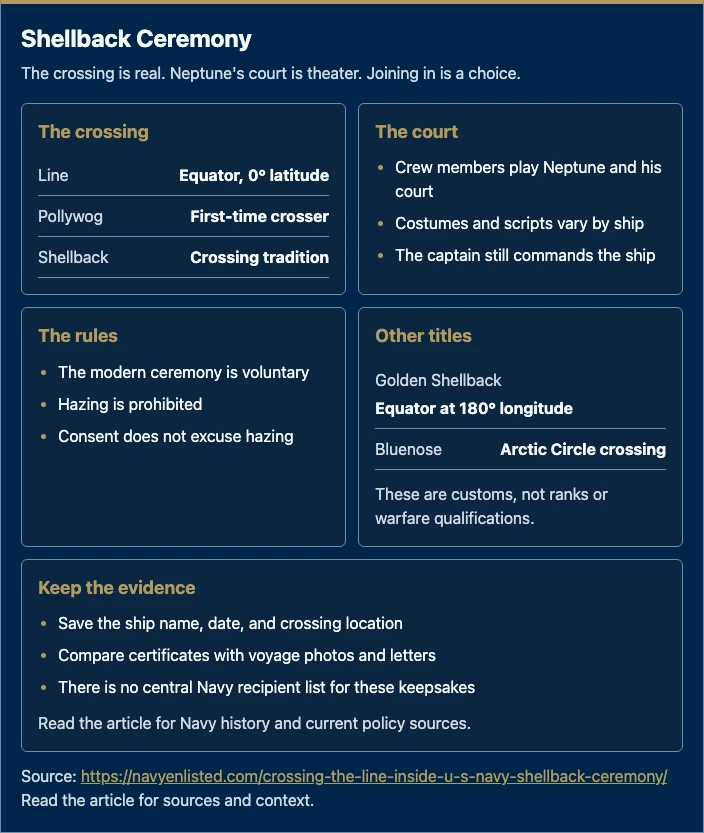
The crossing is real. The court is make-believe. Joining in is a choice. Knowing the difference helps make sense of its strange titles, keepsakes, and place in shipboard life.
The crossing
- Line
- Equator, 0° latitude
- Pollywog
- First-time crosser
- Shellback
- Crossing tradition
The court
- Crew members play Neptune and his court
- Costumes and scripts vary by ship
- The captain still commands the ship
The rules
- The modern ceremony is voluntary
- Hazing is prohibited
- Consent does not excuse hazing
Other titles
- Golden Shellback
- Equator at 180° longitude
- Bluenose
- Arctic Circle crossing
These are customs, not ranks or warfare qualifications.
Keep the evidence
- Save the ship name, date, and crossing location
- Compare certificates with voyage photos and letters
- There is no central Navy recipient list for these keepsakes
Read the article for Navy history and current policy sources.
Source: https://navyenlisted.com/crossing-the-line-inside-u-s-navy-shellback-ceremony/
Read the article for sources and context.
What Makes a Sailor a Shellback
A Shellback is a sailor who has crossed the equator at sea and is recognized through the line-crossing tradition. A first-time crosser is called a Pollywog. Those names come from life at sea. They are not ranks, jobs, or warfare awards.
The equator is the line at zero degrees latitude. It splits the globe into a north half and a south half. A ship can cross it while heading north or south. The sea does not change at that point. There is no visible stripe on the water. Charts and the ship’s position show where the crossing takes place.
That is why crews create a ceremony around it. A point on a chart becomes a shared event. A sailor who has spent weeks on watch, doing repairs, or working below decks gets a memory tied to that voyage. The certificate may outlast the ship assignment by decades.
The Navy’s account of the tradition describes its modern purpose as entertainment and morale. It also makes clear that taking part is voluntary. A sailor does not have to get hurt to prove worth to the crew.
Why King Neptune Holds Court at Sea
Neptune is a sea god from Roman myth. In the skit, he rules the sea the ship is about to cross. Shellbacks from the crew play his court. First-time crossers appear before them as part of a staged hearing.
Names such as Neptunus Rex and Davy Jones give the event its playful language. Rex means king. The grand titles and mock charges turn a normal trip into a play. The court’s claims are part of the joke, rather than a real order from a new chain of command.
The cast and script can differ by ship. A photo of one crew does not establish a required part for every other crew. Even familiar characters may be left out or changed. The ship’s leaders still run the real event. A crown does not change that.
The custom is old, but a precise origin story is harder to pin down. Navy history describes centuries of seafaring practice. The custom has a long past. That does not prove a Viking crew made it up or that each step has stayed the same.
What Happens During a Line-Crossing Ceremony
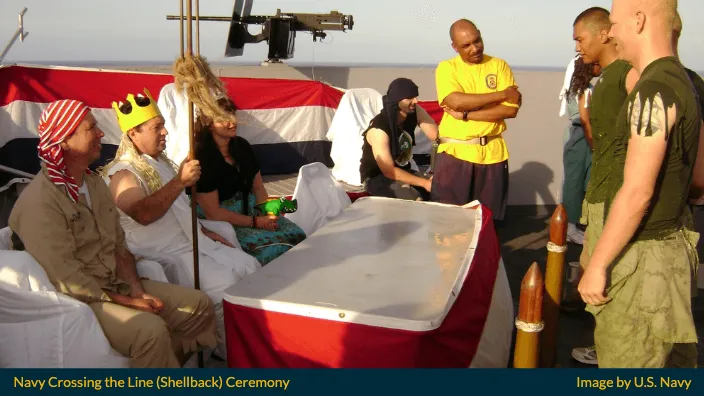
A crew may dress up, issue a mock summons, and call people to the court. First-time crossers then join the Shellbacks in marking the voyage. The crew may give each new Shellback a certificate marking the crossing.
There is no single script that this article can promise for a future ship. The date, format, and activities depend on the actual event. A sailor should get those details from the command, rather than treat a sea story as a set of instructions.
It helps to separate three parts of what is happening.
- The ship reaches a real geographic point.
- The crew stages a voluntary ceremony around that crossing.
- Participants may receive a keepsake that records the occasion.
Each part has a job. A chart records position. A skit gives people a shared story. A keepsake gives that story a date and a name. None replaces the others.
A modern example appears in the Navy’s March 2024 photographs from USS Antietam. The caption identifies a first-equator-crossing ceremony aboard a deployed ship. The custom is still part of fleet life. But that ship’s event does not set the rules for the whole Navy.
The Line Between Tradition and Hazing
Some old accounts describe acts that caused pain or shame. They can help explain why the custom has drawn criticism. They should not be presented as a checklist for a modern event.
The Navy’s definition of hazing covers conduct tied to military service that causes harm or creates a risk of harm for an initiation or change in status, without a proper military purpose. It can harm the body or the mind. A person agreeing to take part does not remove responsibility for hazing.
That last point is easy to miss. A choice to join does not make every act in the event allowed. Calling an act a tradition does not change its effect on a person. A costume or joke can mark the day. There is no need for fear, pain, or pressure to give in.
Some stories tell of forced drinks, grease, hair loss, or dunking. Each act must be judged under the rules. Their presence in a sea story does not make them required. Mixing those stories with present-day guidance can leave a first-time sailor expecting harm as part of the welcome.
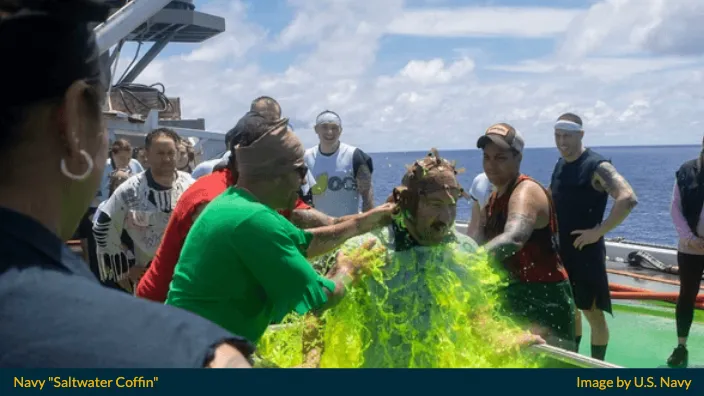
This image shows one water-based ritual. It does not establish whether a particular act is required or permitted today. The command’s approved event and Navy policy control.
If a planned activity raises concern, ask what it involves before taking part. The Navy identifies a chief, the Command Managed Equal Opportunity Program Manager, a Command Climate Specialist, and the Inspector General as routes for raising suspected misconduct. Those are real channels. Neptune’s fictional court is not a way to settle a complaint.
Shellback Certificates and What They Prove
A certificate can be rich with detail. It may name the sailor, ship, date, and place. Art and mock legal language give it a style quite unlike a service award. It makes a good keepsake. It does not give the holder a new skill or rank.
The Navy’s guidance on unofficial certificates says its history command, personnel command, and All Hands do not maintain recipient lists for these keepsakes. Some designs are sold by private firms. Buying a new copy of a design is not the same as finding proof of a crossing.
For a family sorting old papers, start with what the item itself says. Read the ship name and date before guessing at the voyage. A certificate can sit beside photos, letters, and service papers from the same period. Check whether their dates agree. If the dates clash, look for more facts. One wrong date does not mean the whole story is false.
Keep a scan of the old paper before writing on it or trying to fix it. Record where it came from if that is known. A note from the sailor who kept it may explain more than the printed design. Do not add a story about a specific ceremony unless the evidence supports it.
If a certificate has been lost, start with personal copies and the crew’s own records. Do not assume a central Navy office can issue the same keepsake again. A lost keepsake does not prove that a sailor never crossed the equator.
Golden Shellbacks and Other Seagoing Titles
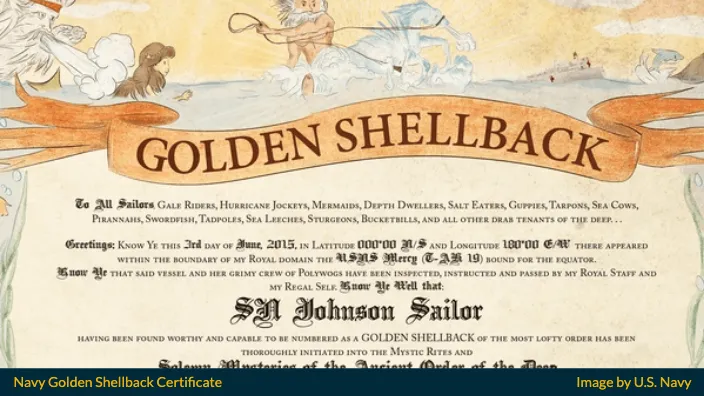
A Golden Shellback marks a more specific crossing. The ship crosses the equator at the 180th meridian. Latitude and longitude meet at that point. The equator runs east and west around the globe. A meridian runs between the poles. Mixing up the two lines makes the title hard to follow.
A 1996 command history from USS Carl Vinson records a crossing at the 180-degree mark and calls the crew Golden Shellbacks. It provides a dated example of the term in a ship’s own history.
Other titles mark other places or events. The Order of the Bluenose concerns crossing the Arctic Circle. A plank owner is tied to a ship’s early crew, rather than an equator crossing. Those distinctions help explain why one sailor may keep several different certificates.
These titles do not form a ladder of military rank. A Golden Shellback is not a senior officer by virtue of the crossing. A Bluenose certificate is not an Arctic job qualification. A voyage can create several keepsakes without changing a person’s pay, authority, or duties.
Some crews use less common names for special crossings. Read those names in the context of that ship and voyage. A long list on a souvenir site is not proof that the Navy uses every title in the same way. The place and date tell more than a claim that one design is the rarest.
A President Called Before Neptune
In 1936, even a U.S. president received a mock summons. Franklin D. Roosevelt crossed the equator aboard USS Indianapolis during a voyage to South America. The Navy’s scrapbook of that cruise records his call before Neptune’s court.
The cruise left Charleston on November 18 and returned there on December 15. The scrapbook sets the event among real ports, people, and dates. It gives the tradition a documented setting, rather than leaving it as an unnamed story passed from crew to crew.
That is also a useful way to read old ceremony photos. Ask who made the record, which ship it concerns, and when it happened. A real photo shows what was there at that time. It cannot tell what every sailor went through. It also cannot set the rules for a ship today.
The president’s mock summons illustrates the reach of the joke. The playful court could draw a famous guest into a shipboard custom. It did not replace the president’s real office or the captain’s command. That gap is part of the joke.
What a Future Sailor Should Take From It
A Shellback ceremony is one small part of life after joining the Navy. It is not a reason to choose a job, a ship, or a contract. Some assignments may never bring the chance to cross the equator. A recruiter cannot promise a route that will make that sea story happen.
If the subject comes up before a first voyage, ask practical questions. Find out whether an event is planned, who is supervising it, and what participants will be asked to do. Ask how work and watches fit around it. Seek a clear answer if opting out is made to sound like a breach of loyalty.
For readers comparing Navy customs, the useful distinction is between a shared story and a service requirement. Ships need real standards for safety, skill, and trust. A day with Neptune is a way to mark a voyage. It does not replace those standards.
A keepsake is worth more when the crew can look back on the day with pride. The people, ship, and place give it value. How much pain someone went through to get it should not.